
Contents
- SEO is changing because AI is exposing the most valuable work
- What has just changed in SEO — and why marketing teams must work differently
- SEO will be pushed toward verification, data structure, and the right to be cited
- In Vietnam, SEO will face the most pressure on useful content and verifiable data
- SEO now: prioritize data verification, topic cluster mapping, and machine-ready sites
- Reference sources
SEO is no longer a race to publish more or write faster. Source data shows AI is being used most for easy tasks like keyword research and brainstorming ideas, while more strategic work such as building topic clusters, finding internal link opportunities, or analyzing SERP gaps is still far less used. For Vietnamese marketers, that is a clear signal: the new advantage is not volume, but the ability to turn data, workflows, and evidence into something machines cannot easily replace.
- Key point:
- AI is being used heavily for fast tasks, but the work that creates real SEO advantage is harder to scale.
- SEO will be redefined around verification, topic gaps, internal links, and connectable data.
- Websites must be prepared for machines to read, understand, and act, not just to look good to people.
- The Vietnamese market will face greater pressure on data quality, source transparency, and genuinely useful content.
SEO is changing because AI is exposing the most valuable work
Looking at developments around the same theme, a common pattern emerges: AI is moving into very specific SEO and marketing touchpoints, but the biggest value lies in the tasks people used to avoid because they were too labor-intensive. Search Engine Land says most marketers use AI for keyword research, brainstorming content ideas, and content briefs; by contrast, a Semrush survey cited in the article shows only a small share use AI to build topic clusters, find internal linking opportunities, or do SERP/content gap analysis. In other words, AI is becoming common at the input stage, while the stage that creates differentiation is still underused.
That is also why updates around WebMCP, site data, and citation mechanisms in AI search matter more than simply “writing faster.” Search Engine Journal describes how WebMCP lets AI agents interact with tools directly inside websites; meanwhile, Search Engine Land emphasizes that the future of SEO will be tied to stories worth covering, earned placement, and broader trust signals. When a website must serve not only readers but also agents, SEO has to move from optimizing individual pages to optimizing content systems, data, and access rights.
At the strategic level, this is a shift from “doing more” to “doing the right things.” AI does not eliminate SEO. It separates the easy-to-copy work from the work that truly matters: verifiable, connectable, and clear enough for both people and machines to use.
What has just changed in SEO — and why marketing teams must work differently
The changes below are all verifiable signals from the sources, and they only matter when viewed as forces that require marketing teams to adjust how they do SEO, not as isolated news items.
WebMCP: websites must let agents work, not just let people click
WebMCP is becoming the bridge that lets AI agents act directly inside websites. Search Engine Journal says Shopify has brought WebMCP tools to Liquid storefronts, Cloudflare has a developer preview for a bridge at the network edge, and OpenAI has added Site tools for the ChatGPT desktop browser. The SEO implication is clear: a website is no longer enough if it is only “readable”; it also has to be “actionable.”

That brings new requirements for page structure, systematic data, and access rights. If an agent can browse a catalog, assemble a cart, or use a site tool, SEO and product marketing teams have to rethink how they organize content, schema, catalog feeds, and conversion flows. In short: optimizing for crawlers still matters, but it is no longer enough; optimizing for agents is becoming a new layer of work. Source: Search Engine Journal.
AI is used more for keyword research than topic clusters: the strategic gap is still huge
A Semrush survey cited by Search Engine Land shows that 60% of marketers use AI for keyword research, 48% for brainstorming content ideas, and 38% for content briefs. But only 18% use AI to plan topic clusters, 15% to find internal linking opportunities, and 11% to do SERP or content gap analysis. That gap says one thing: AI is being used heavily at the top of the workflow funnel, while the part where strategic decisions are made is still not automated enough.
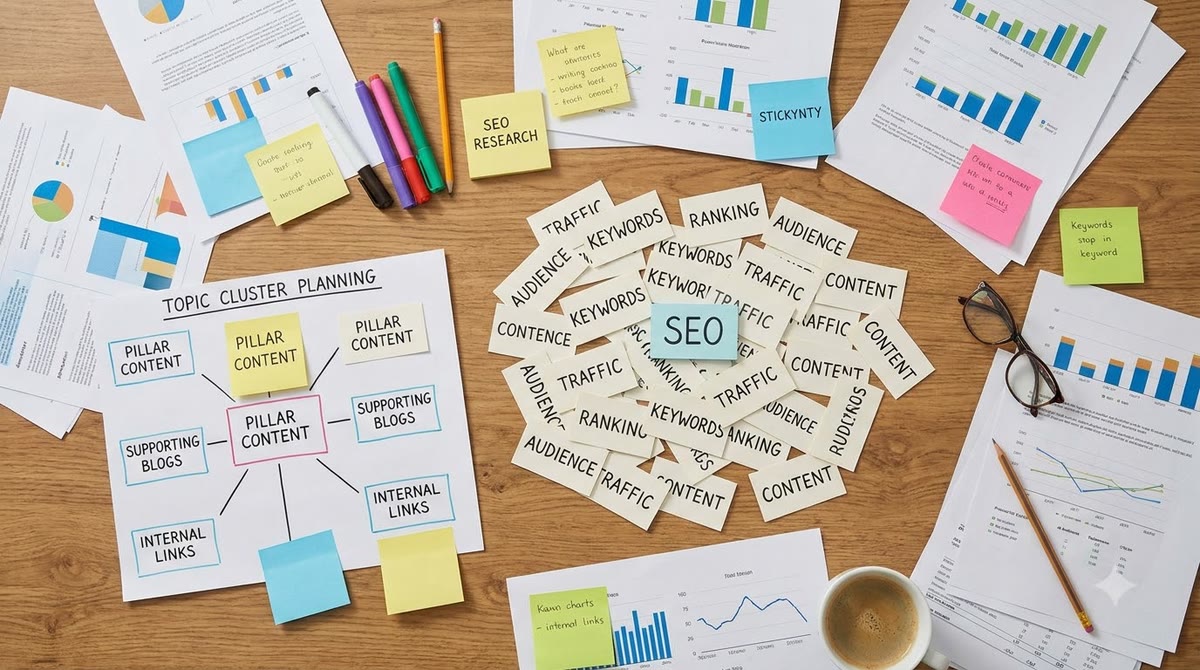
For SEO teams, this is not about the tool being weak; it is about how the work is organized. Anyone who still uses AI only to write faster will soon hit a ceiling on benefits. Anyone who uses AI to map topics, spot content coverage gaps, and suggest internal links will build real advantage over time. Source: Search Engine Land.
Link building is being pulled toward earned stories and digital PR
Search Engine Land writes that link building in 2027 will depend less on link volume and more on whether a brand is worth mentioning. Earned placements bring not only links but also brand mentions, an outlet’s audience, social discovery, and contextual authority. At the same time, the article points out ineffective tactics such as mass pitching, buying links, or creating content just to have something to publish.

The overlap with the AI picture is obvious: tools can help teams move faster, but they cannot replace a meaningful story. To earn strong links, marketing teams need original data, a clear angle, and relationships with the press or specialist communities. SEO is therefore moving closer to digital PR than to a purely technical exercise. Source: Search Engine Land.
SEO will be pushed toward verification, data structure, and the right to be cited
The most worrying part of SEO is not that AI will take traffic away immediately. The bigger concern is that the signals that make a page trusted and cited will need to become clearer and clearer. Google is mentioned by Search Engine Journal through updates to the site reputation abuse policy, where the way site quality and abuse are defined is described in more detail, along with changes in examples and handling by region. Even though the context is spam policy, the broader message fits SEO perfectly: anything that reduces a site’s trustworthiness will be tolerated less and less.

On the other side, the article on “actionable SEO signals” shows Google being asked more often whether updates create signals that are useful enough to act on. That reflects a new market expectation: SEO does not just need to know which pages rise or fall, but also which signals can be turned into concrete action. As AI search, agents, and new display layers develop together, the websites with clear data structure, verifiable content, and a clean trust history will have the advantage. Source: Search Engine Journal; Search Engine Journal.
This is where SEO meets risk and compliance. AI-assisted content that is not carefully verified can damage a site’s quality standards. If the data is not clean, the ability to analyze topic gaps, internal links, or query performance becomes distorted as well. The more a business relies on AI, the heavier its responsibility for content and data accountability becomes.
In Vietnam, SEO will face the most pressure on useful content and verifiable data
For the Vietnamese market, this change will not happen evenly. Large businesses with many product categories, many landing pages, and multiple teams creating content will feel the strongest pressure because data and workflows are easier to drift out of alignment. The more articles there are, the greater the chance of near-duplicate content, missing topic clusters, and internal links built on intuition. In a context where AI is making content production cheaper, the advantage will go to the side with cleaner data and a better ability to prove what the content helps users do.

For Vietnamese SMEs, the challenge is different. There is no need to chase sheer publishing volume. The focus should be on content with proprietary data, real cases, common customer questions, and a very clear system of FAQs, catalogs, pricing, and policies. This is how SEO avoids becoming a race to copy content structures. As search becomes more tied to direct answers and the right to be cited, the Vietnamese website that can write from its own data will have a better chance than one that only repeats what others have already said.
SEO now: prioritize data verification, topic cluster mapping, and machine-ready sites
- Review all high-traffic content to find places where evidence is missing, sources are missing, or ideas are repeated across articles.
- Use AI first for topic clusters, internal links, and gap analysis, then use it to support writing.
- Standardize product data, FAQs, schema, and conversion flows so the website is useful to both people and agents.
- Measure SEO by query quality, answer clarity, and citation potential, not just by the number of published articles.
If SEO is still seen as “optimizing pages for Google,” businesses will miss the biggest value of this period. What is changing is how websites build trust, how content is verified, and how machines can use that information to act. That is the real SEO game in the AI era.
See more marketing analysis and how-to guides at https://marketing365.vn.
Follow more analysis from Marketing365 to stay updated on the latest marketing trends.
Read more articles in the Digital Trends category.
Reference sources
- Search Engine Land — 7 ways to use AI for the SEO work that matters
- Search Engine Journal — WebMCP Connects AI Agents To Actions Inside Websites via @sejournal, @MattGSouthern
- Search Engine Land — Link building in 2027: 13 ways to win or fail
- Search Engine Journal — AI Is Changing Website Security. Here’s What SEO Teams Should Know via @sejournal, @vahandev
- Search Engine Journal — Google Answers If Updates Come With Actionable SEO Signals via @sejournal, @martinibuster
- Search Engine Journal — Google Updates Site Reputation Abuse Policy: Removes Penalties In EEA via @sejournal, @martinibuster
- MarTech — Marketers know AI is using bad data to make decisions
- MarTech — Stop measuring your brand and start listening
- MarTech — Anthropic partnership makes Salesforce’s interface optional