
Contents
- What performance advertising is and why it matters
- The foundational metrics you need to understand first
- The workflow for launching a performance campaign
- Tools and platforms you need to know
- Remarketing: leveraging audiences that have already engaged
- Real-world example: a fashion shop running omnichannel campaigns
- Common mistakes
- How to get started if you are a beginner
- Frequently asked questions
- How is performance advertising different from brand advertising?
- How much budget do I need to start?
- What ROAS is considered good?
- Which platform should beginners run first?
- What is performance advertising?
- How is performance ads different from branding ads?
- Which channels are suitable for performance ads for SMEs?
- References
Performance advertising is a way of running ads in which every budget dollar is tied to a measurable result: a click, a lead, an order. Unlike brand advertising, which focuses on reach and perception, performance advertising forces marketers to answer one simple question: if you spend X, how much do you get back? This is why it has become the backbone of digital budgets for most businesses in Vietnam today, from retail shops on marketplaces to large brands running omnichannel campaigns.
This article is an overview page, guiding you from foundational concepts to implementation workflows, measurement tools, real-world examples, and common mistakes. Each important concept has its own in-depth article so you can dig deeper when needed. Think of this as a map: read it once to grasp the big picture, then branch off into each section based on your actual needs.
What performance advertising is and why it matters
The essence of performance advertising is paying only for a specific action, or at minimum being able to measure exactly how much value that action creates. A strong performance campaign does not stop at “many people saw the ad” — it must trace the path from impressions to clicks, from clicks to conversions, and from conversions to actual revenue. The entire chain is quantified through metrics, so advertisers can increase or reduce budgets, change audiences, and revise creative based on data rather than intuition.

This matters for Vietnamese businesses for three reasons. First, marketing budgets are often limited, so every dollar spent needs to prove its effectiveness. Second, platforms like Google Ads, Meta Ads, and TikTok Ads provide detailed measurement tools that are accessible to everyone. Third, the fiercely competitive environment makes continuous optimization a survival advantage: whoever reads the numbers quickly and adjusts correctly will beat those who rely on habit.
The foundational metrics you need to understand first
Before talking about strategy, you need to master the “language” of performance advertising. The metrics below are the minimum vocabulary; without them, you will not be able to read reports or know whether a campaign is profitable or losing money.

Start with cost. CPC (Cost Per Click) is the amount you pay for each click on an ad. This is the most familiar metric for beginners because most search campaigns and a large share of social campaigns charge by click. If you are not yet clear on how it is calculated and how to lower it while maintaining traffic quality, learn more about what CPC is before putting in real budget.
Alongside CPC is CPM (Cost Per Mille) — the cost for every 1,000 impressions. When the goal is brand reach or when running display and video formats, you pay by CPM instead of by click. Understanding what CPM is helps you know when to pay for impressions, when to pay for clicks, and how to compare platform costs fairly.
If there is cost, there must also be a measure of effectiveness. CTR (Click-Through Rate) is the percentage of people who click an ad out of the total number who see it. A high CTR usually signals that the creative and audience are aligned; a low CTR is an early warning that the ad or targeting has a problem. Knowing what CTR is helps you diagnose campaign health from the first few hours, before budget is wasted.
Finally, the metric that determines profit or loss is ROAS (Return On Ad Spend) — the revenue generated for every dollar spent on advertising. If ROAS is 4, that means every 1 dollar in ad spend generates 4 dollars in revenue. This is the metric management cares about most, and the destination of every optimization effort. You should read what ROAS is carefully to learn how to calculate it correctly, how to set a break-even ROAS threshold based on profit margin, and why a high ROAS is not always the same as profit.
The workflow for launching a performance campaign
A well-structured performance campaign goes through clear steps. Skipping any step leaves gaps that make optimization harder later.

- Define the objective and primary metric. Do you want leads, orders, or app installs? The objective determines which metric is the KPI and how you pay (by click or by impression).
- Set up measurement before launching. Install the correct pixel/conversion tag and check whether purchase events are being sent back to the platform. If you cannot measure it, you cannot optimize it.
- Research and segment the audience. Separate people who do not know you, people who have interacted, and people who have purchased. Each group needs a different message.
- Prepare the creative and landing page. The ad and landing page must be consistent; a slow landing page or a message mismatch will kill conversions even if CTR is high.
- Launch with a test budget. Start small to learn from the data, identify which creative and audience work before increasing spend.
- Read the numbers, optimize, scale. Cut what performs poorly, double down on what works, then gradually increase budget for the profitable clusters without breaking ROAS.
This process repeats in cycles. Performance advertising is not a “set it and forget it” activity, but a continuous loop of measurement — adjustment — measurement. The frequency of intervention depends on budget, but the general rule is to give each ad group enough data before making decisions, avoiding premature shutdown while the system is still learning.
Tools and platforms you need to know
In Vietnam, the three main performance advertising platforms are Google Ads, Meta Ads (Facebook and Instagram), and TikTok Ads. Each platform has its own strengths: Google captures active demand through search, Meta is strong in interest- and behavior-based targeting, and TikTok is well suited to short-form video content and younger audiences. Strong performance marketers often combine multiple channels rather than putting everything into one place.

Alongside the ad platforms, you need measurement and analytics tools. Google Analytics 4 helps track user behavior after the click; Google Tag Manager keeps conversion tags organized; spreadsheets like Google Sheets or Looker Studio help consolidate data from multiple channels in one place to compare cost and ROAS. For advanced measurement, pay attention to Meta’s Conversions API and Google’s enhanced conversions to recover data lost due to browser tracking limitations.
A note for beginners: do not let tools drive strategy. Tools are only a means of collecting and reading data. More important is understanding what the foundational metrics above actually represent, so that when you look at a dashboard you know which number requires action instead of getting overwhelmed by dozens of report columns.
Remarketing: leveraging audiences that have already engaged
One of the strongest performance levers, but one that beginners often overlook, is remarketing. Most users do not buy the first time they see an ad; they look, leave, and then consider. Remarketing lets you show up again in front of people who have visited your website, viewed products, or abandoned carts — in other words, the highest-intent group. Because it targets a familiar audience, this type of campaign often delivers better CTR and significantly higher ROAS than reaching cold audiences.

To do this well, you need to segment audiences by level of interest: people who viewed products but did not add to cart, people who added to cart but did not check out, and people who purchased. Each layer receives a different message — reminders, offers, or cross-sells. If you have never set up these audiences, start with the article what remarketing is to understand how to build audiences, set retention windows, and avoid annoying customers with overly frequent ads.
Real-world example: a fashion shop running omnichannel campaigns
Imagine a mid-sized fashion shop that wants to increase online orders. The performance approach would look like this. At the top of the funnel, the shop runs TikTok and Meta video ads charged by CPM to introduce a new collection to relevant cold audiences, with the goal of building awareness and driving traffic. Here they track CTR to see which creative is most eye-catching, while also monitoring CPM across platforms to allocate budget to the places with cheaper impressions and better quality.
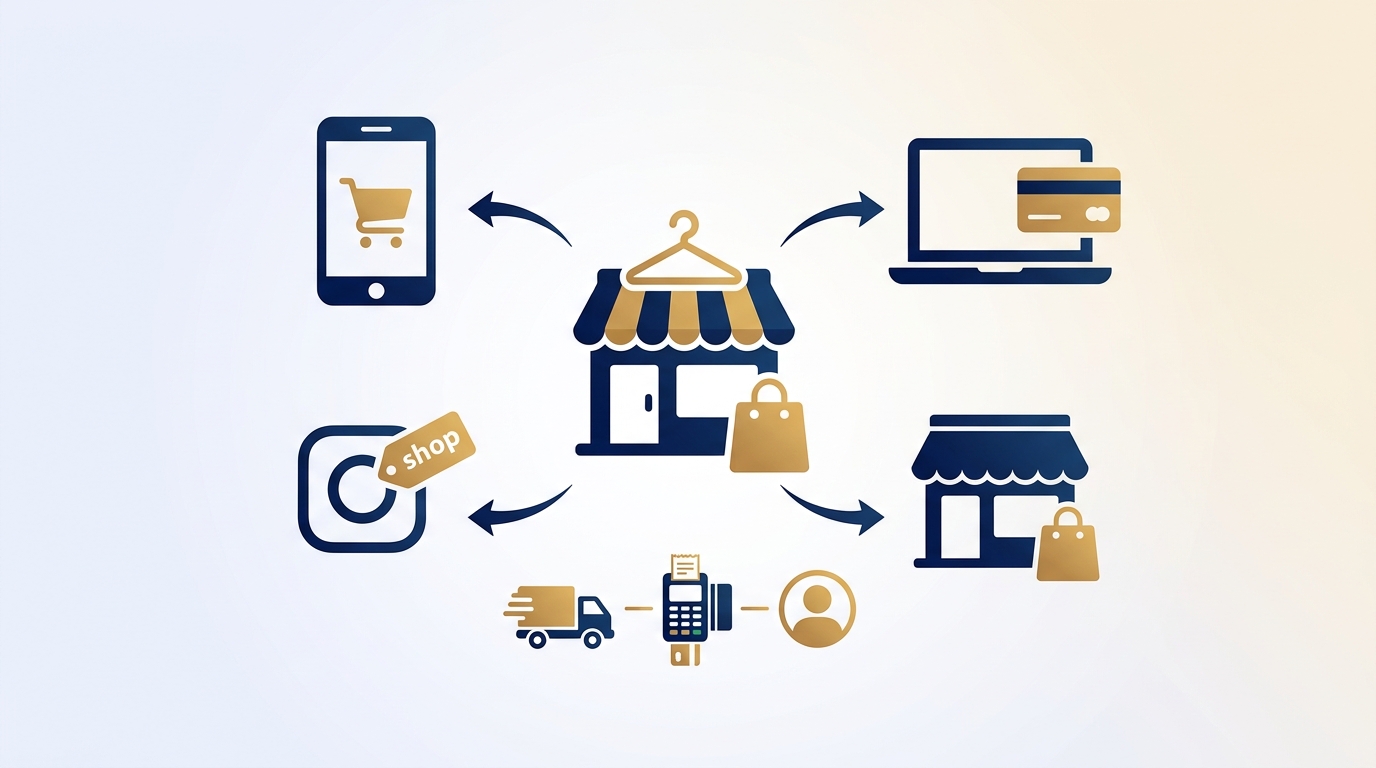
People who visited the website but did not buy are moved into a remarketing campaign with ads that remind them of the exact product they viewed, plus a light incentive for cart abandoners. At the same time, the shop runs Google Search targeting brand keywords and specific product keywords, charged by CPC, to capture people actively looking to buy. All revenue from these three streams is consolidated into one dashboard and measured by ROAS by channel.
After two weeks, the shop realizes that Google Search has the highest ROAS but limited volume, Meta remarketing performs well and still has room to scale, while cold-audience video has low ROAS but is the source of audiences for the other two streams. The right decision is not to turn off video — because if you do, the profitable streams will run out of audiences — but to optimize the video creative to reduce CPM and increase CTR, while increasing budget for remarketing. This is the performance mindset: look at the whole funnel, not each campaign in isolation.
Common mistakes
Do not try to do everything at once. A safe path for beginners is to start from the fundamentals. First, spend time mastering the four core metrics: cost per click, cost per thousand impressions, click-through rate, and return on ad spend. When you can read a report and immediately understand what each number is saying, you are already halfway there.

- Running without measurement setup. Without a conversion pixel/tag, every ROAS number is just a guess. This is the most common foundational mistake.
- Evaluating too early. Turning off ad groups after a few hours while the system is still learning causes you to miss creatives that would have worked if given more time and data.
- Looking at only one metric. High CTR with low conversions, or high ROAS with very small absolute revenue, can easily lead to wrong decisions. Always read metrics in relation to one another.
- Forgetting remarketing. Putting the entire budget into cold audiences while leaving the most convertible group — people who have already engaged — untouched is a major waste.
- Ignoring margin when setting ROAS targets. Break-even ROAS depends on gross profit; setting a random threshold can lead to running at a loss while thinking you are profitable.
- Weak landing pages. Spending money to drive traffic to a slow page or one with a mismatched message will ruin all the optimization work done before it.
How to get started if you are a beginner
Next, choose one platform and one single objective to begin with — for example, run Google Search to generate leads, or Meta Ads to sell one flagship product. Set up measurement correctly, run a small budget for one to two weeks, record the numbers every day, and practice making decisions based on data. Once you are comfortable with the measurement — optimization loop, add remarketing to recover engaged audiences, then expand to a second channel.

Finally, treat every experimental budget dollar as tuition for data, not as money lost. The goal in the early stage is not immediate profit, but understanding which creative, audience, and message fit your product. Once you have that data, increasing budget to generate profit is simply a matter of discipline and steady optimization.
Frequently asked questions
How is performance advertising different from brand advertising?
Brand advertising aims for awareness and long-term perception, and is difficult to measure directly in revenue. Performance advertising ties every dollar spent to a measurable result such as clicks, leads, or orders, and is continuously optimized based on data. In practice, the two approaches complement each other: branding nurtures the audience, while performance turns that audience into revenue.

How much budget do I need to start?
There is no fixed number, but the principle is that the test budget must be enough for the system to collect a minimum amount of conversions for learning. It is better to start with an amount you are willing to treat as tuition for data over one to two weeks, then scale based on actual ROAS results rather than betting big from the start.
What ROAS is considered good?
A good ROAS depends on your margin. A high-margin industry may be profitable at a lower ROAS, while a thin-margin industry needs a much higher ROAS to break even. So calculate your own break-even ROAS threshold based on gross profit, then set a target above that threshold instead of comparing yourself to a generic number.
Which platform should beginners run first?
Choose based on the nature of demand. If your product is something people actively search for, Google Search is the natural starting point. If your product needs demand to be stimulated through images and video, Meta Ads or TikTok Ads are a better fit. Whichever channel you choose, start with one single objective and measure carefully before expanding.
Performance advertising is not magic but discipline: honest measurement, correct reading of numbers, and steady optimization. Master the four foundational metrics, build a structured process, leverage remarketing, and avoid common mistakes — and you will have the foundation needed to turn every budget dollar into real business results. Start small, learn from the data, and scale with control.
What is performance advertising?
Performance advertising is a form of advertising focused on measurable results such as orders, leads, or installs, rather than just brand reach. You pay and optimize based on specific actions, making it easier to calculate how much value each dollar spent brings back.
How is performance ads different from branding ads?
Performance ads aim at actions and short-term revenue, measured by metrics like cost per order or ROAS; branding ads focus on building brand awareness and affinity, which is harder to measure directly in orders. A good strategy usually combines both so you can sell now while also building a long-term foundation.
Which channels are suitable for performance ads for SMEs?
The most common are Facebook and Instagram Ads, Google Ads (search and shopping), and TikTok Ads depending on the customer audience. SMEs should start with a small budget on one or two channels, track conversion metrics, then allocate more budget to the most effective channel and ad groups.