
Contents
- Four signals show AI agents are shifting toward workflow
- Tools and savings levels are changing how AI agents operate
- User behavior changes when agents connect tasks and make decisions on their own
- There is still no independent evidence to use agent rulings as a benchmark
- Vietnamese users will judge AI agents by seamless experience
- What Vietnamese marketers should do before handing workflows to agents
- References
AI agent is moving beyond the role of answering questions to take part in research, content writing, programming, and running workflows. For Vietnamese marketers, the important change is not how many more tools they know, but whether they can connect them into a workflow that can be checked, cost-controlled, and error-handled.
Key points
- The value of AI agents is shifting from individual tools to the output of the entire workflow.
- A long list of tools cannot replace choosing the right step to automate.
- Context-processing costs and dispute-resolution mechanisms will directly affect trust.
- Vietnamese marketers should start with narrow workflows that have logs, human approval, and their own test data.
Four signals show AI agents are shifting toward workflow
Four sources point to the same change: AI is no longer judged mainly by its ability to chat. One post describes a new generation of tools that can research, analyze, create and edit content, write or review code, automate repetitive work, and connect multiple tools to complete a task (source 1). Another list shows users can choose from tools for conversation, images, video, code, research, and automation (source 2).
On the operations side, a context-compression algorithm is introduced as helping save up to 15% in a coding-agent workflow integrated with GitHub Copilot and DeepSeek V4 Pro (source 3). A post about a payment dispute between AI systems raises a different issue: agents need a mechanism to reach a ruling when each system holds its own set of evidence (source 4). These examples do not prove every agent works well, but they show that workflow, cost, and intervention rights are becoming one problem.
Tools and savings levels are changing how AI agents operate
The update block below records only the capabilities stated directly in the source material. They are useful as signals for workflow design, not as proof that every tool fits every business.
AI task groups: marketing teams must design chains of work instead of using a single chatbot
AI in the material is described as being able to research, analyze information, create and edit content, review code, automate repetitive work, and connect multiple tools (source 1). For marketing teams, this opens the door to a chain such as reading campaign data, identifying issues, writing a plan, moving into a design tool, and then sending the draft into review. Each step needs a specific input, pass condition, and owner.

The 50 AI tools list: tool selection has to follow the real problem
The source 2 list ranges from ChatGPT, Claude, Gemini, and Perplexity to Midjourney, Runway, Cursor, Zapier, Make, Consensus, and Elicit (source 2). The value of the list is not that a team should install all 50 tools. It shows that each step may call for a different choice, so the person in charge needs to start from the problem, processing time, and the output that must be reused.
Context compression in coding agents: repeat costs must be measured in the workflow
SOMA is described as a layer that compresses repeated context before it is passed into the model, with savings of up to 15% according to source 3. This information is tied to coding agents in GitHub Copilot and DeepSeek V4 Pro, and should not be generalized into a cost reduction for every marketing workflow. Still, marketers can take away a measurement method: record how many times the same data is resent, the token count or cost per run, then compare before and after optimization.

User behavior changes when agents connect tasks and make decisions on their own
Users will compare the output of the whole chain, not just answer quality
The diverse tool list in source 2 and the workflow description in source 1 both show that users no longer simply ask one model and take the answer. They can move from research to content creation, from code to automation. So the evaluation criteria also change: a good answer is not enough; users need to know which steps the data passed through, whether the output can be used in the next step, and who approves it before publication.
This is a change in decision-making behavior. A tool that creates drafts quickly but increases the time needed for editing, checking, or format conversion can make the workflow slower. Dashboards should measure completion time, the share of outputs that are reused, how often reviewers have to make changes, and errors at each step, rather than counting prompts alone.
Context costs and disputes make intervention rights part of the experience
Source 3 shows that repeatedly sending context can become a cost that needs optimization. Source 4 describes a case where two systems held conflicting evidence about a payment, then proposes a multi-round council to reach a ruling. Although the mechanism in source 4 is a presentation of GenLayer and not yet a common standard, the two examples meet at one point: users need to know when an agent may act on its own, when it must stop, and who has the authority to decide.

For marketing, intervention rights should be designed in advance for actions such as refunds, sending messages to customer segments, or changing budgets. A good workflow does not just run fast. It must leave logs, keep input evidence, and hand difficult cases to the person with authority.
There is still no independent evidence to use agent rulings as a benchmark
Who will handle a wrong transaction between two systems?
Source 4 tells the story of being charged twice and introduces how GenLayer builds a council mechanism for agents to resolve disputes over multiple rounds. This is a narrative and promotional content for a model, and it has not been independently verified in the materials provided; it cannot be treated as proof that the mechanism has reliably resolved real transactions.
What is usable: marketing teams can still set exception-handling rules directly inside the workflow. Save invoices, subscription status, approval history, and the conditions for handing off to a human. Do not give an agent the right to issue refunds or change customer data based only on a product pitch.
Vietnamese users will judge AI agents by seamless experience
In Vietnam, customers usually do not care how many models a business uses. They care whether the answer fits the context, whether the conversation history is preserved, whether the request is handled through to completion, and whether they can reach a real person when something goes wrong. That is why workflows that connect multiple tools must be tested with Vietnamese data, real product names, real pricing rules, and cases with spelling mistakes or missing information.
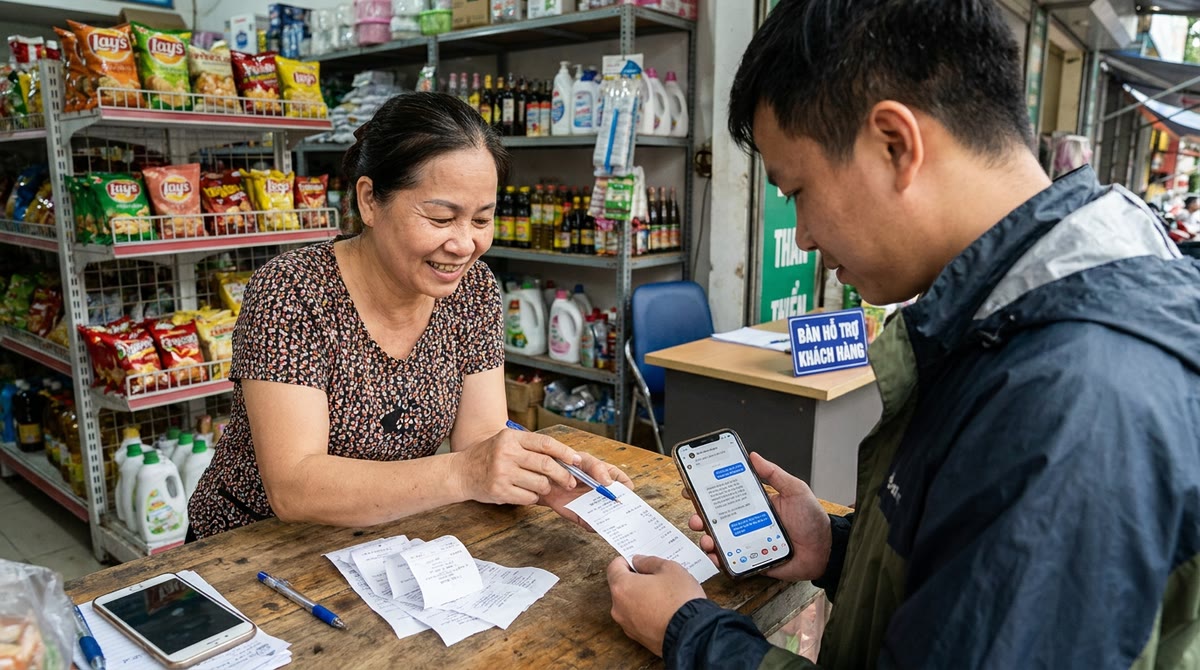
Businesses also need to clearly separate what an agent is allowed to do on its own and what must have human approval. An agent can classify requests, summarize responses, or suggest content. Actions involving complaints, promotions, ad spend, and personal data should have a confirmation step. This approach keeps the customer experience from being sacrificed just for speed.
What Vietnamese marketers should do before handing workflows to agents
- Choose one narrow workflow with measurable output, such as summarizing customer feedback or creating a content draft.
- Map the input data, connected tools, reviewer, stop conditions, and how to hand off errors to a human.
- Measure completion time, cost per run, the share of outputs that are reused, and the number of edits before increasing autonomous rights.
- Test with Vietnamese data and keep logs so you can compare cases where two workflow steps produce different results.
See more marketing analysis and how-to content at https://marketing365.vn.
Follow more analysis from Marketing365 to stay updated on the latest marketing trends.
Read more articles in the same category AI Developments.
References
- AI tools are moving beyond simple chatbots
- 50 AI TOOLS WORTH KNOWING
- A major cost layer for coding agents has just made an extraordinary move on the savings print
- I was billed twice in the same week