Contents
- What is a short video script and why do you need one before filming?
- How to define your goal and audience before writing the script
- What rhythm should a short video script follow?
- How to write dialogue and scene breakdowns so filming doesn’t feel stiff
- Mistakes that make short video scripts hard to watch or hard to convert
- How to review and refine a script before filming
- A starter framework for beginners to use right away when writing short videos
Writing a short video script should start with the hook, then move to the flow of ideas and the shots. If you leave out any of these three parts, the video can easily become rambling, the dialogue can drift away from the visuals, and it becomes harder to keep viewers until the end. For TikTok, Reels, or sales videos, the goal is to say less, be understood quickly, and be ready to shoot right away.
This section focuses on the practical process for writing short video scripts. You’ll learn how to prepare in advance, organize ideas in the right order, write concise dialogue, and break scenes down clearly enough to shoot on rhythm.
If you write for clients, shops, or a new channel, this is the framework to review your draft before filming.
What is a short video script and why do you need one before filming?
A short video script is the blueprint for the message, visuals, actions, and editing rhythm before you start filming. Without it, the person filming is likely to ramble, change direction midway, and spend extra time revising.
A shop owner often sees this clearly when they film three times and still can’t finish 30 seconds of content. The problem is not the camera, but the fact that the hook, which shot comes first, which line to say, and which line to cut have not been defined.
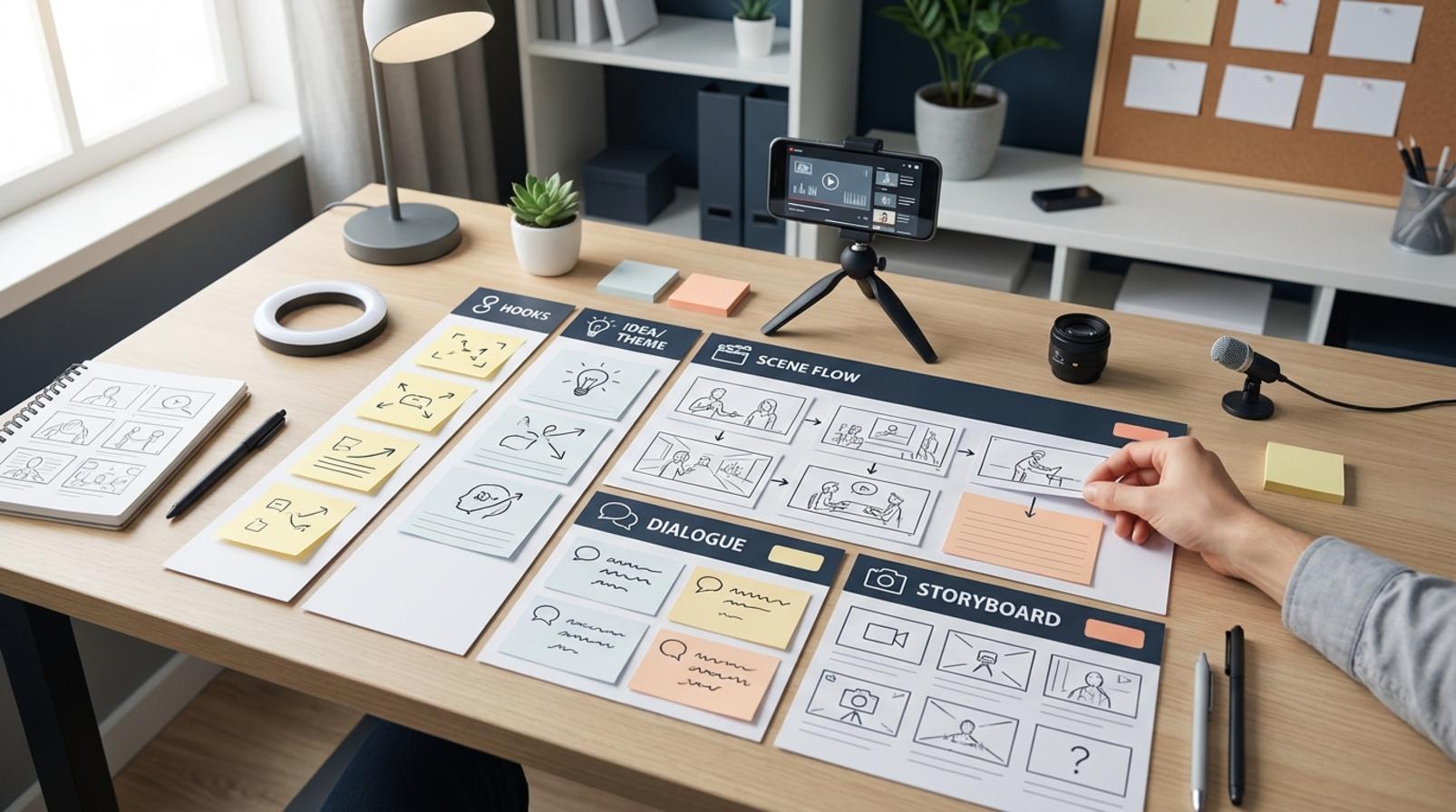
When you write a short video script, you are deciding four things: what to say, in which shot to say it, which shot to move to next, and what you want the viewer to do at the end. That’s how TikTok or Reels videos keep their rhythm, stay focused, and make the message easier to control.
How is a script different from an outline, dialogue, and storyboard?
A script is the most complete version: it includes the message, dialogue, actions, transitions, and the rhythm of each section. An outline is only the main ideas in order. Dialogue is the spoken part in front of the camera or the voice-over. A storyboard is the visual plan for each frame, camera angle, and how the short video is broken into scenes.

For example, a sales video outline may be opening with the problem, presenting the benefits, and closing. The dialogue is the line you read on camera. The storyboard notes a close-up of the product, a hand-action shot, and a change of angle. A short video script brings all four layers together so you need fewer retakes.
When do you need a detailed script, and when is a short framework enough?
A detailed script is needed for sales videos, videos with many steps, many cutaway shots, or when every line must be exact. A short framework works for familiar content, simple talking-head videos, or when you already know how to build TikTok/Reels content.
If you often forget ideas, need to reshoot many times, or have to cut constantly, you should write in more detail. If three bullet points are enough, you can still control the filming rhythm without spending too much time writing. With a process for writing engaging short video scripts, the level of detail should increase with the complexity of the content, not always be long.
How to define your goal and audience before writing the script
Before you write, decide who this video is for, what stage they are at, and whether you want them to remember something or take action. With how to write short video scripts, a good script always starts with the main goal and target audience, then chooses the hook, length, and level of detail.

Define the viewer with 3 very quick questions
Answer these 3 questions before typing the first line: what does the viewer already know about the topic, are they looking for a solution or just scrolling, and after the video do they need to remember, believe, or act. A TikTok script for beginners will need a short explanation, while a Reels sales script for someone considering a purchase needs to address the right concern and proof.
Quick checklist to define the viewer:
- They are new: use familiar examples and avoid dense jargon.
- They are considering: prioritize comparisons, reasons to choose, and objections to risk.
- They are ready to buy or leave contact information: go straight to the benefits and the next step.
If you answer this step vaguely, your short video idea development will become diluted right from the hook.
Set one main goal so the script doesn’t become diluted
Each video should prioritize only one main goal: introduce, explain, build trust, or lead to action. When building the structure of a short video script, don’t try to cram all four goals into 30 seconds, because viewers won’t remember what the focus was.
The decision is simple:
- If the goal is sales, keep the setup very short and state the main benefit clearly.
- If the goal is education, don’t insert the CTA too early and break the rhythm.
- If the goal is awareness, prioritize one memorable line over a long explanation.
A script with a clear goal is easier to turn into short video dialogue, easier to shoot, and easier to measure for effectiveness. Once the goal is set, the tone and length will naturally fall into place.
What rhythm should a short video script follow?
A good short video script structure follows the rhythm hook → body → transition → close, and each part should do only one job. If the opening is there to hold attention, the body should push the idea forward, while the ending only needs to close with a memorable point or a clear action. This rhythm keeps TikTok/Reels videos tight, fast, and less fragmented.

How should you open a video with a hook to keep viewers watching?
The hook is the first line that makes viewers stop, so it should come from a problem, result, mistake, comparison, or familiar situation. A good hook is usually short, specific, and gives a reason to keep watching; for example, an educational video might open with “3 mistakes that make a 15-second video still get swiped past,” while a sales Reels script can go straight to the benefit or buying situation.
When writing how to create a hook in a short video, avoid these 3 mistakes:
- Introducing yourself for too long.
- Being vague, like “today I’m sharing a great tip.”
- Stuffing too many ideas into the first line.
The hook should change depending on the context:
- Educational content: “If your video has enough content but still gets few views, the problem is usually in the first 5 seconds.”
- Review: “Is this worth the money? I tried it for exactly 7 days, and one thing was quite surprising.”
- Sales: “Customers usually ask one question before buying, and that question determines the close rate.”
How should the body develop the idea without feeling fragmented?
The body should follow a clear logic: problem → solution, or example → conclusion. In the process of writing engaging short video scripts, each section should hold only one main idea so viewers don’t get overloaded with information.
The cleanest way is to split the content into 2–4 short beats:
- State the specific problem.
- Give one explanatory or illustrative point.
- Move to the next idea with a natural transition.
- End with the takeaway.
If you’re writing a video script for TikTok, read each sentence again and ask: “Does this sentence pull the viewer into the next idea?” If not, cut it. A transition like “this leads to another mistake” often feels more natural than cutting with spoken words.
Should the ending close the message or the action?
The ending should close according to the goal: an educational video should end with one key takeaway, while a sales video should clearly close with the next step. The final section doesn’t need new information, because the more you cram in, the more the rhythm gets diluted.
For a sales Reels script, the close should be short and include a specific action: view the model, compare, save it, or move to the buying step depending on the context. For a sharing video, it’s enough to wrap up with one line like “The most important point is that the hook and body must serve one goal.”
A simple checklist for closing a video:
- Educational video: repeat 1 main idea.
- Review video: close with a clear opinion.
- Sales video: close with the next action.
- Short ad video: close with the benefit, don’t drag it out.
How to write dialogue and scene breakdowns so filming doesn’t feel stiff
To keep filming from feeling stiff, the dialogue needs to be something you can say naturally right away, and the scene breakdown should help viewers quickly understand the main idea. When writing how to write short video scripts, clearly separate what is said on camera, the on-screen text, and the supporting visuals so filming and editing don’t become confusing.
How to write short, natural, easy-to-say dialogue
Read more: What Is the PAS Content Writing Formula? How to Apply It
Read more: How to Write SEO-Friendly Content for a Website
Good dialogue is short, one idea per sentence, and sounds like the way you normally speak. With how to write dialogue for short videos, avoid phrases like “in today’s article” or “we will explore together,” because they make the line sound stiff.

Checklist for revising lines to make them easier to say:
- Split long sentences into 2–3 short ones.
- Change written language into spoken language: “implement” becomes “do,” “objective” becomes “goal.”
- Read it once; if you have to pause for breath in the middle, cut it.
- If the line sounds like an ad, rewrite it as a real-life story.
For example, instead of “this is the optimal solution for short-form content,” say “this way helps you film faster and spend less time revising.” The second line is less polished, but it’s easier to say and easier to keep the rhythm.
What should a short video scene breakdown include?
A short video scene breakdown should include 4 things: where the scene takes place, who appears, what they are doing, and what text appears on screen. A simple storyboard only needs that much to be enough for filming and editing.
Each scene should have 3 lines of information:
- Talking-head or close-up of hands/product.
- Main action: pointing, unboxing, flipping through documents, typing.
- On-screen text: title, main point, number of steps, short warning.
If the video only has one person speaking, you should still break it up with camera angles or text to avoid monotony. If a scene doesn’t help clarify the idea, remove it. With how to write short video scripts, the goal is to film it, cut it, and make the viewer understand it within the first few seconds.
Mistakes that make short video scripts hard to watch or hard to convert
The mistakes below often make how to write short video scripts lose rhythm very quickly: viewers don’t have time to understand what they’re watching before they swipe away, while content creators think the script is complete but still struggle to convert. The most effective fix is to look at the chain of error → consequence → immediate adjustment in the draft.

A slow or too-generic hook
A slow hook usually shows up as a long opening explanation with no clear stopping point to hold the viewer’s attention. With how to create a hook in a short video, switch from an introduction to a specific problem, a specific result, or a curious situation. For example, instead of “Today I’m sharing this product,” go straight to “After 3 days of posting videos with no comments, the problem is usually in the first 5 seconds.” When writing, read the opening line aloud; if it sounds like the intro to an email, the hook needs revision.
A script that crams in too many ideas and loses rhythm
An overstuffed script often tries to introduce, advise, sell, and tell a story all in one video. The short video script structure then becomes messy, because each idea pulls a different rhythm. The fix is to choose one main goal for one video: either open the problem, prove something, or close with action. If there are supporting ideas, move them to another video or cut them down into one short line that supports the main point. Short TikTok or Reels scripts usually win on clarity, not on the number of ideas.
Dialogue that sounds unnatural and stiff on camera
Stiff dialogue usually comes from writing like a document, not like a speaker. The easiest signs are long sentences, too much jargon, and the feeling that you’re reading a report. With video script writing, shorten sentences to 8–15 words when possible, switch to everyday language, and read it aloud before filming. If a sentence has to be read twice before it flows, it will be even harder to say on camera. A quick trick is to remove abstract nouns, keep the verbs and the main benefit; how to write dialogue for short videos should prioritize being speakable first, then polished.
How to review and refine a script before filming
How to write short video scripts before filming should be reviewed on 3 layers: goal, scene structure, and language safety. Spending just 5 minutes checking it can reduce many retakes caused by a weak hook, stiff dialogue, or wording that is too risky for a sensitive channel.
A 7-point checklist to self-review a script in 5 minutes
A good short video script template must have 1 main goal and 1 hook that appears early in the first 3–5 seconds. If the opening is too slow, viewers usually skip before the main point.

- Identify exactly 1 goal: sales, explanation, driving comments, or leading to other content.
- Check whether the hook appears right at the start of the opening.
- Each scene should hold only 1 main idea; if a scene carries 2–3 ideas, it should be split.
- Read the dialogue aloud to check naturalness; if a line is hard to read, fix it immediately.
- Find any parts that are too long, too vague, or repetitive and cut them down.
- Combine ideas that are close together if they are filmed in the same setting and with the same action.
- Review the wording: avoid overpromising and avoid lines that could be misunderstood if the video belongs to a safer content category.
With this how to write short video scripts approach, you usually only need to revise individual lines, not rewrite the whole script. A quick trick is to highlight any line longer than 12–15 words; the shorter the sentence, the easier it is to keep the rhythm.
When should you rewrite from scratch instead of making small edits?
You should rewrite from scratch when the hook is completely wrong, the video goal changes midway, or the content rhythm has become so diluted that no amount of cutting can save it. Keeping a script with the wrong structure usually takes more time than starting over.
If the opening no longer matches the promise, discard it. Likewise, when a sales Reels video shifts from product introduction to market education, the old structure is almost no longer suitable.
- Rewrite when the opening doesn’t hold viewers.
- Rewrite when every scene talks in circles.
- Rewrite when the dialogue feels forced into selling and could reduce channel safety.
In the process of writing engaging short video scripts, small edits are only suitable for minor issues. If the framework is wrong, rewriting will be faster and cleaner.
A starter framework for beginners to use right away when writing short videos
The best framework for beginners is to write in 3 fixed steps: open with the problem, develop 2–3 solution points, then close with one small action. How to write short video scripts using this framework helps you move from idea to video faster, especially when you need to make TikTok, Reels, or sales videos for different industries.
A framework for short educational videos
A short video script template for educational content can follow this formula: problem – 2 to 3 explanatory points – close with one memorable line. With video script writing, you only need to fill in these three parts for the video to stay focused.
- State the problem the viewer is facing.
- Give 2–3 short solution or explanation points.
- Close with a summary line, a memory tip, or a call to action.
For example: “Why do videos get so few views? It could be because the hook is too slow, the content gets to the point too late, or the wording doesn’t make the benefit clear. Open immediately with the result the viewer wants to see. If needed, shorten the first 1–2 seconds into a tighter line.”
This framework works well for short video idea development when you don’t yet know what to say first. Just replace the topic with a mistake, question, or misunderstanding that customers often have, and you can film right away.
A framework for sales videos or product introductions
A sales short video script should follow situation – differentiator – next step. This is a more natural how to write short video scripts marketing approach than listing features, because viewers often decide very quickly in the first few seconds.
- State the pain point or specific situation.
- Choose the single most worth mentioning differentiator.
- End with a short next step, such as viewing the model, trying the usage method, or choosing the right version.
For example: “Does your shirt wrinkle easily after a full day at work? This model uses a better shape-retaining fabric, so it creases less at the shoulders. If you need a neat office option, check the right size before ordering.”
This framework works for sales Reels scripts, product introduction videos, or soft-conversion content. For fashion, beauty, or household products, just change the pain point and the main benefit.

MARKETING365
📧 Email: lienhe@marketing365.vn
🌐 Website: https://marketing365.vn
👍 Fanpage: https://facebook.com/marketing365.official
To stay updated with official and latest guidance, you can also refer to materials from HubSpot Blog.
You can also read more articles on the same topic in the Content Marketing section.