
Contents
- Kimi K3: the open-model breakthrough drawing market attention
- Kimi K3 overtakes Claude Fable 5 in frontend code rankings
- Pressure on Anthropic and OpenAI: the market awaits the next launch cycle
- Opus 5 rumored to be near launch as Fable 5 enters its final stretch
- Kimi K3 and the story of pricing, enterprise data, and semiconductors
- AI agents are becoming a new application layer, from blockchain to business
- Web3 projects continue to follow the AI agent wave
- Working with multiple subagents: AI is moving from “chatbot” to “digital team”
- Google Gemini 3.5 Pro is still rumored to be delayed
- AI and the “ownership problem”: a bigger story than model capability
- Don’t lock into one AI platform; turn agents into workflows
- Test open and closed models side by side on your own cases
- References
As of July 2026, the AI race is being reshaped less by any single flagship product than by how quickly open models are closing the gap with closed ones. Moonshot AI‘s Kimi K3 sits at the center of that shift. For Vietnamese marketers, this is not an abstract benchmark contest: it directly affects deployment cost, speed to market, vendor choice, and how much of your AI stack you can own rather than rent.
The global AI race is entering a new phase as Kimi K3 from Moonshot AI appears frequently in international discussions about open models, coding capability, and the impact on the valuations of Western AI “giants.” For Vietnamese marketers, this is not just a benchmark story: it directly affects deployment costs, speed to market, vendor selection, and how businesses use AI agent to boost productivity.
Key points
- Kimi K3 is being seen by the tech community as a major leap for open models, creating new pressure on OpenAI and Anthropic.
- The “AI agent” wave continues to spread into Web3, with many projects promoting task automation, governance, and trading capabilities.
- Signals around Opus 5, Gemini 3.5 Pro, and other models suggest AI product launches may accelerate even further.
- For Vietnamese businesses, the focus should be on choosing the right use case, controlling data, and evaluating total deployment cost rather than chasing launch news.
Kimi K3: the open-model breakthrough drawing market attention
Early reports suggest that Moonshot AI’s Kimi K3 is being regarded as one of the most notable open models right now, with many comments saying it has surpassed the previously shocking milestones set by DeepSeek. Reuters also reported that Moonshot AI has just unveiled a very large open model, narrowing the gap with U.S. rivals.
What stands out is not only the specs or rankings, but the ripple effect: when an open model reaches sufficiently high quality, questions about the value of closed models, usage costs, and the advantage of internal data become much sharper. That is why Kimi K3 is being watched closely as a variable that could affect the entire AI market landscape.
Source: Reuters; public posts on X cited in the source data.
Kimi K3 overtakes Claude Fable 5 in frontend code rankings
Citing the @arena community, Kimi K3 has risen to No. 1 on the Frontend Code Arena with 1,679 points, surpassing Claude Fable 5 and jumping from 18th place to first. According to the same source, the model ranks first in 6 of 7 task groups in frontend, trailing only Fable 5 in gaming.
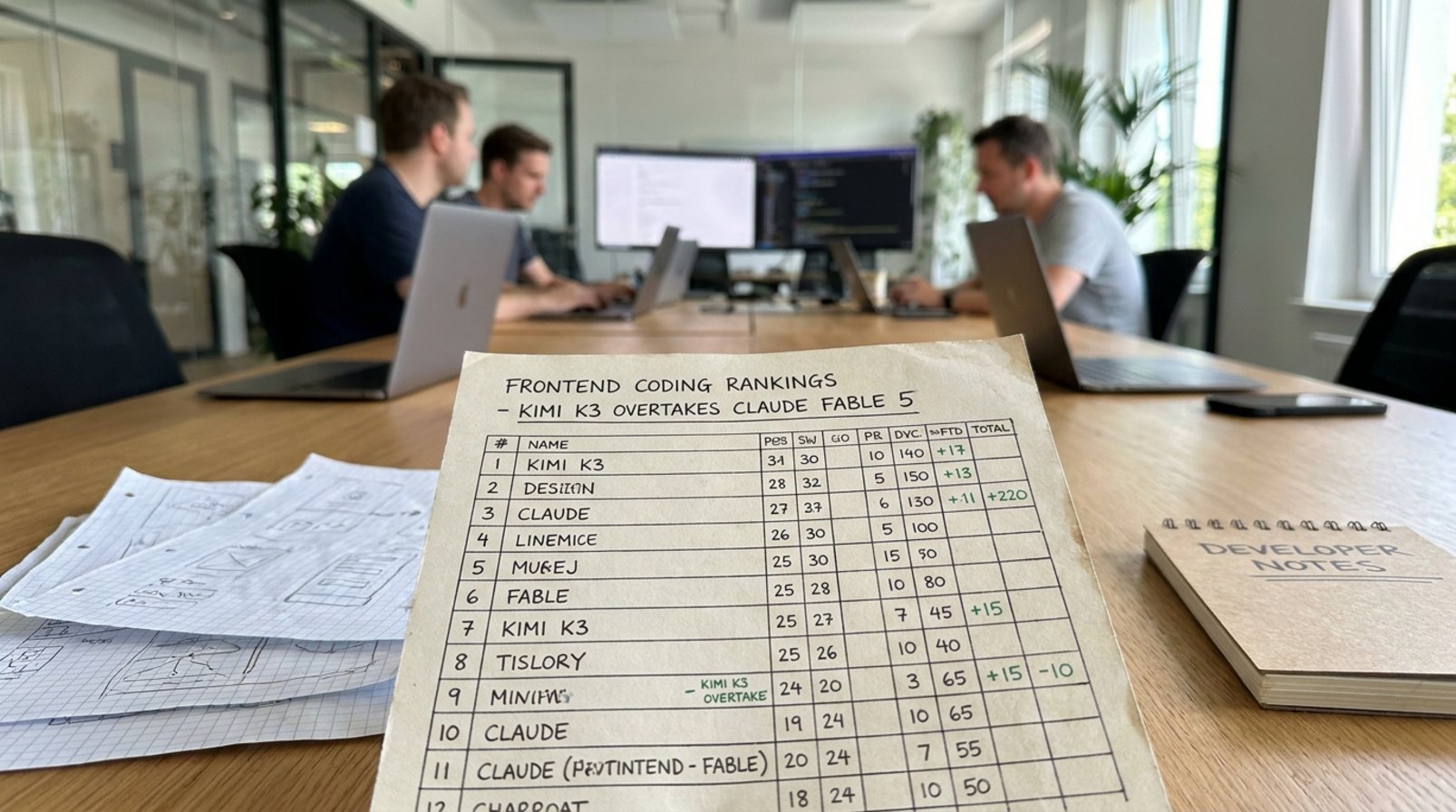
For digital product teams, this has practical meaning: AI models are no longer judged only by “lab scores,” but by their ability to support interface creation, user experience, data, content, and operational tools. If this result is more broadly confirmed by the community, competitive pressure on closed models will rise significantly.
Source: data cited from @arena in sources [3] and [8].
Pressure on Anthropic and OpenAI: the market awaits the next launch cycle
Many posts in the source list center on one message: Kimi K3 could force U.S. labs to speed up their launch plans. Some comments on X suggest Anthropic is likely to release Opus 5 soon, while OpenAI will also face pressure to shorten the gap before its next generation arrives.

The market mood appears to be shifting from “who has the better benchmark” to “who reacts faster.” For marketers and businesses, this is an important signal because AI product lifecycles may now be much shorter than before; being late by a few months can mean competitors have already optimized workflows, launched new features, and told a stronger brand story.
Source: public posts in sources [1], [2], [8], [14], [17].
Opus 5 rumored to be near launch as Fable 5 enters its final stretch
Among the Anthropic-related updates, some sources on X suggest Claude Opus 5 could launch around 20–21/7, and there had even been earlier speculation about a release window next week. The common thread in these posts is the view that Anthropic can no longer stretch the Fable 5 cycle much longer amid intensifying competition.

Although this is still only a rumor, it reflects an important reality: market expectations in AI are no longer centered solely on model quality, but also on release cadence. Businesses using AI need to prepare for a world where features and pricing change constantly, requiring more flexible internal testing and evaluation processes.
Source: public posts in sources [2], [14].
Kimi K3 and the story of pricing, enterprise data, and semiconductors
Some comments on X argue that when open models become good enough, businesses will more strongly consider running AI in their own infrastructure instead of paying for closed models. The argument rests on three points: avoiding vendor lock-in, better data control, and reduced concerns about IP risk.

This is a perspective worth noting for marketing, technology, and operations teams in Vietnam. When choosing an AI platform, the key question is not only “which model is strongest,” but also “which model best fits the business’s security, cost, and integration needs.”
Source: sources [3], [4], [15].
AI agents are becoming a new application layer, from blockchain to business
Many sources in the list show that AI agents remain a hot topic. Swapfone announced SwapfoneAI, an open-source agent that can handle blockchain tasks and everyday work; Auvin and NP_Official_X also discussed the economic infrastructure for AI agents; Ledger emphasized an “agent proposes, human approves” model to keep automated transactions safe.

The common thread here is the need to turn AI from a response tool into an action tool. For businesses, that could mean agents for market research, content writing, email filtering, report generation, or internal transaction preparation. But the more automation increases, the stricter control, permissions, and oversight must become.
Source: sources [6], [13], [16].
Web3 projects continue to follow the AI agent wave
Another group of posts shows the Web3 ecosystem trying to keep pace with the AI narrative through “agent economy” projects, where tasks, skills, and value flows are packaged into reusable assets. Some argue the market is shifting from meme to utility, especially on chains such as Robinhood Chain and Virtuals.

From a marketing communications perspective, this signals that the AI agent story will continue to be explored across multiple layers: infrastructure, consumer applications, on-chain transactions, and revenue-sharing models. However, businesses need to separate technology vision from actual revenue potential.
Source: sources [5], [9], [11], [12], [13].
Working with multiple subagents: AI is moving from “chatbot” to “digital team”
Miles Deutscher shared that Hermes Agent can run multiple subagents in parallel at low cost, with each agent assigned a separate role such as research, content, or operations. Some guides in the source even describe how to configure models, APIs, and inference modes to optimize each task.

This shows a very clear trend: instead of using one AI for everything, users are breaking work into specialized agents. For marketing teams, this approach is especially useful for repetitive workflows such as competitor research, brief drafting, content creation, and performance tracking.
Source: sources [12], [15].
Google Gemini 3.5 Pro is still rumored to be delayed
While Kimi K3 and other models are creating a rapid-fire launch cycle, Gemini 3.5 Pro is being mentioned with yet another delay rumor. Although there is no official confirmation in the source data, the repeated delay speculation shows that market expectations for Google remain very high.

For marketers, what matters is the gap between expectations and each vendor’s actual execution. When an AI product launches late, the communications advantage can quickly fall to competitors who know how to capitalize on better timing.
Source: source [17].
AI and the “ownership problem”: a bigger story than model capability
One post in the source argues that AI does not lack capability; it lacks a clear ownership mechanism for workflows, models, and automation. From there, the author raises the idea of turning AI skills into on-chain assets with licensing, revenue sharing, and tradability between creators and agents.

This is a notable perspective because it expands the AI race from “who runs the better model” to “who owns the value layer around the model.” For Vietnamese businesses, the practical lesson is: if you have built a useful workflow or prompt set, think about how to standardize, document, and protect that knowledge asset.
Source: source [9].
Don’t lock into one AI platform; turn agents into workflows
For businesses and marketing teams in Vietnam, this week’s news points to three clear priorities. First, do not lock yourself into a single AI platform; test open and closed models in parallel to optimize cost, security, and output quality. Second, AI agents will soon move from experimentation to real operations in areas like research, content, CRM, and ops; therefore, approval workflows, risk controls, and performance measurement should be designed early. Third, long-term value may not lie in the strongest model, but in the ability to turn AI into repeatable processes, internal assets, and scalable competitive advantage.

In short, the Kimi K3 race and related news are not just about international technology. They are a sign of a market where speed, flexibility, and data ownership will determine who uses AI better.
Test open and closed models side by side on your own cases
- Test open and closed models in parallel instead of locking into one platform, comparing them on cost, security, and real output quality for your own use cases.
- Weigh total deployment cost and data control — not just benchmark scores — when selecting an AI vendor, especially for sensitive first-party data.
- Prepare for shorter AI product cycles by building lightweight internal testing and evaluation processes so you can adopt new features without disruption.
- Move AI agents from experiments into real operations such as research, content, CRM, and ops, with clear approval workflows, permissions, and oversight from the start.
- Standardize and document the workflows and prompt sets that work, treating them as internal knowledge assets that compound your competitive advantage.
Overall, the Kimi K3 moment is less about one model overtaking another and more about a market where speed, flexibility, and data ownership decide who uses AI better. For Vietnamese marketers, the advantage will go to teams that experiment deliberately and turn AI into repeatable, owned processes.
See more marketing news and guides at https://marketing365.vn.
Follow more updates from Marketing365 to stay on top of the latest marketing trends.
Read more articles in the same category AI Moves.
References
- China’s Moonshot unveils world’s largest open AI model, closing in on US rivals
- Kimi-K3 launch is so much bigger than the previous Deepseek shock moment
- Kimi K3 will accelerate development even further
- Big news: Kimi-K3 by @Kimi_Moonshot is now #1 in the Frontend Code Arena
- What Kimi K3 means for USA AI
- SwapfoneAI is Live
- AI doesn’t have a capability problem. It has an ownership problem.
- I still think Hermes agent is the most slept-on AI tool of 2026
- We are delighted to establish a strategic partnership with @NP_Official_X
- Opus 5 Leaks – Claude Opus 5 is expected to launch on July 20-21
- Moonshot AI dropped Kimi K3 a 2.8 trillion parameter open model
- WHALE WATCH :Ledger launched an open source AI Agent Stack
- Gemini 3.5 Pro was rumored to launch today