Contents
- What is AI Marketing and why you can’t ignore it
- Core concepts you need to know before getting started
- A learning path for AI Marketing beginners
- AI Marketing tools you should use
- Practical examples in the Vietnamese context
- Common mistakes that make AI backfire
- How to start today
- Frequently asked questions
- Can people who are not tech-savvy learn AI Marketing?
- Will Google penalize content written with AI?
- How much does it cost to get started?
- When should you use an AI Agent instead of a regular chatbot?
- What is AI marketing and how can SMEs apply it?
- What are some popular AI marketing tools?
- Does getting started with AI marketing cost a lot?
- References
AI Marketing is no longer a matter of the future or something reserved for large corporations. Right now, a freelance content creator, an online shop owner, or a marketer at a small or medium-sized business in Vietnam can use artificial intelligence to write content faster, analyze customers more deeply, and optimize ads more accurately. The question is no longer “should we use AI or not,” but “how do we use it properly so we don’t waste time and money.”
This article is a complete overview of AI Marketing for beginners: from foundational concepts and step-by-step learning paths to the tools you should use, along with practical examples in the Vietnamese market and common mistakes that make many people give up halfway. You can read it straight through from top to bottom, or jump to the section you care about most and come back later.
What is AI Marketing and why you can’t ignore it
AI Marketing is the application of artificial intelligence to marketing activities: from market research and content production to message personalization, ad campaign optimization, and customer care. Simply put, instead of doing everything manually, you let AI handle the repetitive tasks and large-scale data processing, while humans focus on strategy, creativity, and decision-making.
What makes AI Marketing urgent is speed. A campaign that once took a team several days to prepare content can now be drafted by one person in just a few hours. But speed is only the surface. The real power lies in data processing: AI can read thousands of customer comments, identify sentiment trends, suggest segments, and predict buying behavior at a scale humans cannot handle manually.
For beginners, there is one misconception that needs to be cleared up right away: AI does not replace marketers. AI replaces marketers who do not know how to use AI. Tools are only leverage — the people who understand customers, understand the brand, and know how to ask the right questions are the ones who create results. This is also why the ability to communicate with AI has become a core skill for modern marketers.
Core concepts you need to know before getting started
Before jumping into tools, you should understand a few core concepts. You do not need deep technical knowledge, just enough to know what you are working with and why results are sometimes good and sometimes poor.
The first is how to “instruct” AI. The quality of responses from a model like ChatGPT or Gemini depends heavily on how you frame your request. The skill of writing clear, context-rich, and constrained instructions is called prompt engineering. If you have ever seen AI give vague, rambling, or off-topic answers, the problem is almost certainly the prompt, not the model. You should take time to learn what prompt engineering is before doing anything serious with AI, because this is a foundational skill that runs through every marketing task.
The second concept is accuracy. AI models are trained on older data and sometimes “hallucinate” information with confidence. To address this, people use a technique that allows AI to look up a company’s real documents before answering — called RAG (Retrieval-Augmented Generation). For marketers, understanding what RAG is is very important when you want to build a product-advice chatbot or a content assistant based on your brand’s actual data, instead of letting AI make things up.
The third concept is the level of automation. A chatbot that only answers questions is one thing; an AI system that can plan, call tools, and complete a multi-step workflow is something else. The latter is called an AI Agent. When you want AI not just to “answer” but to “do the work” — for example, research keywords, draft an article, and then publish it to a website — you are entering the realm of agents. Beginners should learn what AI Agent is to understand the highest level of automation AI Marketing can achieve today.
These three concepts — prompt, RAG, and agent — form three layers of capability: instructing AI, giving AI the right data, and letting AI act on its own. Once you understand these three layers, you will know where each tool fits and what expectations are realistic.
A learning path for AI Marketing beginners
The biggest mistake beginners make is learning in a scattered way: today they watch a video about ChatGPT, tomorrow they play with an image-generation tool, the next day they try an automation plugin — and after a month, they still cannot apply anything to their work. The path below follows the principle of “learn it and use it right away.”
- Week 1 — Master one chat model. Choose a single tool (ChatGPT or Gemini) and use it to write captions, emails, and product descriptions. The goal is to get comfortable writing prompts, not to learn every feature.
- Week 2 — Upgrade your prompt skills. Learn how to add role, context, sample examples, and output format to your instructions. This is when results start to look noticeably more professional.
- Week 3 — Apply it by channel. Use AI in a real workflow: brainstorming monthly content ideas, writing short video scripts, or analyzing competitors. Attach AI to something you already have to do.
- Week 4 — Data and personalization. Use AI to read and categorize customer feedback, segment audiences, and suggest tailored messages for each group. Start tapping into the power of data.
- Month 2 onward — Automation. Once you are proficient, learn how to connect tools into a self-running workflow, from a chatbot based on brand data to automated posting flows.
The key point: do not jump straight into automation before mastering prompts. An automated workflow powered by poor prompts will produce poor content at scale — and take more effort to fix than to do manually.
AI Marketing tools you should use
The market has thousands of AI tools, but beginners only need a compact set to get started. The rule is to choose fewer tools and use them deeply, rather than installing many and leaving them unused.
- Language models: ChatGPT, Gemini, or Claude for all text-based tasks — writing, brainstorming, summarizing, translating, and analyzing. This is the center of the entire workflow.
- Image generation: AI image tools help create article covers, banners, and illustrative product images without needing to hire a designer for every small task.
- SEO support: Keyword research and content analysis tools help you know what to write so people will search for and read it, instead of writing based on intuition.
- Workflow automation: Platforms like n8n or Make let you connect multiple tools into an automated flow, for example pulling in news and then drafting and publishing an article automatically.
- Data analysis: AI built into advertising and analytics platforms helps optimize budgets, predict performance, and detect anomalies.
Advice for beginners: start with one language model and one image-generation tool for the first three months. Only when you find yourself repeating the same task many times a week should you think about automation — because that is when building a workflow is truly worth the effort.
Practical examples in the Vietnamese context
Theory will feel dry if it is not tied to real situations. Below are three common scenarios that marketers in Vietnam can apply right away.
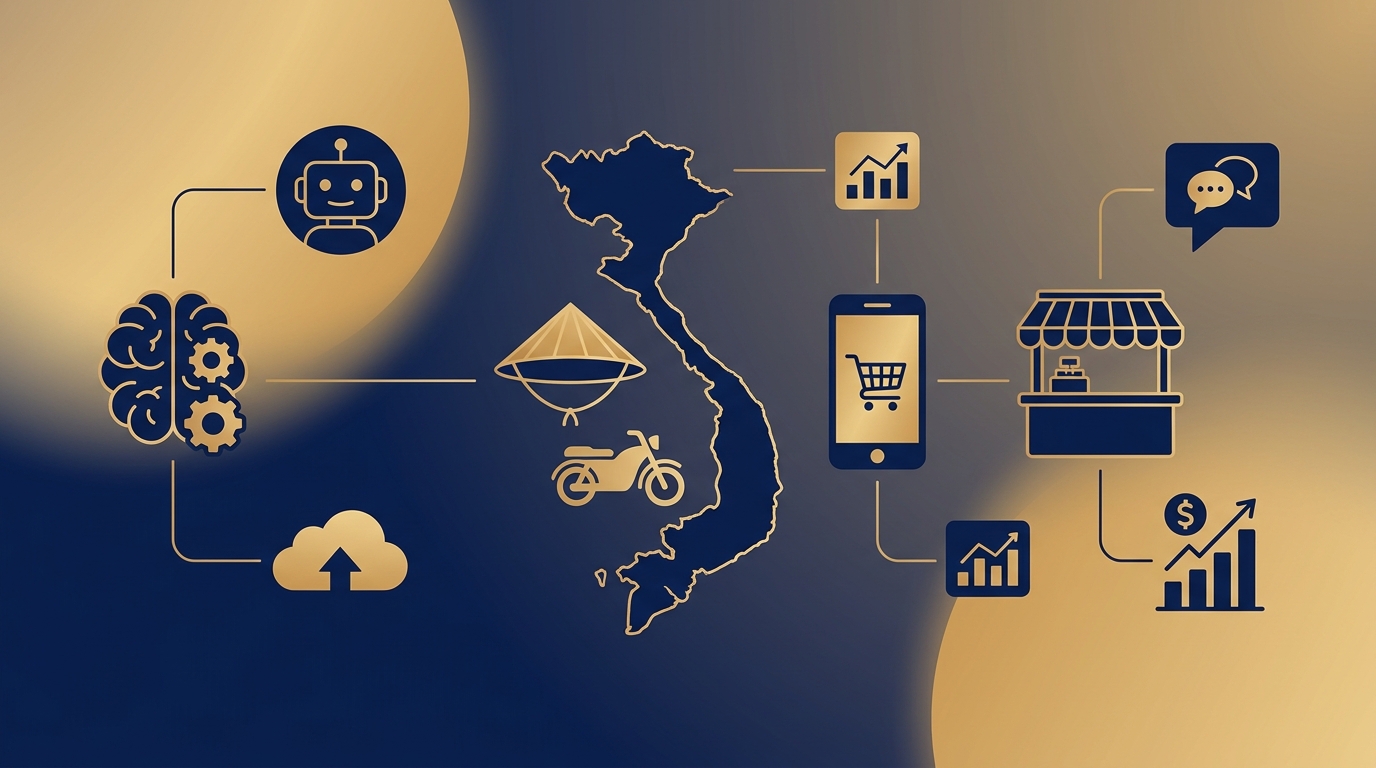
An online cosmetics shop owner. Every day, the shop receives hundreds of messages asking the same few questions: price, ingredients, how to use it, shipping. A chatbot built on the shop’s real product data — using a technique that lets AI look up internal documents — can answer accurately 24/7 and only hand off to a human when the situation is difficult. Customers get instant replies, and the shop owner saves hours every day.
A marketer at a B2B company. Instead of manually reading industry reports and competitor news, the marketer can use AI to quickly summarize dozens of sources every morning, extract notable points, and suggest content angles. What used to take half a day now takes thirty minutes, with the remaining time spent on strategy.
A freelance content creator. A freelancer writing for multiple clients can build a set of sample prompts for each brand voice, use AI to draft the first version, and then edit it with their own experience and aesthetic judgment. Productivity increases many times over while still preserving a personal touch — as long as the human editing step is not skipped.
The common thread in all three examples: AI handles the heavy, repetitive work, while humans retain quality control and final decision-making. That is the sustainable formula, not the kind where you hand everything to the machine and publish it as-is.
Common mistakes that make AI backfire
AI is a double-edged sword. Used well, it multiplies productivity; used poorly, it creates brand risk and waste. Below are the mistakes almost every beginner makes.
- Publishing AI-written content as-is. AI writing is often correct but bland, lacking real experience and sometimes containing factual errors. Failing to edit it is the fastest way to lose credibility with readers and be rated poorly by search engines.
- Trusting AI’s numbers completely. Models can “hallucinate” statistics and cite sources incorrectly. Every important piece of information must be verified from the original source.
- Writing a lazy prompt and then complaining AI is bad. A one-line instruction without context will naturally produce generic results. Input quality determines output quality.
- Chasing new tools constantly. Every time a hot tool appears, people install it and never use any tool deeply enough to become proficient. A stable toolset is always more effective than constantly switching.
- Ignoring privacy and copyright. Pasting sensitive customer information into public tools, or using AI-generated images without checking the terms, can cause legal trouble.
The safety principle can be summed up in one sentence: treat AI as a capable colleague who often sounds certain even when it is not — always check again before trusting and before publishing.
How to start today
You do not need an expensive course or a powerful computer to begin. All you need is a free account on a chat model and one real task from your daily work to try it on.
- Choose one task you do often and that takes time — for example, writing captions or replying to customer messages.
- Use AI to try that task for one week, and record which prompts produce the best results each time.
- Refine the prompts based on the results, and turn the best ones into reusable templates.
- Once things are stable, expand to a second task, and only then think about automation.
This approach helps you see real value early, stay motivated, and avoid feeling overwhelmed. AI Marketing is an accumulation journey — every good prompt and every refined workflow is a long-term reusable asset.
Frequently asked questions
Can people who are not tech-savvy learn AI Marketing?
Absolutely. Today’s AI tools communicate in natural language, so you can give instructions in Vietnamese as if you were talking to an assistant. The most important skill is not technical knowledge, but the ability to clearly express what you want — which is exactly prompt engineering. Marketers who are already good at communication often progress very quickly.

Will Google penalize content written with AI?
Google does not penalize you for using AI; it penalizes low-quality content whether it is written by a person or a machine. If you use AI to draft content and then edit it with knowledge, experience, and fact-checking, the content can still be highly valued. Problems only arise when you publish large volumes of raw, bland, and inaccurate AI content.
How much does it cost to get started?
Almost nothing in the early stage. Most major chat models have free versions that are enough to learn and handle basic tasks. When your needs grow — more capacity, advanced features, or automation — you can then consider paid plans, usually a few hundred thousand VND per month for one main tool.
When should you use an AI Agent instead of a regular chatbot?
A regular chatbot is suitable when you only need one-step Q&A. An AI Agent is suitable when you need AI to carry out a multi-step sequence — for example, researching, drafting content, and then publishing it without intervention at each stage. Beginners should first become proficient with prompts and chatbots, then move on to agents once they clearly understand the workflow they want to automate.
What is AI marketing and how can SMEs apply it?
AI marketing is the use of artificial intelligence tools to support marketing activities such as content creation, data analysis, personalization, and workflow automation. SMEs can use it to write content faster, generate ideas, classify customers, and optimize ads without needing a large team.
What are some popular AI marketing tools?
There are many groups of tools, such as language models for writing and ideation, image and video generation tools, workflow automation platforms, and AI features built into advertising and email tools. Beginners should choose a few tools that solve the specific task they need instead of trying to use too many at once.
Does getting started with AI marketing cost a lot?
Many AI tools have free or low-cost plans that are enough for SMEs to test, so you can start small before investing more. The important thing is to identify the task that needs automation, measure the time and results saved, and then expand based on real effectiveness.