
Contents
- How should B2B content be written to match each stage of the buying journey?
- To make B2B content effective, define the brief before writing
- What formats does B2B content need to avoid boredom and still generate leads?
- The structure of a B2B article that is easy to read and persuasive enough
- Common mistakes that make B2B content fail even after repeated writing
- How should B2B content be measured to know whether it is on the right track?
- Frequently asked questions about how to write B2B content
Writing B2B content is not the same as writing for the masses. Readers usually already have context and need enough depth to assess risks, compare options, and decide on the next step. That is why the question how to write B2B content should be answered from the buyer journey, the content format for each stage, and how to measure effectiveness through real signals such as reading time, downloads, feedback from sales, or repeated questions from customers. If done right, the marketing team will know what to write, what to leave out, and how to check performance at a basic level.
How should B2B content be written to match each stage of the buying journey?
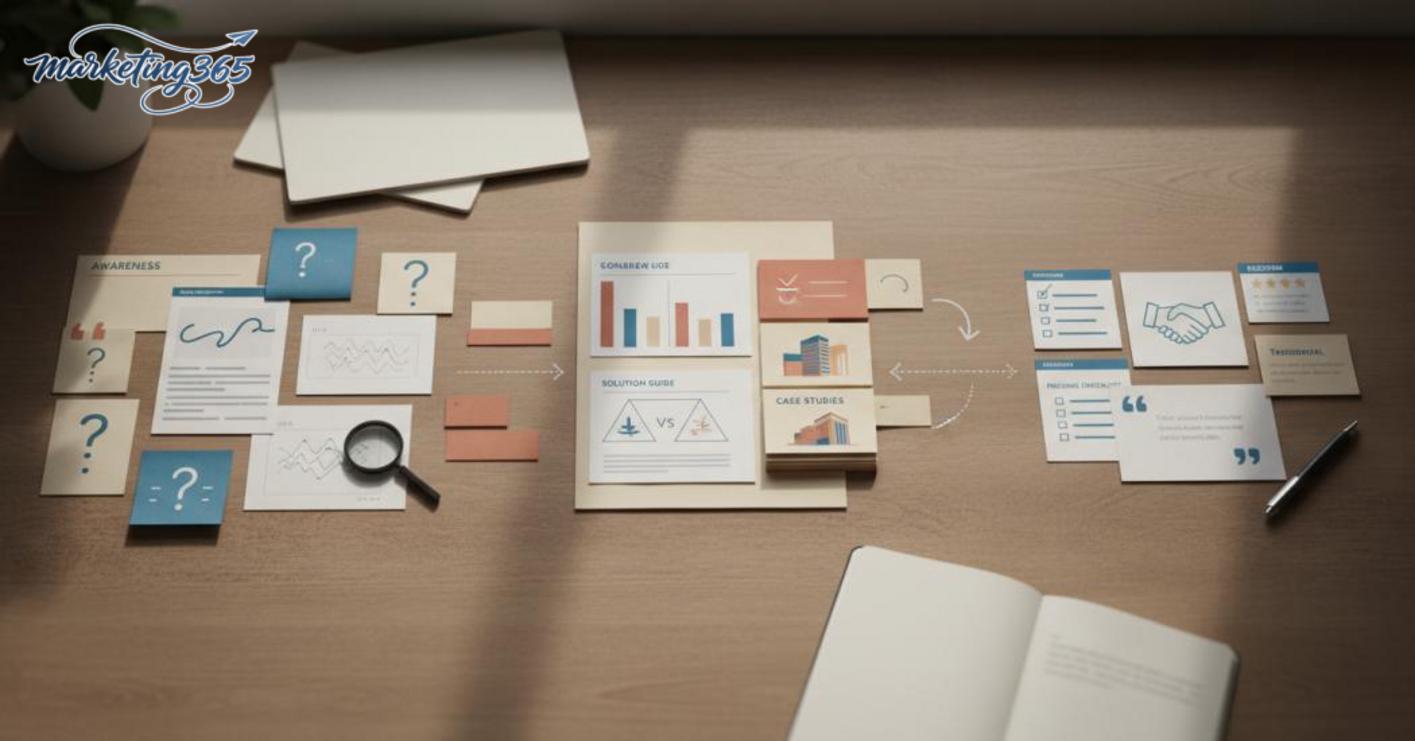
How should B2B content be written to match each stage of the buying journey? To make B2B content effective, you must start from the reader’s buying journey, not from the topic you want to write about. Good B2B content changes its approach across the awareness, consideration, and decision stages, because each stage needs a different goal: define the problem, compare solutions, or reinforce trust to close. If you write one article for all stages, content marketing in B2B often becomes diluted, full of information but lacking a clear action trigger. When done properly, content for business customers stays closer to business goals and is easier to measure through leads, meetings, or quote requests.
Identifying the real B2B reader: who reads, who decides, who influences?
In B2B content, “the business” is not a single reader but a group of roles with different goals. One article may be read by the business owner to make a decision, by the marketing manager to assess fit, by procurement to scrutinize purchasing terms, while the end user cares about day-to-day operations. For example, in the same B2B content about management software, the decision-maker needs benefits and risks, while the operations team needs usage processes and common errors. Once you identify the right customer profile, you will know whether to write from a strategic angle or an operational angle.
Segment content by the buying funnel to avoid going off track
B2B content along the buyer journey should be divided into three clear layers: problem awareness, solution comparison, and trust-building for the close. At the awareness stage, suitable formats include problem explanations, symptom checklists, and “why” articles; at the consideration stage, you need deeper B2B content such as solution comparisons, selection criteria, and B2B case studies; at the decision stage, use comparison tables, FAQs, demos, or B2B lead nurturing content to address final concerns. A common mistake is writing one generic article that leaves readers still unsure what to choose, what to do first, or who needs to be involved in the decision.
To make B2B content effective, define the brief before writing
To make B2B content effective, you need to define the brief before writing, because an article is only strong when it serves the right goal, the right reader, and the right action. If you start with an idea and then look for a goal, the piece can easily become diluted: lots of information, but no lead generation, no sales support, or not enough clarity to nurture B2B leads.
A B2B content marketing article should lock in 6 points first: the content goal, the primary reader, the pain point they are facing, the desired action after reading, the distribution channel, and the measurement metric. For example, an article meant to generate leads should prioritize the problem, solution, proof, and a clear CTA; while an article meant to build expert branding should emphasize depth, perspective, and practical examples. The same topic can produce very different content for business customers depending on the goal, in terms of length, tone, and how directly it closes the point.

Questions to lock in before launching a B2B piece of content
A good content checklist always starts with the right questions. Before assigning a brief or writing it yourself, answer briefly: who is the primary reader; what do they already know about the problem; where are they stuck; what does this article need to persuade them of; what should they do after reading; is the article for SEO, social, or sales support. If you cannot answer these 6 questions yet, the content brief is incomplete and the article is very likely to miss the goal.
A quick check is to write one very specific sentence describing the content goal. For example, “This article is to support sales when customers are comparing solutions” is completely different from “This article is to drive traffic from SEO.” That final sentence determines whether you need deep B2B content or short, scannable content.
When should you write to educate, and when should you write to convert?
B2B content for education is used when the reader does not yet fully understand the problem; content for conversion is used when they already have a need and are comparing options. These two types require different writing approaches, and if you mix them, the article becomes blurred: readers may learn a lot, but not enough to trust and act.
Educational articles should prioritize clear concepts, real examples, common mistakes, and how to recognize the problem. Conversion-focused articles should prioritize selection criteria, the risks of choosing wrong, proof such as B2B case studies, and a specific next step. If the goal is B2B lead nurturing content, emphasize explanations and customer insights; if the goal is business solution content, increase the comparison, reasoning, and CTA aligned with the B2B buying journey.
What formats does B2B content need to avoid boredom and still generate leads?
B2B content generates leads best when the right format is chosen for the right goal and the right funnel stage. An effective B2B content strategy usually does not rely on long-form blogs alone, but combines blogs, case studies, checklists, comparisons, landing pages, nurturing emails, and in-depth resources.
How are blogs, case studies, checklists, and in-depth resources different?
Blogs are suitable for explaining problems, driving traffic, and building SEO foundations. B2B case studies are used to prove capability through a problem – approach – result structure, so they fit the stage where readers are already comparing vendors. Content checklists lean toward quick action, such as an editorial audit checklist or a pre-campaign launch checklist. In-depth B2B resources such as whitepapers, ebooks, or long guides are suitable when readers need to go deeper, evaluate solutions, and leave their information.
| Format | Main goal | Persuasion level | Suitable stage |
|---|---|---|---|
| Blog | Build awareness, SEO | Medium | Awareness |
| Case study | Build trust | High | Consideration |
| Checklist | Drive action | Medium | Consideration, decision |
| In-depth resource | Nurture leads, educate the market | High | Deep consideration |

A common mistake is using a blog to do the job of a case study or an in-depth resource, which makes B2B content both too long and unable to close the information needed to persuade.
Which format should you choose if the goal is SEO, lead nurturing, or sales support?
SEO should prioritize explanatory articles, Q&A articles, and content clusters mapped to the B2B buying journey to capture the right search intent. Lead nurturing works better with email sequences, checklists, in-depth resources, and content broken down by problem. Sales support should use B2B case studies, comparisons, and FAQs because these formats quickly answer objections in the closing stage.
If the goal is to write content for businesses without making it boring, choose the format based on how customers read:
- Need to understand the problem: blog.
- Need to see proof: case study.
- Need to act now: checklist.
- Need to persuade internally: comparison, FAQ, in-depth resource.
- Need long-term relationship nurturing: nurturing email.
This approach helps B2B content marketing play the right role instead of cramming every message into one long article that does not generate leads.
The structure of a B2B article that is easy to read and persuasive enough
A B2B article that is easy to read and persuasive enough usually follows a flow of real problem, cause, solution, example, and mistakes to avoid. This framework helps the writer keep the pace, avoid going off track, and create B2B content marketing that is clear enough for the sales team or decision-maker to use later.
What should the introduction start with to keep readers engaged?
The introduction should immediately touch on a pain point happening in real work, because that is where readers recognize the content is useful to them. In B2B content, the two situations most likely to keep readers engaged are “writing a lot but not generating leads” and “content is published but no one on the sales team uses it again.”
For example, an article could begin with a situation where the marketing team produces content consistently, but sign-up forms still show few signals; or where the sales team has materials, but every customer meeting still starts from scratch. This kind of opening immediately creates context for the B2B content problem instead of giving a dry definition. If needed, use only one sentence to set the context, then move on to the concrete consequences such as wasted effort, hard-to-measure performance, or deep B2B content that still does not drive decisions.
What order should the body follow so readers do not get lost?
The body should follow this flow: define the goal, clarify the reader, choose the format, write the message, then check effectiveness. Each point should keep only one job, so the B2B content strategy does not cram too many concepts into the same paragraph.
A practical way to execute it is:
- Lock in the article goal: build awareness, nurture B2B leads, or support sales.
- Identify the reader and the buying stage.
- Choose the right format: guide, B2B case study, comparison, content checklist.
- Write the main message first, for example one argument for content for business customers.
- Review whether each paragraph serves the original goal.
An article is easier to follow if each paragraph answers only one question. This is how to write content for businesses in a way that is both clear and structured.
Read more: What Is a CTA? Effective Calls to Action
What should the ending close with so it does not feel abrupt?
The ending should close with a short summary, an action checklist, or an internal link that matches the reader’s next need. For B2B content marketing, the final paragraph only needs to restate the working framework and make the next step clear so readers know whether to apply it immediately or see related resources.

For example, you can close with 3 actions: review the opening problem, check the flow of the article, and cut any section that does not serve the goal. If the article has an internal link, place it where the reader needs to broaden their perspective, rather than turning the ending into a sales invitation. This kind of closing keeps B2B content neat, directional, and easy to reuse in the content process.
Common mistakes that make B2B content fail even after repeated writing
How should B2B content be written to deliver results often fails at the level of problem selection, wording, and goal setting. If the writing does not help readers recognize their exact situation, or does not point to the next step, the article can easily get views but no action.
Writing too broadly makes readers fail to see themselves in the article
B2B content that is too broad often talks a lot about “businesses,” “solutions,” and “improving efficiency” without touching the specific context of B2B customers. The easiest signs are vague wording, no industry, no reader role, and no situation example such as a sales team needing nurturing leads or a marketing department needing deep B2B content. The fix is to choose a narrower customer group, name one specific problem, and then write from the situation they are facing so B2B content marketing has a clear anchor.
- If the introduction only states general benefits, change it to a problem that can be measured in daily work.
- If there is no example, add a situation of “what the reader is doing, where they are stuck, and what decision they need to make.”
Stuffing in jargon but lacking examples makes content “pretty but hard to use”
B2B content with many technical terms is not necessarily stronger than clear content. When an article uses too many concepts without process examples, checklists, or recognition cues, readers may understand the general idea but not know how to apply it. In writing content for businesses, prioritize an “if… then…” structure to turn an abstract idea into a concrete action. For example, instead of only saying optimize content by the B2B buying journey, show what to write at each stage, who reads it, and what signal they need to see before moving on.

- There are terms but no explanation through a specific case: add an example.
- There is an idea but no checklist: add a verification step.
An article trying to do too many things at once often fails to convert
An article on how to write B2B content can also fail if it tries to define, sell a service, and ask readers to contact you all in the same flow. This mistake dilutes the message and leaves lead generation content without one main action to follow. The fix is to separate goals by article or by content cluster: one article to educate, one to compare solutions, one to drive action. If the current article is trying to do too much, lock in one single goal and remove the sections that do not serve it.
- If the opening explains, the middle sells, and the ending closes: the structure needs to be split again.
- Each article should have only one main action so readers are not distracted.
How should B2B content be measured to know whether it is on the right track?
The right way to measure B2B content is to compare each group of metrics with each goal, then look at the content cluster instead of relying on a single number. One article may have little traffic but still generate form fills; conversely, an article with many views may not support sales.

Which metrics fit SEO content, lead nurturing content, and sales support content?
Each type of B2B content needs a different KPI set. SEO should prioritize organic traffic, time on page, bounce rate, and internal clicks. B2B lead nurturing content should look at return visits, clicks to related article sequences, form fills, and MQLs. Sales support content should track deeper-funnel behavior such as viewing B2B case studies, downloading resources, requesting demos, or being passed to sales.
| Goal | Metrics to watch | Quick read |
|---|---|---|
| SEO | organic traffic, engagement | Is it attracting the right audience |
| Lead nurturing | return visit, internal click, form fill | Is it guiding readers forward |
| Sales support | MQL, resource download, handoff to sales | Is it creating clear buying signals |
If an article increases traffic but has no internal clicks, the B2B content strategy is leaning toward “read and done.” If traffic is low but form fills are high, the article still has value.
When should you revise content instead of writing something new?
Revise content when the topic is right, but the B2B content is still unclear, lacks direction, or lacks an internal CTA. For example, if an article already has traffic but readers leave quickly, it usually needs more explanation, concrete examples, and links to related articles.
Write something new when the goal is completely different, the reader segment is completely different, or the old article no longer matches the search structure. A simple rule is: if the B2B content is still on the right track but not converting, revise it; if it was off track from the start, write a new piece. When reviewing content, look at the topic cluster, because a single article rarely reflects the full effectiveness of B2B content optimization.
Frequently asked questions about how to write B2B content
This FAQ section gives short answers, grounded in real situations, with criteria you can use right away for how to write B2B content. Prioritize comparisons, observable signals, and how to choose the right direction based on the current goal of the B2B content.
How is B2B content different from B2C content?
B2B content differs from B2C content in its goals, buying cycle, number of decision-makers, and the level of proof required. B2B content marketing often has to explain logic, risks, and operational impact; B2C content marketing is usually shorter, more emotional, and pushes faster decisions.
For example, an article for business customers needs to state the process, criteria, and expected results. An article for individual consumers can focus on immediate benefits and the user experience. If your content has to persuade multiple people at once, that is a sign of B2B.
Should B2B start with blogs or case studies?
If the goal is to expand awareness and attract research queries, start with blogs. If you already have a real story, real numbers, and need to increase credibility for a B2B case study, prioritize the case study first. The most effective B2B content is content that matches the current stage, not the one chosen out of habit.
A new team often needs blogs to cover the problem space, then case studies to close trust. If you do not yet have enough solid real-world data, a case study will be hard to persuade with.

How do you know whether B2B content matches customer insight?
B2B content matches customer insight when readers pause on the part that speaks to their pain point, return to read more, and click through to related content. This is a sign that B2B lead nurturing content is touching the real issue, not just the keyword.
You can check it with 3 signals: feedback from sales or CS, deep-read rates on the problem-description sections, and the questions readers leave after viewing. If they ask about cost, process, or implementation risks instead of asking for basic definitions again, the content is closer to insight. If they skim and leave quickly, revise the angle, examples, and language used in the article.