
Contents
- What is CPM on Facebook and how do you read this metric?
- Factors that make Facebook ad CPM rise or fall
- Step-by-step ways to optimize Facebook ad CPM
- Comparing CPM with CPC and CPA to choose the right optimization approach
- Common mistakes when trying to lower CPM and how to avoid them
- Checklist before and after optimizing CPM
- Frequently asked questions about cách tối ưu cpm quảng cáo facebook
When Facebook CPM rises or falls unusually, the issue is often how the numbers are being read, not just the cost of impressions. For beginners in marketing, cách tối ưu cpm quảng cáo facebook needs to be viewed by campaign: is the target too narrow, is the content getting stale, is the placement off, is frequency too high, is the budget being pushed at the wrong pace, and is the campaign objective driving CPM up? This section focuses on how to check and handle things in practice so you optimize the right area, avoid optimizing for the wrong goal, or skewing the account when running ads.
What is CPM on Facebook and how do you read this metric?
CPM on Facebook is the cost to get 1,000 ad impressions. When reading this metric, it should be considered alongside clicks, conversions, and revenue to avoid a distorted view; a low CPM is not necessarily good if traffic quality is poor, while a high CPM is not necessarily bad if you are reaching the right valuable audience.

What does CPM measure in Facebook advertising?
Facebook CPM reflects the impression price the system has to pay to show your ad 1,000 times. This metric shows the level of competition to win impressions and delivery efficiency, but it does not directly say whether the ad generates sales.
When reading ad metrics, look at CPM together with CPC and CPA. If CPM rises but clicks and conversions remain stable, the campaign may not have a problem. Conversely, a low CPM with no sales often indicates cheap impressions, but the audience or message is not right.
When is a low CPM not necessarily a good thing?
A low CPM only matters when traffic quality and conversion rate move in the same direction. Many campaigns lower Facebook Ads CPM by broadening the audience too much, but those impressions do not buy, do not sign up, or do not stay engaged.
A quick check is to compare CPM across ad sets with the same objective, the same placements, and the same funnel stage. Do not compare two different industries carelessly, because impression prices and competition levels can vary widely. If one ad set has a cheap CPM but low CTR, high CPA, and insufficient frequency, prioritize fixing the target and ad content before concluding the campaign is effective.
Factors that make Facebook ad CPM rise or fall
Facebook ad CPM rises or falls mainly due to auction competition, audience quality, content, campaign objective, placements, and how well the ad matches the viewer. When CPM suddenly increases, read the signs: high frequency, low CTR, skewed delivery in one placement, or an audience that is too narrow or too broad. Cách tối ưu cpm quảng cáo facebook is effective when you diagnose the real cause first, then adjust target, creative, or placement.
How does audience targeting affect CPM?
Targeting determines the level of competition within the group your ad is bidding for. An audience that is too narrow often pushes CPM up because the system has fewer people to deliver to; an audience that is too broad can also lead to poor CPM when the ad reaches many irrelevant people, CTR drops, and delivery quality declines.
Signs of poor targeting are usually clear: CPM jumps after narrowing the audience, frequency rises quickly but conversions do not come in, or the ad is delivered heavily but gets few clicks. If your audiences overlap across multiple ad sets, you are also competing against yourself.
Practical fixes:
- Expand the audience when it is too small, especially if CPM is high and frequency has already exceeded your acceptable level.
- Narrow it when reach is large but CTR is low, with many views but little engagement.
- Check overlap between target groups to avoid internal bidding.
- Do not optimize targeting to reduce Facebook CPM at all costs if it distorts business goals.
How do ad content and placements affect performance?
Content and placements directly affect CTR, which in turn pushes CPM up or down. Overly “salesy” creative, cluttered images/videos, or messaging that does not match the audience often makes viewers scroll past quickly, driving up impression costs.

One easy-to-spot sign is creative fatigue: the same ad runs for a long time, frequency rises, but clicks gradually decline. At that point, optimizing ad content to reduce CPM is not about changing a few words, but about changing the angle, layout, and CTA to fit the context.
With placements, not every position performs the same. Some campaigns see low CPM in certain feed placements, but higher CPM in placements that are fast-moving, quickly ignored, or less naturally displayed. If one placement is clearly driving CPM up, break down the report by placement before deciding to turn everything off.
Quick checklist:
- Check CTR by creative.
- Compare CPM by placement.
- Run Facebook ad A/B testing to optimize CPM when changing the content angle or format.
- Remove placements with skewed delivery that do not produce proportional results.
Read more: How to Measure Email Campaign Effectiveness Properly
Step-by-step ways to optimize Facebook ad CPM
Cách tối ưu cpm quảng cáo facebook step by step means working in order: define the campaign objective, check the audience, change the creative, then review placements, frequency, and budget. Doing it sequentially helps you see which variable is driving CPM up, instead of changing too many things at once and losing sight of the real cause.
Step 1: define the right campaign objective and delivery structure
CPM often goes off from the very first step of choosing the campaign objective. If the campaign is optimizing for awareness but the actual output needs conversions, the system will learn from different signals and deliver ads in a way that is harder to compare. For the same product, a traffic campaign and a conversion campaign can produce very different CPMs even with the same creative.
Check in this order:
- Does the current objective match the output you need to measure?
- Is the ad set split too small, causing slow learning?
- Has the delivery structure changed too much across ad sets?
If you want to reduce Facebook Ads CPM, do not rush to adjust bids or budget. First bring the campaign back to the right objective, then keep the structure stable for at least a few days to see how CPM responds.
Step 2: adjust targeting based on real signals, not intuition
An audience that is too narrow or misaligned with the signal often leads to high CPM because the system struggles to find enough suitable impressions. The way to optimize targeting to reduce Facebook CPM is to look at the data for each group, not guess based on an imagined customer profile.
Choose 3 groups to compare:
- High-CPM, low-CTR group: usually the target is not aligned or the message is not right.
- Too-narrow group: impression costs can easily rise because the audience is too small.
- Group with good engagement but still high cost: you may need broader audience testing or a separate segment with stronger signals.
If one ad set has a clearly higher CPM while the other metrics are also weak, widen the audience or split the group by actual behavior. Do not cut targeting based on gut feeling just because it looks “right” on paper.

Step 3: change the creative before touching a large budget
Creative is often the fastest lever for optimizing ad content to reduce CPM. An ad with a blurred message, unclear visuals, or a weak CTA will make viewers scroll past quickly, lower impression performance, and worsen CPM.
When reviewing creative, check in order:
- Does the message communicate the main benefit clearly?
- Is the image or video clear enough within the first 1-2 seconds?
- Does the CTA match the final action?
If the ad has been running for a long time and CTR drops, comments repeat, or the same creative gets stale quickly, that is a sign of ad fatigue. At that point, Facebook ad A/B testing to optimize CPM should focus on changing one element at a time: only the headline, or only the image, or only the CTA. That is the only way to know which variable is actually bringing CPM down.
Step 4: review placements, frequency, and budget
Placements, frequency, and budget determine how quickly the audience is “consumed.” When a placement performs poorly, it can raise CPM without adding value. Likewise, high frequency means the same group of people sees the ad too many times, making impression costs more expensive.
Handling checklist:
- Remove placements with high CPM but low efficiency.
- Track frequency to detect saturation early.
- Increase budget gradually, avoiding a sudden large jump.
This is also the right step to optimize the budget for a Facebook CPM campaign. If you want to compare before and after, keep two similar ad sets, change only one variable, then compare CPM, CTR, and frequency over the same period. This helps you clearly see which approach runs Facebook CPM more cheaply, instead of increasing budget and guessing.
Read more: What Is ROI in Marketing? How to Understand It Properly
Comparing CPM with CPC and CPA to choose the right optimization approach
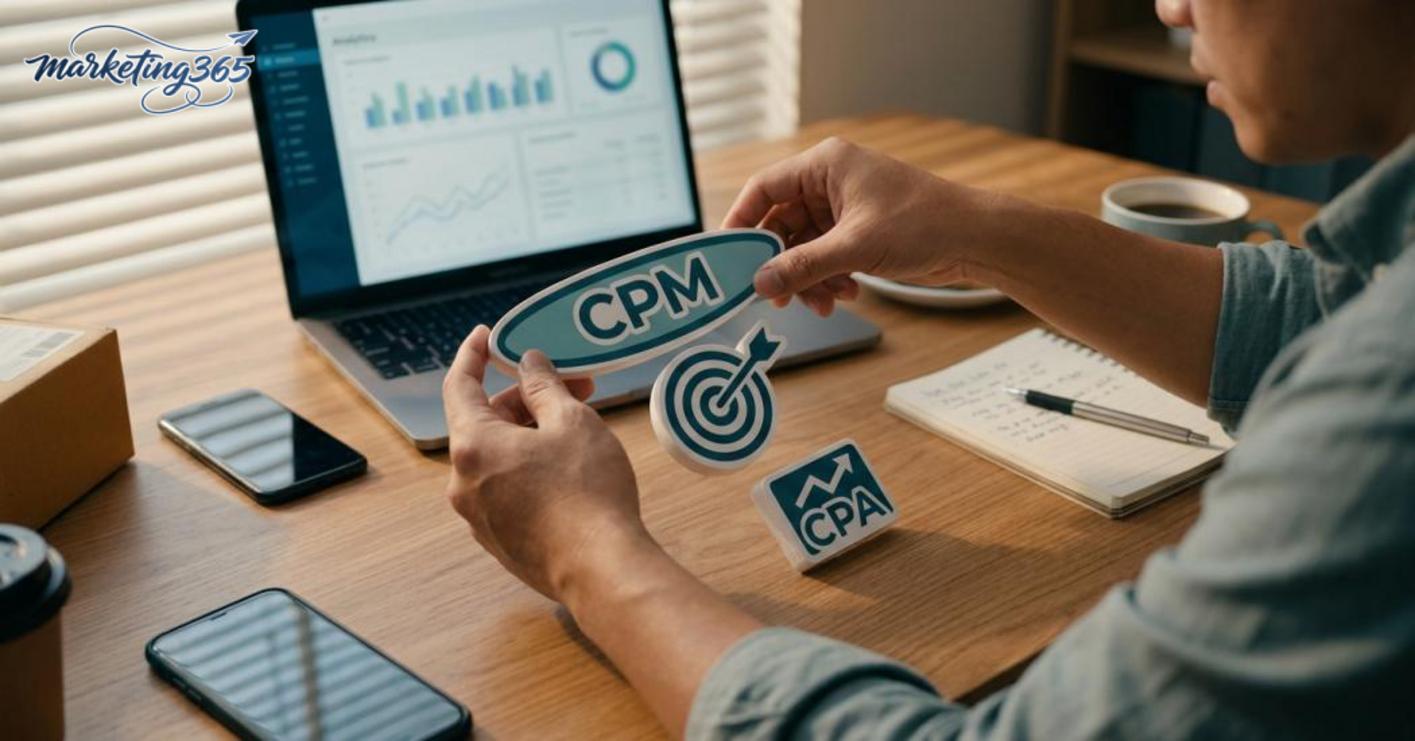
Comparing CPM with CPC and CPA is how you choose the right objective instead of looking at one cheap metric and concluding the campaign is effective. CPM is suitable when you need reach and want to check impression performance; CPC is suitable when you need clicks; CPA is suitable when you need to measure conversion cost and read it together with landing page or event data.
When is CPM appropriate, and when is CPC appropriate?
CPM should be prioritized when the goal is brand awareness, broad reach, or testing ad content to reduce CPM before scaling budget. CPC is more suitable when you need clear traffic, for example bringing readers to an article, form, or product page. If the campaign is new, comparing CPM and CPC against the campaign objective will give a more accurate answer than simply looking at a low CPM.
Quick selection checklist:
- Choose CPM when you need reach, frequency, and Facebook ad placement optimization.
- Choose CPC when you want to test whether the message can drive clicks.
- Do not use CPC to evaluate a purely broad-reach brand campaign.
Where does CPA fit in the conversion funnel?
CPA is suitable once you have enough conversion data to evaluate campaign performance, because it reflects the cost of a specific action such as sign-up, purchase, or form submission. When CPM is already stable but conversions are still weak, you need to look again at the landing page, event, or target audience instead of only reducing Facebook Ads CPM. Comparing CPM and CPA makes it clear: cheap impressions do not necessarily create cheap conversions.
Shift focus to CPA when:
- The landing page already has enough traffic to read signals.
- The pixel or event is working stably.
- You need to optimize for conversion cost, not just views or clicks.
To get the cách tối ưu cpm quảng cáo facebook right, place CPM inside the funnel: CPM for reach, CPC for traffic, CPA for performance.
Common mistakes when trying to lower CPM and how to avoid them
The right way to reduce CPM is to keep impression costs down without hurting traffic quality. With cách tối ưu cpm quảng cáo facebook, the biggest mistake is seeing a low CPM and quickly concluding the campaign is good, while CTR, CVR, and audience quality are actually getting worse.
The checklist below helps avoid decisions that make ads look cheaper on the surface but less effective overall.

Do not lower CPM by making the audience too broad or too narrow
An audience that is too broad often makes CPM fluctuate because the targeting is diluted, while an audience that is too narrow makes delivery constrained, frequency rise, and costs easily increase. A very clear sign is that CPM drops slightly but CTR falls, or the audience is so small that the ad keeps repeating to the same viewers.
The safe way to handle this is to widen or tighten targeting in small steps, then keep it unchanged for 2–3 days to read the data. For example, expand only age, location, or interests once, not the entire audience at the same time. When you need to reduce Facebook Ads CPM, do not sacrifice quality just to see a prettier number in the CPM column.
- Too broad: many impressions but little engagement.
- Too narrow: high frequency, CPM can rise easily due to limited delivery space.
- How to fix it: adjust one small variable at a time, and monitor CTR and CVR before concluding.
Do not change multiple variables at once when testing
When you change creative, targeting, and placement in the same test, you will not know where the cause of high Facebook ad CPM lies. This is a very common Facebook ad optimization mistake, especially when trying to do Facebook ad A/B testing to optimize CPM but over-editing the setup.
The safe rule is to change only one factor at a time: either creative, or audience, or placement. Keep the time frame long enough to gather data, then compare. If you change the ad format and placement at the same time, the conclusion will be skewed and can easily damage a running campaign.
Read more: How to Measure User Engagement on a Fanpage Properly
- Test only 1 variable at a time to read the impact correctly.
- Do not make decisions when the data is still too limited.
- If you want to check an ad, lock the other factors so the result is clearer.
Checklist before and after optimizing CPM
This checklist helps you verify cách tối ưu cpm quảng cáo facebook by measuring before and after under the same conditions. Only compare when the time frame, target group, and placements are kept as consistent as possible; if too many variables change, a lower CPM is not necessarily better.
Which metrics should be reviewed alongside CPM?
CPM only matters when viewed together with CTR, CPC, frequency, and conversions. CTR shows whether the ad creative is compelling enough to earn initial engagement; CPC shows whether each click is getting cheaper after optimization; high frequency often signals audience saturation; conversions confirm whether a low CPM is tied to business results. A campaign with lower CPM but falling CTR and rising frequency is usually a sign to revisit targeting or creative, rather than continuing to force the budget.

A 5-minute checklist to review an active campaign
- Keep the same time frame: compare the same 3-day or 7-day window, not today versus last week if the budgets differ a lot.
- Keep the same audience and placements: if you just changed targeting or placement, note it separately to avoid misreading the cause.
- Read in order: CPM -> CTR -> CPC -> frequency -> conversions; the metric that deviates most will point to the bottleneck.
- Check the creative: if CTR drops, try changing the image, headline, or call to action before adjusting budget.
- Check frequency: if frequency rises quickly while CPM is still high, revisit whether the audience is too narrow or the ad content is no longer fresh enough.
The right way to check Facebook CPM is to change one variable at a time and measure again. That way, you know which part is truly lowering Facebook Ads CPM and which part only makes the numbers look better temporarily.
Frequently asked questions about cách tối ưu cpm quảng cáo facebook
An optimized CPM is one that is viewed in the right context: lower than the campaign’s own average, while still keeping CTR and conversions stable. If you only look at CPM, it is very easy to choose the wrong cheap ad that does not produce results.

- Compare CPM by ad set over 3–7 days, not against a single industry-wide number.
- Keep the ad set with lower CPM if CTR does not drop sharply, for example if CTR still stays around 1% or higher for a small cold audience.
- Remove ad sets early if CPM rises together with continuously falling CTR after enough data has been collected, because that is often a sign of creative fatigue or an audience that is too narrow.
Unusually high CPM often appears after you change targeting, narrow placements, or let the content wear out. For example, if an ad set runs for 6 days and CPM rises 25% compared with the first 3 days, while CTR drops from 1,4% to 0,8%, it should be addressed immediately.
Cách tối ưu cpm quảng cáo facebook should be done in this order: 1) broaden or refresh the audience, 2) change 1–2 creative variations, 3) split placements, 4) check the campaign objective in Ads Manager. For beginners, change only one variable at a time to identify the real cause.
CPM differs from CPC in that CPM is the cost for 1,000 impressions, while CPC is the cost per click. A campaign with low CPM but high CPC is often due to weak click-driving content or an unclear call to action.
When should you change targeting? Change targeting when CPM rises and frequency exceeds roughly 2,5–3, CTR drops, and the same ad performs better with a different audience. When only one ad is underperforming, fix the content first, then expand the target. A/B testing in Facebook Ads will help you know whether to optimize CPM through targeting or creative.
For official and up-to-date guidance, you can also refer to materials from Meta for Business.
Related articles
- How to Increase Engagement Rate on a Fanpage Effectively
- What is KPI? A metric for measuring marketing performance
- What is conversion rate? Conversion rate
You can find more hands-on marketing guides at https://marketing365.vn.
Content from marketing365 is created for SMEs, online shop owners, and new marketers.
You can also read more articles on the same topic in the Analytics category.