
Contents
An AI agent for customer messages helps SMEs respond 24/7, instantly, and consistently on Facebook, Zalo, and websites by combining large language models with a knowledge base and retrieval tools. To use it effectively and safely, you need accurate data, clear human handoff points, and compliance with platform policies.
Key points
- Main benefits: runs continuously 24/7, responds instantly, answers consistently, and frees staff from repetitive questions.
- The three most common channels for Vietnamese SMEs: Facebook Messenger, Zalo OA, and website live chat – all should share the same knowledge base.
- An agent consists of three parts: an LLM, a knowledge base (pricing, products, policies), and tools (inventory lookup, order checks, ticket creation).
- Hand off to a human when customers complain, ask out-of-scope questions, handle high-value transactions, or explicitly request it.
- Comply with Messenger’s 24-hour window, Zalo OA rules, Decree 13/2023/NĐ-CP on personal data, and transparency about AI.
An AI agent for customer messages is becoming a familiar tool for many shop owners and small businesses (SMEs) in Vietnam, as message volume on Facebook, Zalo, and websites grows faster than human response capacity. Unlike the rigid reply scripts of the past, an AI agent can understand natural questions, look up product information, and draft context-appropriate responses. This article explains the practical benefits, applicable channels, basic setup, when to hand off to a human, and the key platform policy considerations SMEs should know before deploying one.
The biggest benefit: 24/7 replies and instant responses
For online stores, response speed directly affects conversion rates. If a customer asks about pricing at midnight and only gets a reply the next morning, the order may easily go to a competitor. An AI agent fills that gap with clear benefits:

- Runs continuously 24/7: replies outside business hours, on holidays, and during peak times without adding staff.
- Instant responses: handles dozens of conversations at once, reducing customer wait times.
- Consistent answers: the same return policy, pricing, and shipping information is communicated the same way in every conversation.
- Frees up staff: employees can focus on difficult cases and high-value orders instead of answering repetitive questions.
To understand the technology behind it, you can also read What is an AI agent? and compare it with traditional chatbots in How is an AI agent different from a chatbot?.
Common channels: Facebook, Zalo, and websites
Vietnamese SMEs usually receive messages from three main channels, each with its own characteristics:
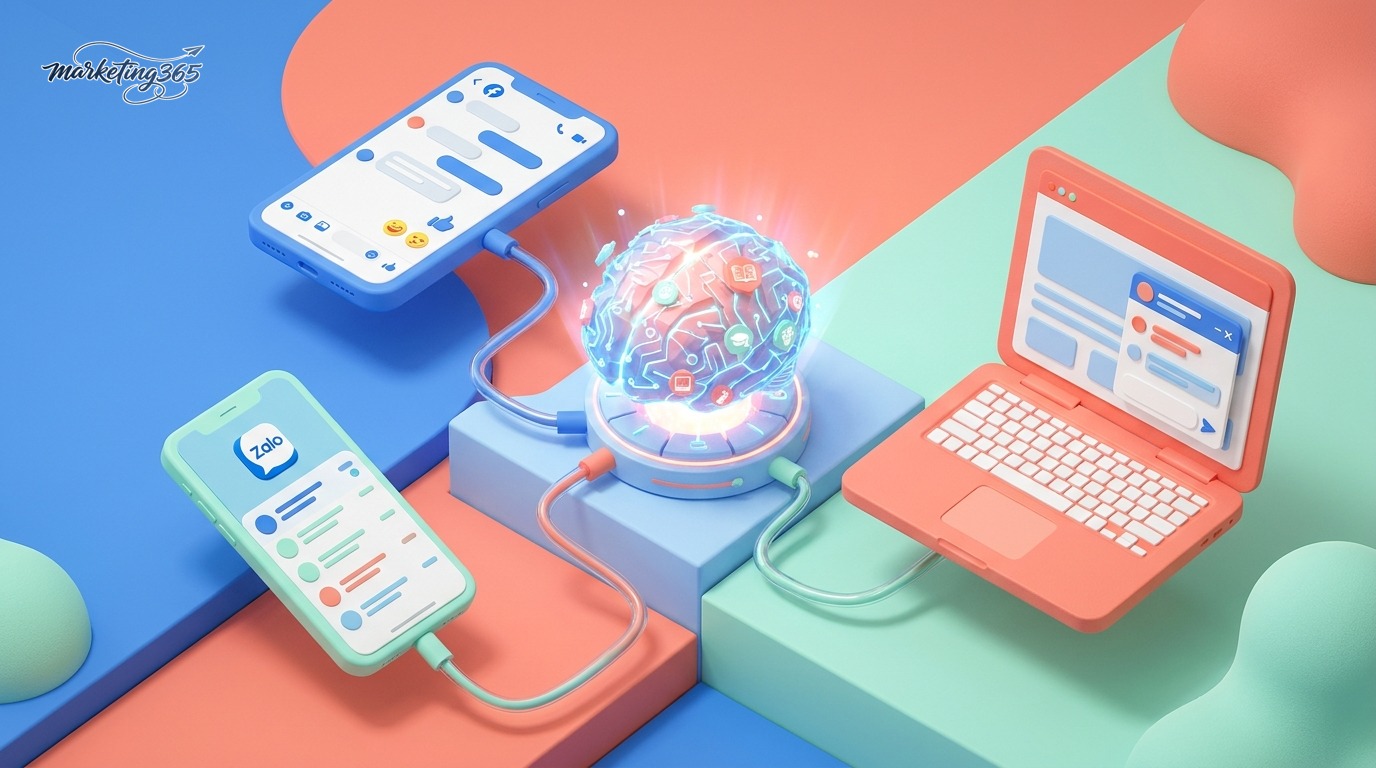
- Facebook Messenger: connected through Fanpages and the Messenger Platform. This is a high-engagement channel for retail, fashion, and cosmetics.
- Zalo Official Account (OA): a messaging channel trusted by Vietnamese users, suitable for customer care and order notifications.
- Live chat on websites: convenient for customers browsing products and asking questions directly on the page without leaving it.
A good AI agent should use the same “brain” of knowledge while delivering consistent answers across all three channels. The official documentation for Messenger Platform and Zalo Developers describes how to integrate apps that receive and send automated messages for each platform.
How to build an AI agent for messaging
In essence, an AI agent for customer messages is built from three components:

- Large language model (LLM): the part that understands the question and drafts the response. Popular models today include those from Anthropic (Claude) and OpenAI (ChatGPT/GPT), accessed via API.
- Knowledge base: where pricing tables, product descriptions, return policies, shipping fees, and FAQs are stored. The AI relies on this to answer with the shop’s actual information instead of “making things up.”
- Tool: actions the AI can call, such as checking inventory, verifying order status, creating a support ticket, or transferring the conversation to a staff member.
For SMEs, there are usually two practical approaches. The simpler one is to use an off-the-shelf chatbot platform with AI integration, where you only need to upload documents and connect your Fanpage/Zalo. The more flexible approach is to build workflows yourself using automation tools that connect the LLM to the knowledge base. If you want to go deeper into the architecture, refer to how to build an AI agent and the foundational article on what is a chatbot.
Whichever approach you choose, the most important principle is this: provide the AI with accurate, regularly updated data, and write clear system prompts about brand voice as well as what it is and is not allowed to say.
When to hand off to a human
An AI agent does not fully replace people, and it should not try to. A good workflow needs a clear “handoff” point. Set up the AI to proactively transfer conversations to staff in the following situations:

- The customer complains, is upset, or uses clearly negative language.
- The question is outside the knowledge base, or the AI is not confident enough in its answer.
- High-value transactions, custom orders, or special price negotiations.
- Requests involving refunds, sensitive personal information, or legal issues.
- The customer explicitly asks to speak with a human.
Clearly informing customers that they are chatting with a virtual assistant, along with an option to speak with a staff member, helps build trust and reduce the risk of misunderstandings.
Platform policy considerations
Message automation must comply with each platform’s rules, otherwise your Fanpage or OA may be restricted:

- Messenger’s 24-hour window: Facebook limits messages sent outside 24 hours from the customer’s last interaction, except for certain allowed message types. Read the policy section in the Messenger Platform documentation carefully before sending proactive messages.
- Zalo OA rules: the number and type of outgoing messages may be limited depending on the package; user consent must be obtained properly.
- Customer data protection: comply with Decree 13/2023/NĐ-CP on personal data protection when collecting and storing information in the knowledge base or chat history.
- Transparency about AI: do not impersonate a virtual assistant as a real person; make it clear when content is AI-generated.
See more guides on applying AI in business in Marketing365’s AI Guide section.
Frequently asked questions
Can an AI agent answer incorrectly and lose customers? Yes, if it lacks accurate data or there is no human handoff mechanism. Limit the scope of answers, review regularly, and always provide an escape route to staff.

Is the implementation cost high? For SMEs, the main costs are LLM API usage fees (based on message volume) and the integration platform. Starting small with repetitive questions and expanding gradually is the most cost-effective approach.
Do I need to know how to code? Not necessarily. Many platforms allow configuration through drag-and-drop interfaces; however, understanding the basics of LLMs, knowledge bases, and tools will help you operate more effectively.
Can AI fully replace customer service staff? No. AI handles most simple questions, while staff focus on complex situations and relationship building.
In short, an AI agent for customer messages, when built correctly, can help SMEs respond faster, serve customers 24/7, and reduce team workload, as long as you prepare a solid knowledge base, set clear human handoff points, and comply with platform policies.