
Contents
AI marketing automation is becoming a survival choice for small and medium-sized enterprises (SMEs) that want to do more with fewer resources. Instead of hiring more people for every repetitive task, marketers can now hand over the most time-consuming work – drafting content, sending emails, segmenting customers, and building reports – to artificial intelligence tools and automated workflows. This article helps you understand the concept, know which tasks can be automated, which tools to use, and where to start without feeling “overwhelmed”.
What is AI marketing automation?
Simply put, it is the combination of two layers of technology: workflow automation and generative artificial intelligence (generative AI). Automation handles the “when event A happens, do action B” part – for example, when a customer fills out a form, send a welcome email. AI handles the “make decisions and create content” part – for example, automatically write that email based on customer information.
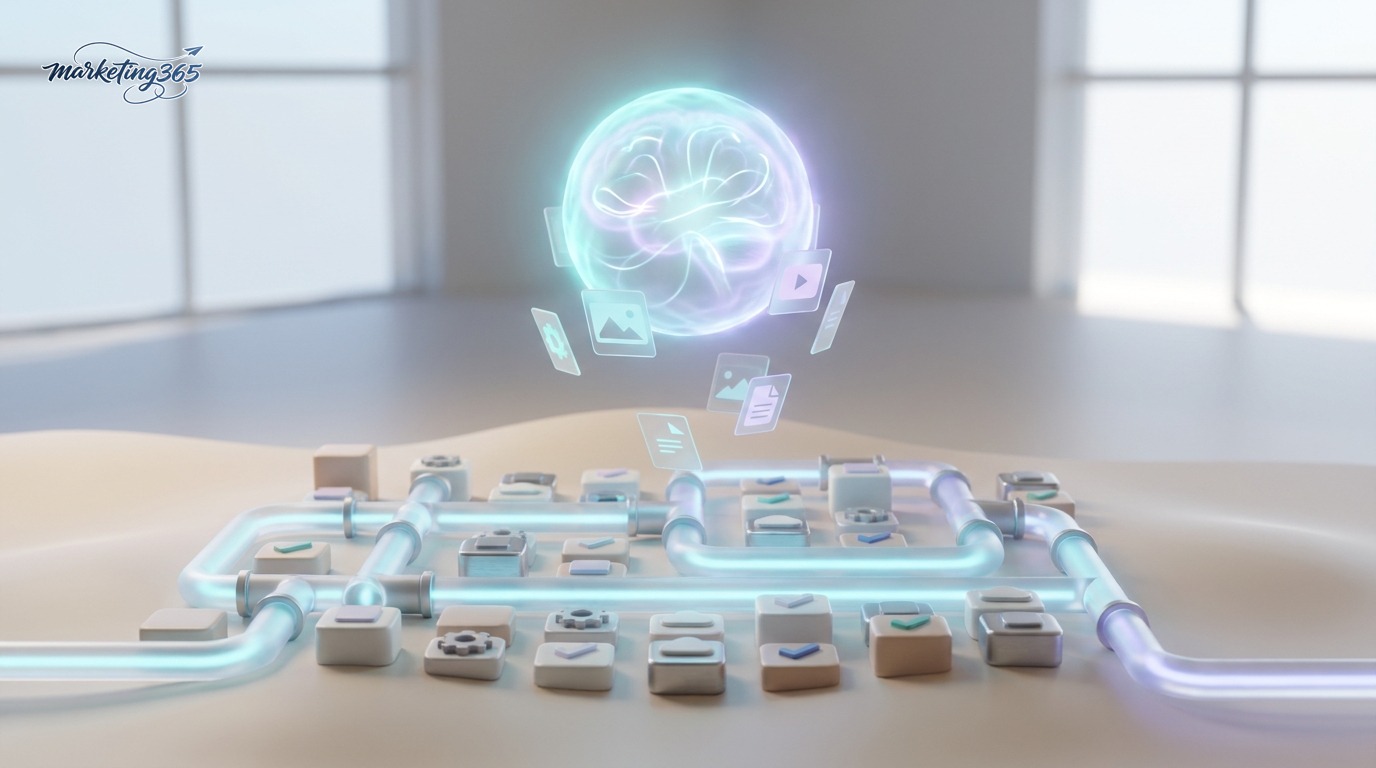
The biggest difference from traditional automation is the ability to process natural language and unstructured data. A large language model (LLM) can read a customer response, understand the sentiment, and then write a suitable reply – something rigid “if-then” rules could not do before. To better understand the “brain” behind these workflows, you can read What is an AI Agent?.
Which marketing tasks can be automated with AI?
Not everything should be handed over to machines, but there are tasks that deliver clear results as soon as they are automated. Below are the most common groups for SMEs:

- Content production: drafting blog posts, product descriptions, social media captions, and turning one long article into multiple short formats. AI creates the draft, while humans review and refine it.
- Email marketing: personalizing subject lines, segmenting lists, drafting nurture email sequences, and sending them automatically based on recipients’ open/click behavior.
- Advertising (ads): generating multiple headline and description variations for A/B testing, suggesting audiences, and summarizing campaign performance reports to decide whether to increase or cut budget.
- Customer support (CSKH): chatbots answer frequently asked questions, classify and route requests, and draft replies for staff to confirm before sending.
- Reporting and analytics: collecting data from multiple sources (website, fan page, e-commerce marketplace), automatically compiling weekly reports with plain-language commentary for managers.
The common thread across these tasks is that they are high-volume, repetitive, and rule-based – exactly the “taste” of automation.
Tools for AI marketing automation
The tool stack usually consists of three layers working together:

| Layer | Role | Example |
|---|---|---|
| AI model (LLM) | Create content, understand and classify text, make decisions | Claude by Anthropic, GPT by OpenAI |
| Workflow platform | Connect applications, trigger actions based on events | n8n, Make, Zapier |
| AI Agent | An agent that independently plans and executes a chain of tasks on behalf of humans | Agent built on n8n + LLM |
Among them, n8n is favored by many SMEs because it can be self-hosted, is low-cost, and connects to hundreds of applications. You can see a specific implementation in n8n automation for marketing and AI marketing workflow with n8n. The platform’s official documentation is at docs.n8n.io. When you want to upgrade from a simple flow to a smarter agent, refer to AI Agent for marketing automation and the guide on how to build an AI Agent.
A starting roadmap for SMEs
A common mistake is trying to automate everything at once. A safe roadmap should go step by step:

Read more: Using AI Agents for Email Marketing: A Practical SME Guide
- Step 1 – Choose the most painful task: list the most time-consuming tasks from the past week. Start with one clear, repetitive task, such as “drafting fan page captions every day”.
- Step 2 – Build a small workflow: use n8n to connect the data source → call an LLM to generate content → push it to where it needs to go (email, fan page, Google Sheet). Keep the workflow simple and focused on one goal.
- Step 3 – Keep humans in the review loop: in the early stage, let AI create drafts and have people review them before publishing. This helps catch errors and build trust.
- Step 4 – Measure: compare time saved and quality before and after. Only with data can you know whether to scale or stop.
- Step 5 – Scale: once one workflow runs stably, copy the model to the next task.
The “start small, make it work, then expand” approach fits SMEs’ limited resources better than a large project that is easy to fail. According to reports from Gartner, businesses achieve better results when they embed AI into existing processes rather than replacing everything.
Mistakes to avoid
Automating the wrong thing can do more harm than doing it manually. Some common mistakes:

- Skipping the review step: letting AI publish directly without human review can easily lead to inaccurate content or off-brand tone.
- Automating a messy process: if the manual process is already chaotic, automation will only make it chaotic faster. Standardize first.
- Depending on a single vendor: locking yourself into one tool makes it hard to adapt when prices rise or services change. Prioritize flexible platforms that are easy to switch models on.
- Forgetting data and privacy: do not send sensitive customer data into tools with unclear security policies.
- Measuring the wrong metrics: automating just to “look modern” without tying it to business goals (revenue, leads, time saved) makes it hard to sustain long term. HubSpot resources include many useful measurement frameworks for marketers.
Frequently asked questions
Can SMEs with a small budget do this? Yes. Many tools like n8n allow free self-hosting, while LLMs charge based on usage. You can start with very low cost for a single workflow.

Do you need to know programming? Not necessarily. Drag-and-drop platforms like n8n help non-technical users build basic workflows. However, understanding process logic is still very important.
Will AI replace marketers? Not in the near future. AI is good at repetitive work and drafting, but strategy, creativity, and brand judgment still require humans. The marketer’s role shifts from “the doer” to “the coordinator and reviewer”.
Where should I start learning? You can visit the AI Guide section for more hands-on articles by topic.
In short, AI marketing automation is not a complex technology race, but a smarter way of working: choose the right tasks, build small workflows, keep humans in control, and expand gradually. For SMEs, this is a practical lever to compete with larger rivals in terms of resources.