
Contents
- The threshold from conversing to working is being crossed
- The advantage is shifting from intelligence to speed and infrastructure
- The new ecosystem is expanding faster than the models themselves
- Commercial power will lie where AI touches transactions and content
- AI Act and Vietnam: what to watch from an operations angle
- Move repetitive tasks to agents with KPIs attached
- References
AI is gradually leaving behind its role as a “chat assistant” and moving into the role of an “executor” on the computer, in payment workflows, translation, and even deep knowledge tasks. For Vietnamese marketers, this is no longer a story about testing a new tool, but a sign that productivity, implementation costs, and competitive advantage will shift to teams that know how to integrate AI into real operations.
Key points
- AI’s value is shifting from answering to acting: computer operations, payments, translation, automation.
- The competitive edge is no longer about “which model is smarter” but about speed, infrastructure, and the ability to integrate into workflows.
- The expansion of open-weight, agent skills hubs, and instructional materials is pulling AI out of the lab.
- Vietnamese businesses need to prepare for a market where AI directly affects content, commerce, and internal processes.
The threshold from conversing to working is being crossed
Multiple signals at once show that AI is crossing a very important threshold: from a model that can converse to a system that can work. A user on X described GPT 5.6 Sol as having clearly improved computer-control capabilities, faster than before and much closer to human operating speed than older versions. On another front, the MoonPay CEO said he booked a flight by talking to Claude, paid via x402, and received a boarding pass without ever opening a browser. At the same time, the developer community is discussing moving the same AI task from the cloud down to a personal computer, to see which kind of agent is actually more useful in daily life and work.
The common thread in these developments is not a single product update, but a change in AI’s “unit of value.” If users used to pay for better answers, now they are starting to pay for the ability to complete tasks: opening apps, filling out forms, translating long documents, making payments, or connecting with other tools. That also explains why resource hubs like Nous Research’s Hermes Skills Hub, or prompt guides for Claude, are drawing attention: the ecosystem around the model is becoming just as decisive as the model itself.
At the market level, the race is no longer centered only on a few closed labs. Alongside discussion of new models such as GPT 5.6, Astra, or DeepSeek v4 Flash, there is also intense debate about open-weight, about who should be allowed to release models, and about regulatory frameworks such as the EU AI Act entering its enforcement phase. In other words, AI is moving from “a technology to try” to “an infrastructure layer to run on,” where deployment speed, integration capability, and compliance will matter as much as benchmark scores.
The advantage is shifting from intelligence to speed and infrastructure
What users describe about GPT 5.6 Sol on computer-control tasks reflects a familiar rule of technology: once quality is good enough, speed and stability become the deciding factors. If a task used to take 90 minutes and can now be cut down to a few minutes, the economic value is not that AI “speaks better,” but that it frees up time and turns workflows into reusable assets. This observation aligns with the comment that when tasks move from the cloud to a personal computer, users will quickly see which kind of agent is truly worth paying for.

At the infrastructure layer, discussions about faster inference, models running on personal devices, and platforms like Pi harness for DeepSeek are all pointing to one thing: whoever controls latency and execution context will create a better experience. That is especially important for automation, because a slow agent or one that frequently “gets lost” will raise supervision costs and erase AI’s advantages.
The new ecosystem is expanding faster than the models themselves
It is no coincidence that many users are excited about Nous Research’s Hermes Skills Hub or Anthropic’s prompt guide collections. This is evidence that the market has entered a stage where a “good model” is no longer enough; businesses and individuals need skill libraries, standard processes, and ways to package problems into repeatable steps. An AI product is only as strong as the ecosystem it is attached to in the right context.

An AI media example of a “Reddit for use cases” shows the community shifting from asking “What can AI do?” to “How are other people using AI to gain an edge?” That is a very notable change for marketers: real value does not lie in impressive demos, but in repeatable use cases across content, research, translation, customer service, and sales. When AI is socialized into a shared knowledge base, the speed at which businesses learn increases very quickly.
Commercial power will lie where AI touches transactions and content
The two most notable signals at the application layer are payments and translation. PayBox points to a future where users no longer need to “visit a website and enter a card,” but instead give direct commands to an agent in Claude or ChatGPT. At the same time, the story of AI translating an entire long novel shows that language content has entered large-scale production, not just drafts or short pieces. Both show that AI is not only changing writing, but also changing the path from intent to action.

Read more: Why Is AI Getting Cheaper but the Race Harder for Marketers?
Read more: Target, the NBA and Snowflake Put Content on the Revenue Line
This is very important for marketing: when the interface shifts from web forms to conversation and agents, conversion optimization will no longer be just about optimizing landing pages. Businesses will have to think about “conversation-to-conversion,” meaning how AI guides users through the entire decision-making journey. At the same time, if long-form content can be translated and localized faster, competition around SEO, content authority, and multilingual distribution will become much more intense.
AI Act and Vietnam: what to watch from an operations angle
For Vietnamese businesses, this signal has three clear implications. First, AI should not be seen only as a content-writing tool, but as an automation layer for marketing operations: competitor research, document summarization, ad variant creation, CRM data handling, and sales support. Second, teams need to evaluate AI by execution effectiveness, not by a subjective sense of “intelligence.” A powerful model that is slow, hard to integrate, or lacking local context will struggle to generate ROI.

Third, the legal and trust environment will become increasingly important. With the EU already enforcing the AI Act and international markets tightening transparency requirements, Vietnamese businesses working with global clients should standardize their AI usage processes, especially in content, data, and transaction automation. This is not just compliance; it is also a brand advantage.
Move repetitive tasks to agents with KPIs attached
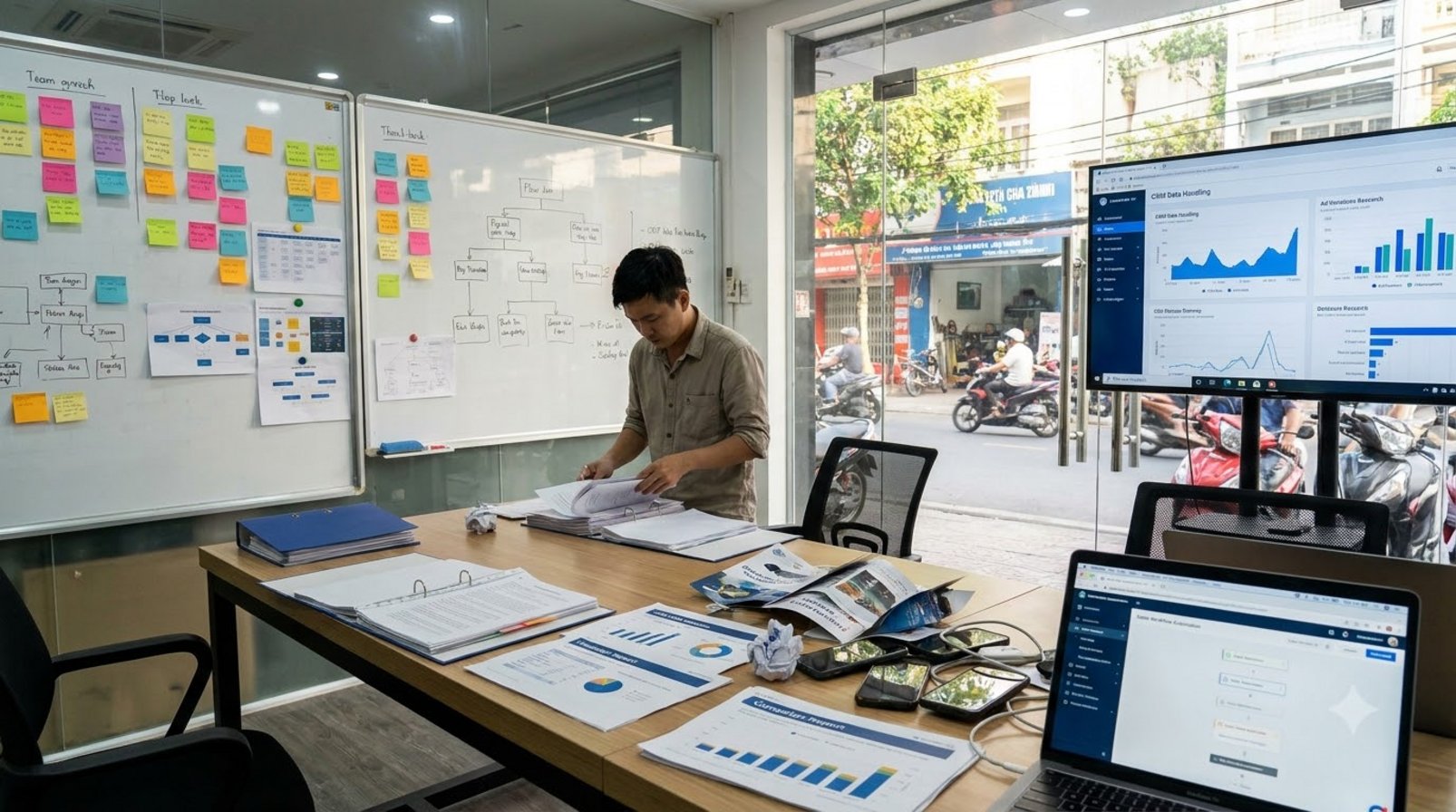
- Review repetitive marketing processes to identify where they can be moved to an agent or a semi-automated workflow.
- Prioritize AI testing on tasks with clear KPIs: reducing content production time, shortening lead response times, speeding up market research.
- Build an internal “use case library” instead of testing scattered tools; each use case should have a goal, input data, and evaluation criteria.
- Standardize principles for using AI for content and data, especially when working with international clients or sensitive materials.
In short: the AI race is shifting from “which model is smarter” to “which system actually gets the job done faster and more reliably.” For marketers, the winners will not be the teams using the most tools, but the teams that turn AI into a seamless part of the revenue-generating process.
See more marketing analysis and guides at https://marketing365.vn.
Follow more analysis from Marketing365 to stay updated on the latest marketing trends.
Read more articles in the same category AI Developments.
This article focuses on AI shifting from chat to doing work with a perspective for the Vietnamese market.
References
- GPT 5.6 Sol is 10 miles ahead of every Anthropic model when it comes to computer use.
- what changes when the same AI task goes from the cloud to your own computer?
- “Taking your card out when you go to a website. That will eventually die.”
- I wish I had found this sooner. Nous Research launched a FREE Hermes agent Skills Hub.
- Why is no one talking about this Claude 5 guide from Anthropic?
- the team that released this machine translated novel just now released an audit of the previous “human” translation
- We just launched the Reddit for AI use cases.
- Enforcement of the AI Act starts TODAY, and non-compliance may result in fines.