Contents
- Key points
- A detailed definition of the marketing funnel
- Why the marketing funnel matters
- How the marketing funnel works and how to calculate metrics
- A real-world example in Vietnam
- Common mistakes when building a marketing funnel
- Frequently asked questions
- How are a marketing funnel and a sales funnel different?
- Do small businesses need a marketing funnel?
- How many stages are enough for a marketing funnel?
- How do you know if a marketing funnel is working well?
- What is a marketing funnel and what stages does it include?
- How do you build a marketing funnel for a small shop?
- How is a marketing funnel different from the customer journey?
- References
- Related reading
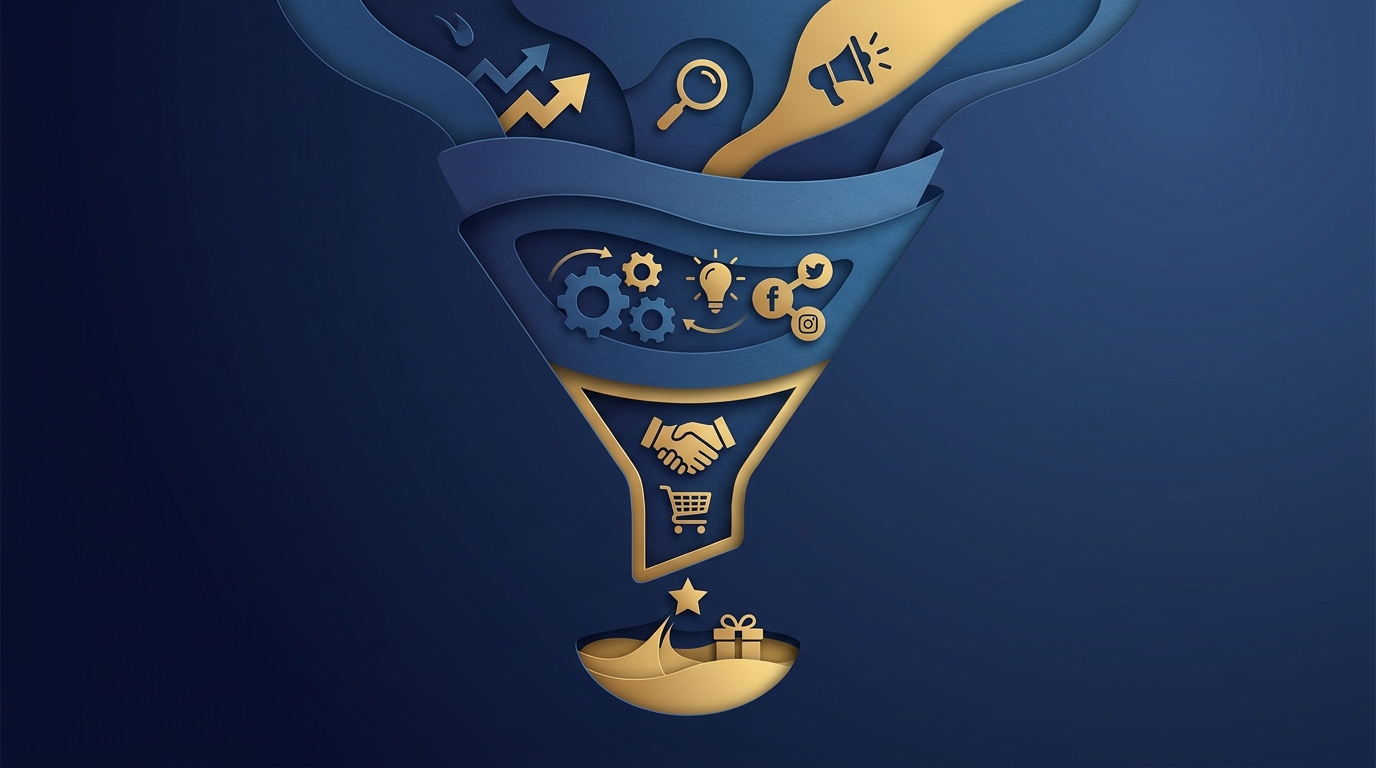
A marketing funnel is a model that describes the customer journey from first learning about a brand to making a purchase and coming back again. It is called a “funnel” because the number of people decreases at each stage: many become aware, fewer consider, and only a portion convert into actual customers. Understanding the funnel correctly helps businesses know where customers are in the journey so they can choose the right content and channels to guide them forward.
Key points
- Three common layers: TOFU (awareness), MOFU (consideration), BOFU (decision); the classic AIDA model has the same essence.
- The funnel is shaped like a funnel because the number of people decreases at each conversion stage.
- Each layer needs different types of content and channels to move customers forward.
- Measure conversion rates between layers to see where the funnel is leaking customers.
- Avoid common mistakes such as putting all the budget into one layer or neglecting post-purchase retention.
What is a marketing funnel? A marketing funnel is a model that describes the customer journey from first learning about a brand to making a purchase and coming back again. The model is shaped like a funnel because the number of people decreases at each stage: many become aware, fewer consider, and only a portion convert into actual customers.
Understanding the marketing funnel correctly helps businesses know where customers are in the journey, so they can choose the right content and channels to guide them forward. This article explains the definition, how the funnel works, how to apply it in the Vietnamese market, and the common mistakes to avoid.
A detailed definition of the marketing funnel
The marketing funnel is a strategic framework that divides the customer journey into connected stages. The most common structure today condenses it into three layers:

- TOFU (Top of Funnel) – Awareness: customers have just realized they have a problem or need, and are encountering the brand for the first time. This is the widest layer of the funnel.
- MOFU (Middle of Funnel) – Consideration: customers understand the problem and are comparing solutions, including your product.
- BOFU (Bottom of Funnel) – Decision: customers are ready to buy and only need one final reason to choose you over competitors.
Some classic models use the name AIDA: Attention, Interest, Desire, Action. Although the labels differ, the essence is still to describe increasing purchase readiness as customers move down the funnel. Many businesses today add post-purchase stages such as retention and advocacy, turning a straight funnel into a loop model.
Why the marketing funnel matters
Not every customer is ready to buy the first time they see an ad. Someone just discovering a brand needs very different information from someone deciding between two products. The marketing funnel helps teams avoid costly mistakes: spending sales budget on people who are not ready, or overlooking those who are close to making a decision.

- Allocate budget more effectively: know which layer is leaking customers so you can invest money and content in the right place.
- Measure clearly: each stage has its own metrics (reach, click-through rate, conversion rate), making bottlenecks easier to identify.
- Align marketing and sales: both teams work from the same journey map and hand off customers at the right time.
- Personalize messaging: the right person, the right need, the right stage instead of sending one message to everyone.
How the marketing funnel works and how to calculate metrics
The funnel works on a gradual filtering principle. At each stage, a percentage of customers continues downward, while the rest drop off. The percentage that moves on is called that stage’s conversion rate.

Basic formula: Conversion rate (%) = (Number of people moving to the next stage ÷ Number of people in the previous stage) × 100.
For example, a campaign has 10,000 people seeing an ad (awareness), 1,000 people clicking through to the landing page (consideration), and 50 people making a purchase (decision). In that case, the conversion rate from awareness to consideration is 10%, from consideration to purchase is 5%, and the overall conversion rate from the top of the funnel to the bottom is 0.5%. Looking at these numbers, the team can immediately see which layer is weakest and prioritize improvements.
Each layer needs its own content and channels to work effectively:
- TOFU: problem-solving blog posts, short videos, SEO articles, awareness ads, social media content.
- MOFU: comparison articles, case studies, webinars, nurture emails, lead-magnet ebooks in exchange for contact information.
- BOFU: product pages, customer reviews, free trials, discount codes, direct consultations.
Read more: What Can Self-Learning Marketing Do for a Business? Scope and Limits
A real-world example in Vietnam
Imagine a local cosmetics brand wants to sell a new serum line. They could build the marketing funnel like this:

- Awareness: post TikTok and Reels videos about skincare in dry weather, combined with SEO-optimized articles on the website for the keyword “serum cho da khô”. The goal is to reach as many people interested in the topic as possible.
- Consideration: run retargeting ads to people who have watched the videos, leading them to an article comparing ingredients and real customer reviews. At the same time, collect emails through mini-games or sign-up offers.
- Decision: send a first-purchase discount code via Zalo and email, place quick-buy buttons on Shopee and the website, and include a clear return policy to remove the final barrier.
- Post-purchase: send care messages, suggest repurchasing when the product is about to run out, and invite satisfied customers to refer friends in exchange for gifts.
A distinctive feature of the Vietnamese market is that customers make many decisions on social media and e-commerce platforms, and prefer messaging via Zalo and Messenger over phone calls. That is why the funnel should strongly leverage chat channels and social proof such as reviews and marketplace sales volume.
Common mistakes when building a marketing funnel
- Focusing only on the bottom of the funnel: putting all the budget into sales ads while neglecting awareness-building, causing the flow of new customers to dry up over time.
- Pushing sales messages too early: forcing customers to buy as soon as they learn about the brand, which backfires and increases costs.
- Not measuring each stage: looking only at final revenue, so you do not know where customers are leaking out and what to fix.
- Ignoring the post-purchase stage: spending heavily to acquire new customers but not taking care of existing ones, even though retention is often much cheaper than acquisition.
- Content that does not match the stage: using the same type of content for every layer, causing the message to miss each group’s actual needs.

Frequently asked questions
How are a marketing funnel and a sales funnel different?
The marketing funnel focuses on the stages of creating awareness and nurturing demand, while the sales funnel describes the process of the sales team closing deals in the final steps. In practice, the two funnels connect: marketing brings customers to the point of readiness, and sales takes over to close the deal.
Do small businesses need a marketing funnel?
Yes. A funnel does not require a large budget; it requires the right mindset. Even a small store can build a simple funnel: an article or video to attract customers, consultation messages, then a purchase offer. The important thing is knowing where customers are so you can say what they need to hear.
How many stages are enough for a marketing funnel?
There is no fixed number. The most common structure is the three layers TOFU, MOFU, BOFU, but many businesses add retention and referral stages. Choose the number of stages that accurately reflects your customers’ real buying journey, and do not overcomplicate it unnecessarily.
How do you know if a marketing funnel is working well?
Track conversion rates between stages over time. If the rate at one layer rises steadily and the cost per actual customer decreases, the funnel is working effectively. When one layer drops unexpectedly, that is a signal to review the content and channels for that stage.
📚 See the overview: Analysis section
What is a marketing funnel and what stages does it include?
A marketing funnel is a model that describes the customer journey from first learning about a brand to making a purchase and becoming a loyal customer. The funnel usually includes awareness, interest, consideration, and decision stages, helping you visualize where customers are so you can approach them appropriately.
How do you build a marketing funnel for a small shop?
You need content and channels suited to each stage: capture attention at the top of the funnel, provide information and proof in the middle, then drive action with offers and calls to action at the bottom. Measuring the transition rate between steps helps you see where customers are dropping off so you can improve it.
How is a marketing funnel different from the customer journey?
A marketing funnel looks at the journey from the business perspective, with stages that lead customers toward purchase, while the customer journey describes the customer’s real experience and emotions across touchpoints. The two concepts complement each other: the funnel helps you plan strategy, while the customer journey helps you understand and optimize the real experience.
References
Related reading
- Does a Marketer Need to Draw? The Visual Skill Level a Team Needs
- Free Marketing Certifications Worth Learning
- What a Marketing Team Really Costs