
Contents
- Where is an online shop’s sales funnel actually “leaking”?
- Where should a basic conversion funnel for an online shop begin?
- How to build a sales funnel for an online shop step by step
- Step 1: Choose a teaser product, a core product, and a conversion goal
- Step 2: Design the funnel entry flow from traffic to landing page
- Step 3: Create content and proof to nurture customers in the middle of the funnel
- Step 4: Optimize the closing step to reduce friction
- Step 5: Measure data and fix each drop-off point in the funnel
- Which metrics should you track to know whether the funnel is working well?
- Common mistakes that make an online shop funnel break halfway
- How to optimize the funnel after you have data
- Frequently asked questions about building a sales funnel for an online shop
Many shops have steady traffic but low orders because the funnel breaks at some stage. How to Build a Sales Funnel for an Online Shop is not about learning a model by the book, but about designing each touchpoint to move viewers from awareness to purchase and back again.
For beginners in marketing or shop owners, the focus is on checking four layers: attracting the right audience, keeping them engaged long enough, closing the sale clearly, and then nurturing them again with the right content and offers. When you read an online shop sales funnel correctly, you will know where customers are dropping off, what needs fixing, and how to measure performance instead of guessing.
Where is an online shop’s sales funnel actually “leaking”?
An online shop sales funnel is a system of touchpoints that leads customers from awareness to consideration, purchase, and repeat purchase. If a shop gets only sporadic orders even though it is still running ads and posting regularly, the problem usually lies in one of four places: the top of the funnel lacks relevant traffic, the product page is not persuasive enough, there is no lead nurturing mechanism, or the shop cannot measure metrics and therefore does not know where the leak is.
An effective way to build a sales funnel for an online shop always starts with identifying the right drop-off point. Some shops get plenty of visits but still few orders; others get fairly steady inbox messages but low close rates because trust is lacking and the closing step is unclear. The biggest difference between “having a lot of visits” and “having a funnel that works” is the ability to guide customers forward step by step, instead of letting them fall out of the journey on their own.
When does a shop need a sales funnel, not just more traffic?
A shop needs a sales funnel when traffic increases but orders do not, when inbox messages are frequent but close rates are low, or when there are first-time orders but customers do not return. If you have not separated new customers from existing ones, it is also very difficult to optimize the sales funnel or measure funnel performance clearly.
The clearest sign is when customers view a product and leave, visit the page often but spend little time there, or staff have to answer the same question over and over. In that case, increasing the budget only makes the leak more visible; it does not solve the root of the conversion funnel.
Common leak points in an online shop
The top of the funnel often leaks because the traffic attracted at the top is not the right customer group, and the content bringing them in does not match their needs. The middle of the funnel leaks when the landing page or product page lacks trust signals, images are unclear, descriptions are vague, or the value proposition is not strong enough; this is where optimizing the landing page in an online shop sales funnel becomes effective.
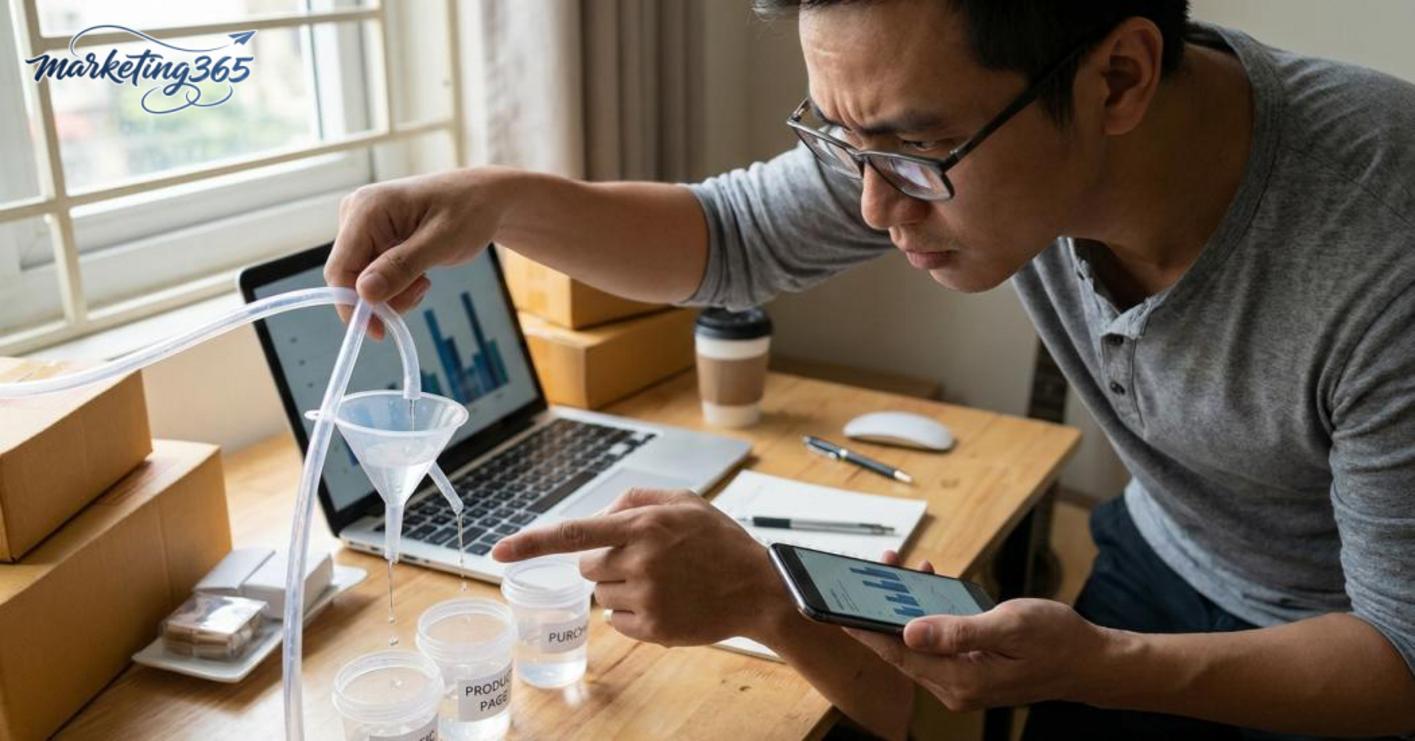
The bottom of the funnel leaks when there are no offers, no closing step, or the response process is too slow. After purchase, leakage happens when there is no way to nurture leads for an online shop, so customers buy once and disappear. A good automated sales funnel for online business must connect these four stages instead of focusing only on bringing people in.
Quick checklist:
- Traffic exists but orders do not increase: review the top of the funnel.
- Page views exist but people leave quickly: review the content and trust signals.
- Inbox messages exist but close rates are low: review the closing step.
- Orders exist but customers do not buy again: review the re-engagement step.
Where should a basic conversion funnel for an online shop begin?
A basic conversion funnel for an online shop starts with the flow from seeing content to buying and returning. For a new shop, the most effective way to build a sales funnel for an online shop is to clearly separate five layers: attract, interest, consider, buy, and return; each layer has its own goal, action, and metric to measure.
3-stage funnel or 5-stage funnel: which should each shop use?
A 3-stage funnel is suitable when a shop has limited resources, while a 5-stage funnel is better when traffic is larger or there are many SKUs and behaviors to separate. If you are just starting, use a simplified sales funnel model based on TOFU MOFU BOFU to avoid confusion and difficult measurement.
A new fashion shop often only needs 3 stages: drive clicks, keep interest, close the sale. When there are many different customer groups, you can go deeper using the AIDA sales funnel process for an online shop, but only when you have enough data to read.
| Model | When to use | Risk |
|---|---|---|
| 3-stage | Small shop, few staff | Easy to miss some touchpoints |
| 5-stage | Many products, lots of traffic | Hard to track if there is not enough data |

Each funnel stage needs a specific action
Each stage of an online shop sales funnel must be tied to a clear action, otherwise it is just a pretty diagram on paper. The first stage needs to attract top-of-funnel traffic for an online shop through posts, ads, or videos; the middle stage needs to maintain interest through content, proof, and a lead magnet strategy for an online shop; the final stage needs to optimize the landing page in the online shop sales funnel to reduce checkout friction.
For example, a customer views a post, clicks through to the product page, leaves a message, adds to cart, then checks out: that is the sequence of actions you need to map out. With lead nurturing for an online shop, each step should have its own metric such as clicks, page dwell time, add-to-cart rate, and completed orders.
How to build a sales funnel for an online shop step by step
How to build a sales funnel for an online shop step by step means choosing the right product, the right entry flow, and the right closing point from the start. A streamlined funnel usually has only one conversion goal, such as purchase, leaving contact information, or sending a consultation message.
Read more: How to Track User Behavior on the Web
Step 1: Choose a teaser product, a core product, and a conversion goal
A teaser product is the item that grabs attention, while the core product is the one that generates the main revenue. For an online shop, a funnel should have only one goal to avoid distracting customers.

For example, a cosmetics shop can use a 10ml sample or mini size as the teaser product, then lead customers to a best-selling set. A fashion shop can use a basic T-shirt or an easy-to-wear dress as the teaser product, while a jacket or a pre-styled set is the core product.
Quick checklist:
- Choose 1 product with clear demand.
- Assign 1 main action to each funnel.
- Do not combine multiple goals into the same flow.
- Clearly note the metrics to track: click-through rate, message rate, purchase rate.
Step 2: Design the funnel entry flow from traffic to landing page
Each traffic source should have its own landing page. If an ad is running for a new dress style, send users directly to that style’s landing page; if a short video talks about a promotion, the link should point to the offer page, not the general category.
A clean way to do this is to map the sequence: which traffic source → which page → which action. For example: Facebook post → product landing page → buy button or message button. If you run Meta Ads, you can add UTM parameters such as utm_source=facebook, utm_medium=cpc, utm_campaign=ao-thun-basic to measure which source generates orders.
Step 3: Create content and proof to nurture customers in the middle of the funnel
In the middle of the funnel, customers need a reason to trust before they buy. Prioritize real reviews, before-and-after results, customer feedback, how-to videos, product comparisons, and answers to concerns such as size, material, warranty, or returns.
An easy content sequence to use is: problem → proof → how to use → risk reassurance. For example, a customer viewing a shirt can see real-life photos, feedback on the fit, and then the size-exchange policy before closing the purchase. For shops with a website, the FAQ section should clearly answer shipping fees, delivery time, and 7-day or 14-day returns.
Step 4: Optimize the closing step to reduce friction
The closing step needs to make all purchase conditions clear before the customer clicks the button. Price, shipping fees, delivery time, payment methods, returns, and the buy or message button should be placed where they are easy to see, not hidden in a long block of text.
Read the closing page through three questions: does the customer know how much they need to pay, do they trust the product, and is there any step that forces them to guess? If the page has a form, it should only keep truly necessary fields such as name, phone number, and address; every extra field can reduce completion rates.
Step 5: Measure data and fix each drop-off point in the funnel
A sales funnel only works when you can measure each step. At minimum, track four metrics: landing page visits, buy-button click-through rate, message rate, and order close rate.
If many people visit the page but few click the button, the issue is usually the headline, image, or unclear price. If many people message but few buy, the issue is usually the consultation script, shipping fees, or return policy. With Google Analytics 4 and Google Search Console, you can compare traffic sources with landing pages to see which step is losing customers.
Which metrics should you track to know whether the funnel is working well?
When measuring a funnel, you need to look at the flow from entry → engagement → conversion → repeat purchase, rather than judging only by revenue. An effective way to build a sales funnel for an online shop is to clearly separate behavioral metrics from outcome metrics, then see whether each stage is dropping off in the right place.
| Metric | Meaning | When to worry | What to check next |
|---|---|---|---|
| Reach, source traffic | Top-of-funnel attraction level | Many people enter but from the wrong source | Check the traffic-driving channel and opening content |
| Click, CTR | Message appeal | Impressions are high but few people click | Review the headline, image, and offer |
| Time on page, bounce rate | How long people stay and keep reading | People leave quickly after entering | Check the landing page, load speed, and content match |
| Add-to-cart, lead rate, inbox | Level of real interest | There is engagement but no buying signal | Review offers, CTA, forms, and Q&A flow |
| Conversion rate, checkout abandonment | Closing performance | Many carts but abandoned checkout | Check shipping fees, payment steps, and form errors |
| Repeat purchase | Return behavior | Orders exist but no repeat purchases | Review post-purchase care and repurchase reminders |
Which metrics should you look at first at the top of the funnel?
At the top of the funnel, prioritize reach, CTR, source traffic, time on page, and bounce rate. This set of metrics shows whether the conversion funnel is attracting the right people, not just generating views.
If reach is high but CTR is low, the issue is usually the message or opening image. If clicks are good but time on page is low, the landing page is misaligned with expectations or loads too slowly. With this way of measuring sales funnel performance for an online shop, these metrics help filter top-of-funnel traffic for an online shop early before you spend more budget.
Which metrics should you look at in the middle and bottom of the funnel to make decisions?
In the middle and bottom of the funnel, track add-to-cart, view content, inbox, lead rate, conversion rate, checkout abandonment, and repeat purchase. This group of metrics reflects how well interest turns into action, which is very important when optimizing a sales funnel.
Read more: How to Measure Landing Page Conversion Rate Correctly

For example, many people viewing a product but few adding it to cart usually points to the value proposition, product photos, or lack of trust. Many carts but abandoned checkout indicate friction in the payment process. If there are orders but low repeat purchases, you need to review how you nurture leads for an online shop after purchase.
Read metrics as a sequence, not as isolated numbers
Reading metrics as a sequence helps you see which part of the online shop sales funnel is broken, so you do not fix the wrong thing. A single good metric is not enough to conclude the funnel is healthy if later stages drop sharply.
- High traffic but low clicks: fix the headline, image, and opening hook.
- High clicks but low purchases: check the landing page, price, CTA, and trust.
- Some purchases but low repeat purchases: review email nurturing, repurchase reminders, and after-sales care.
When you look at the sequence, you will see how sales funnel metrics are connected. That is how to build a sales funnel for an online business based on real data, not on the feeling that “orders mean everything is fine.”
Common mistakes that make an online shop funnel break halfway
An online shop sales funnel often breaks halfway because the wrong audience enters, the message does not match, nurturing is missing, and the wrong metrics are measured. To fix it quickly, prioritize the top-of-funnel drop-off first, then optimize the landing page and the post-click tracking step.
Top-of-funnel mistake: attracting the wrong people or casting too wide a net
A misaligned top of the funnel is when you get many clicks but the people entering are not the right buyers. The easy-to-see sign is that the ad has decent CTR, the post gets many views, but add-to-cart and conversions barely move. This usually happens when one content template is used for every customer group, or the caption is too generic, such as “good price, nice quality, fast delivery.”
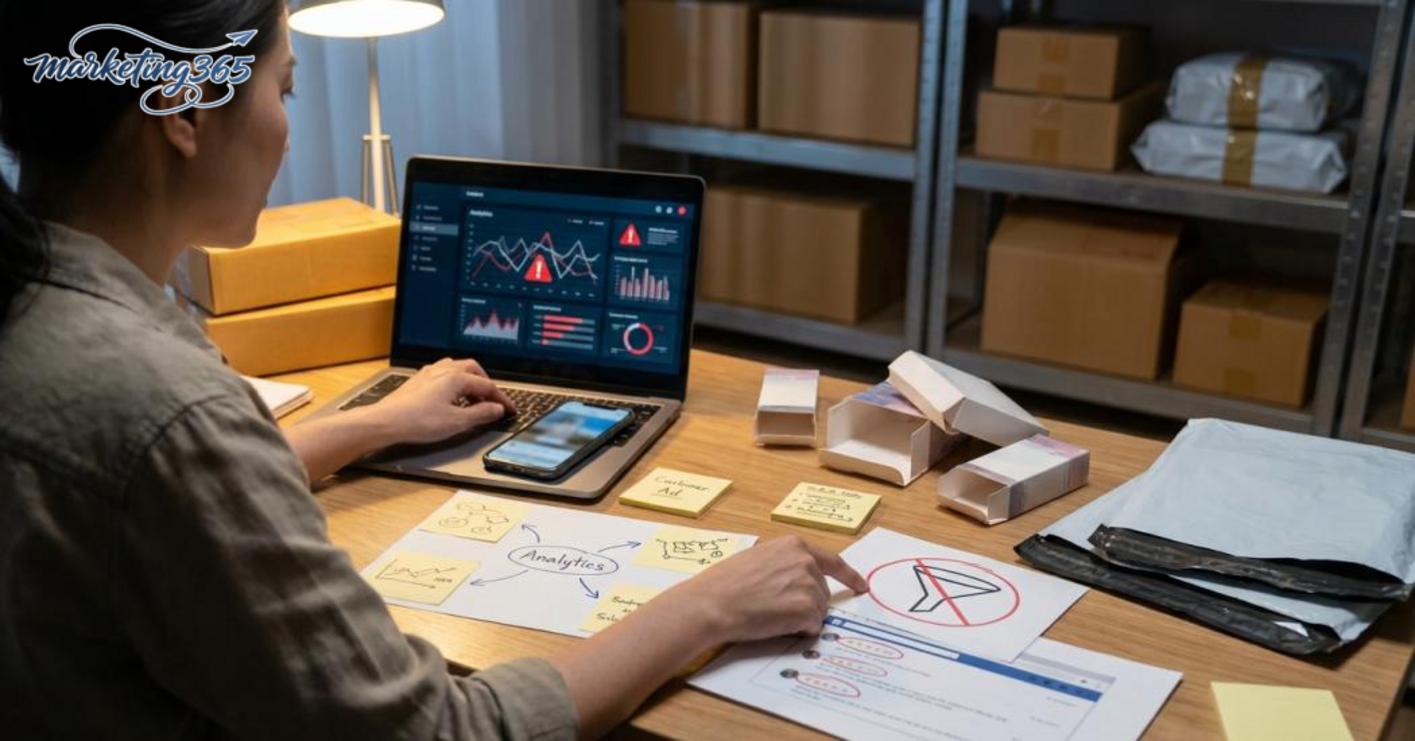
The fix is to define each audience segment clearly before increasing budget:
- Separate groups by real need, for example bargain hunters, gift buyers, and urgent delivery customers.
- Write a separate message for each group; the headline, image, and offer must all say the same thing.
- Only drive top-of-funnel traffic for an online shop when the landing page already answers that segment’s question correctly.
If clicks are high but there is no next action, the problem is usually not traffic volume but expectation mismatch.
Middle and bottom-of-funnel mistake: not enough trust and not enough reason to buy
A break in the middle or bottom of the funnel happens when customers have seen the product but still do not trust it enough to decide. Common signs are short time on page, many viewers but few add-to-cart actions, or people leaving at checkout. Frequent causes are missing social proof, unclear comparisons, vague return policies, weak CTAs, and slow-loading pages.
To optimize the landing page in an online shop sales funnel, follow this order:
- Add the proof closest to the decision: real reviews, real-use photos, and sales numbers if available.
- Insert a short comparison table between options so customers can eliminate choices themselves.
- Place shipping, returns, and warranty policies in visible positions.
- Shorten the form, reduce the number of clicks, and keep only one main CTA.
Many shops only look at final revenue and miss the bottleneck in the middle of the funnel. Measuring sales funnel performance for an online shop should start with clicks, page views, add-to-cart, and only then purchases; if you optimize too many things at once, you will not know which change actually had an impact.
How to optimize the funnel after you have data
Only optimize a sales funnel when each stage has enough minimum data to show a trend, because changing too early can lead to the wrong decision. With a way to build a sales funnel for an online shop, prioritize fixing the biggest bottleneck first, then test one small change to measure its impact.
One way to measure sales funnel performance for an online shop is to follow this order: see which step drops the most, identify the cause, then change only 1-2 variables at a time. If you change too many things at once, you will not know which part truly created the result.

Quick action checklist:
- Low click-through rate: review the hook, headline, opening image, and promise in the ad or post.
- High page entry rate but early exits: check the opening content, load speed, layout, and above-the-fold CTA.
- Add-to-cart exists but no purchase: check shipping fees, checkout flow, trust signals, and return policy.
In an online shop sales funnel, do not optimize broadly based on intuition. Record the old version, change one variable, wait for enough visits or orders to read the difference, then decide whether to keep or discard it. If you do not yet have enough data, prioritize driving more top-of-funnel traffic for an online shop instead of jumping to conclusions.
Read more: How to Measure Website Performance Correctly and Avoid Mistakes
When should you revise content, and when should you revise the landing page?
Revise the content when clicks are low; revise the landing page when clicks are fine but conversions are low. With a landing page in an online shop sales funnel, the signs are very clear: the ad or post gets many clicks, but the product page still has few orders, few inbox messages, or visitors leave before the CTA.
How to separate the issue quickly:
- Low clicks: adjust the hook, thumbnail image, headline, and opening message.
- Good clicks but high exits: shorten the top of the page, clarify the benefits, value, and FAQ.
- Conversions exist but are low at checkout: check the form, fees, shipping options, and trust.
When should you add automation, and when is it not needed yet?
Only add automation when the flow is already stable, because an automated sales funnel for online business only works when the data is clean enough. If the funnel still has issues in content, landing page, or checkout, automation will only spread the mistakes further.
Start with simple flows such as cart reminder emails, repurchase reminder messages, remarketing, or lead segmentation. With lead nurturing for an online shop, prioritize one flow first, check open rates, response rates, and resulting orders, then expand further.
Frequently asked questions about building a sales funnel for an online shop
A sales funnel and a conversion funnel share the same goal of measuring performance, but a sales funnel focuses on the buying journey, while a conversion funnel can also track sign-ups, lead capture, add-to-cart, and purchases. With a way to build a sales funnel for an online shop, you need to decide the final destination first so you can choose the right metrics.
Small shops still need a sales funnel because with less traffic, every step matters even more. A simple 3-step flow includes bringing viewers to a product post, sending them to a landing page, and nurturing them through messages or email. For example, a newly opened fashion shop can offer a 10% discount code or a size guide file in exchange for an email address.
How long does it take to know whether the funnel works?
You should let the funnel run for at least 2 to 4 weeks to gather enough data to see a trend. If there are around 100 top-of-funnel visits per day, after 14 days you can already see which step is dropping the most. Do not decide too early just because of a few initial orders; look at click-through rate, form completion rate, add-to-cart rate, and order close rate at each step.
Which metrics should you measure first?
You should start with 3 metrics: traffic into the top of the funnel, the conversion rate to lead or add-to-cart, and the purchase rate at the bottom of the funnel. This set of metrics is enough to show where the funnel is stuck. Once these three metrics are stable, then optimize the landing page, nurturing content, and automation scripts more deeply.
How do you know which step the funnel is dropping off at?
Record each step in Google Sheets or check it in Google Analytics 4. For example, if 1,000 people visit the product page but only 80 click through to the landing page, the issue is usually the headline, CTA, or top-of-funnel offer. If 80 people enter the landing page but only 6 orders come through, you need to review the offer value, price, shipping fees, and closing point.

What should you fix before driving more traffic?
You should fix the step with the highest drop-off rate before increasing ad spend. In one cosmetics shop running Meta Ads, simply changing the CTA from “Buy Now” to “Get 20% Off” at the top of the funnel increased form entries more clearly than increasing the budget. This helps reduce waste when the funnel is not yet complete.
If you are using Google Analytics 4, create events for view_item, add_to_cart, begin_checkout, and purchase. When you track these four milestones, you will know exactly where the online shop sales funnel is strong and where it is weak.
For official and up-to-date guidance, you can also refer to materials from Google Analytics Help.
Related articles
- How to Optimize Facebook Ad CPM Effectively
- How to Increase Engagement Rate on a Fanpage Effectively
- What Is KPI? Marketing Performance Metrics
You can find more hands-on marketing guides at https://marketing365.vn.
Content from marketing365 is created for SMEs, online shop owners, and new marketers.