
Contents
Dify is an open-source platform that helps build AI apps and agents with drag-and-drop simplicity, without having to write all the code from scratch. For marketers, it lets you create chatbots, content assistants, and AI workflows based on your company’s own data.
Key points
- An open-source platform (more than 147,000 GitHub stars) for developing production-ready applications and agentic workflows.
- An intuitive drag-and-drop interface for designing AI workflows: combining processing steps, connecting models, data, and business logic.
- Connects multiple AI model providers and brings in your own data to answer in a more business-relevant context.
- Marketing applications: customer service chatbots, brand-aligned content assistants, process automation, knowledge-base Q&A.
- Use the cloud version for a quick start or self-host to control data; quality depends on how the workflow and data are designed.
If you’ve ever dreamed of a customer-advice chatbot or an AI assistant handling internal workflows but felt discouraged by the need to hire a whole development team, Dify could change your mind. It is an open-source platform for building AI apps and agents with drag-and-drop simplicity, and it is currently one of the AI marketing tools drawing the most attention from the community.
What is Dify?
Dify is an open-source platform developed by langgenius with more than 147,000 stars on GitHub, described as a “production-ready platform for developing agentic workflows.” In simple terms, it is where you build AI applications — chatbots, assistants, automated processing flows — without having to write all the code from scratch.

The highlight of Dify is its intuitive interface for designing AI “workflows”: you combine processing steps, connect language models, data, and business logic into a complete application. Because it is open source, you can run it on your own infrastructure to control your data.
Main uses
Dify aims to shorten the path from an idea to a real AI application. Common use cases include:

- Building chatbots and AI assistants based on large language models.
- Designing multi-step workflows for complex AI tasks in a visual way.
- Connecting multiple different AI model providers within one platform.
- Bringing in your own data so AI can answer in a way that matches business context.
Because Dify is a large and fast-moving project, the detailed feature list changes continuously — check the official documentation to get the latest version before deciding.
What can Dify be used for in marketing?
Read more: Pathway llm-app: A RAG App Template for AI-Powered Marketers
For marketing and growth teams, Dify is appealing because it lets them build their own AI tools without relying entirely on developers. A few real-world scenarios:
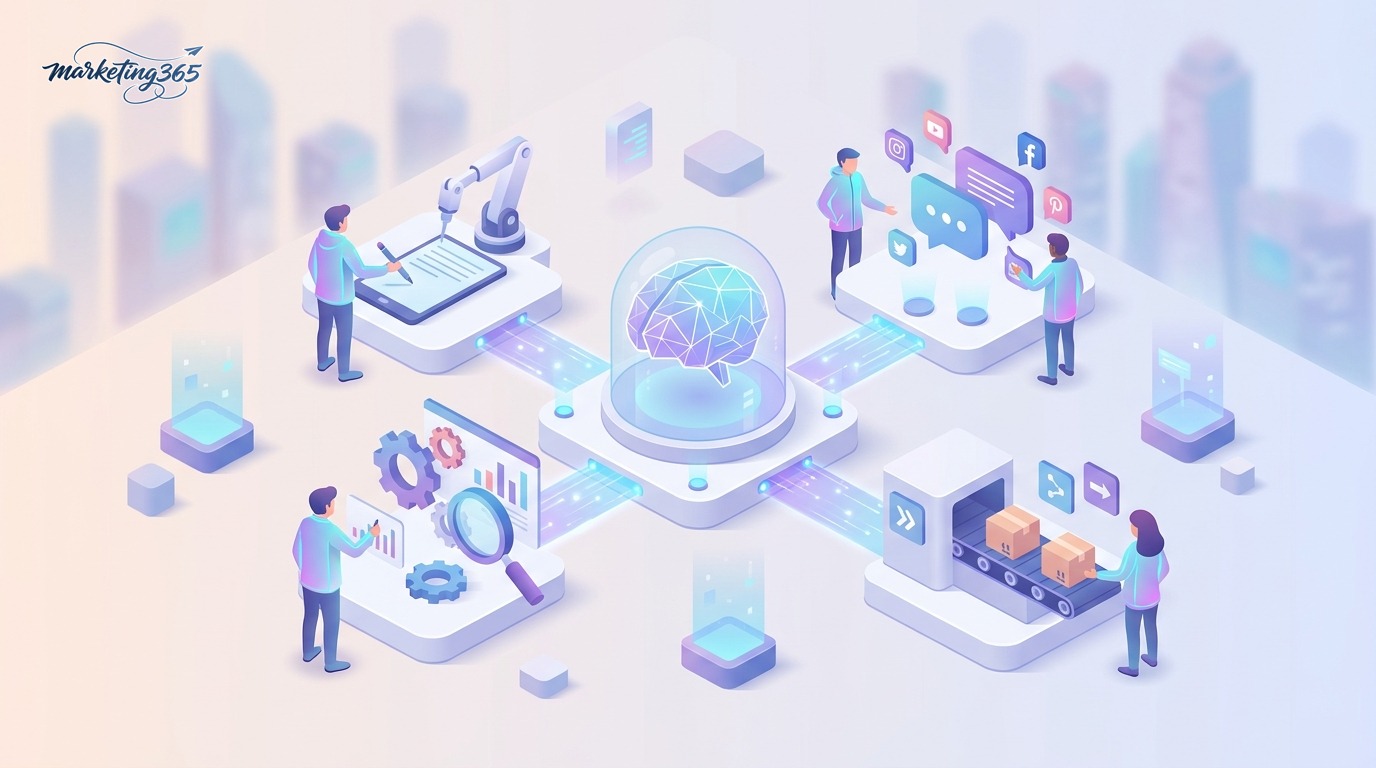
- Customer support and service chatbots: answer frequently asked questions based on your own product documentation.
- Content assistant: build an internal app that helps the team draft captions, emails, or ideas in line with brand guidelines.
- Workflow automation: combine steps such as lead classification, feedback summarization, and response suggestions into one workflow.
- Knowledge-base Q&A: turn documents, FAQs, and policies into an assistant that employees or customers can ask directly.
This is an interesting piece for anyone looking to upgrade content marketing or customer care workflows with AI. That said, the final application quality still depends on how you design the workflow and the data you feed in — it takes testing and refinement; this is not a “one-click miracle.”
How to get started
There are two common approaches: use the cloud version provided by the Dify team for a quick experience, or self-host the open-source version on your own server if you need data control and deeper customization. Self-hosting usually requires some technical knowledge of infrastructure.

A sensible path for beginners: start with a small application such as a Q&A chatbot based on a few documents, get familiar with building workflows, then expand gradually. You also need to prepare the API key from your AI model provider to connect it. Refer to the official installation guide, as the exact steps may change by version.
Pros and cons
- Pros: open source, can be self-hosted for data control; intuitive interface lowers technical barriers; supports multiple model providers; very large community (more than 147,000 GitHub stars) so documentation and examples are plentiful.
- Cons: self-hosting requires technical capability and infrastructure; as a feature-rich platform, it has a learning curve; real-world costs also come from the API keys of the models you use; it takes time to fine-tune for good results.

Verdict: is it right for you?
Dify is a good fit for marketing teams that want to build their own AI tools and have at least one tech-savvy person to handle deployment. If you only need a simple chatbot with an all-in-one service, packaged SaaS solutions may be faster. But if you want control, customization, and to avoid being locked into a single provider, Dify is well worth considering.
Read more: OpenHands: The AI Agent That Writes Code for Marketers

Advice: build a small pilot project to assess the operational effort before committing. To keep up with more AI agent trends, you can follow our AI updates section.
Source code & official documentation: github.com/langgenius/dify. This information is for general reference — please check the official documentation before implementation.
Frequently asked questions
What is Dify?
Dify is an open-source platform developed by langgenius that lets you build chatbots, assistants, and AI workflows in a visual way without writing code from scratch.
Is Dify free?
The Dify source code is open and can be self-hosted, but the real costs come from the API keys of the AI model you use and the server infrastructure when self-hosting. Dify also has a cloud version for quick testing.
Can marketers who don’t know how to code use Dify?
Yes, at a basic level thanks to the drag-and-drop interface, but Dify is a feature-rich platform with a learning curve. It’s best to start with a small application such as a Q&A chatbot based on a few documents and expand gradually.
How is Dify different from packaged chatbot services?
Dify gives you data control, workflow customization, and helps you avoid being locked into a single provider. If you only need a simple packaged chatbot, a closed SaaS solution may be faster.