Contents
AI is the field that enables computers to do tasks that normally require human intelligence, such as understanding language, recognizing images, reasoning, and making decisions. AI Agents are a step beyond the familiar generative AI (the ChatGPT-style that answers questions): they can plan, call tools, and execute an entire sequence of tasks in place of humans, rather than simply responding once.
Key points
- Generative AI (LLMs) only answers one question at a time; AI Agents think, act, and observe in a loop.
- There are several AI categories: narrow AI excels at one task, generative AI writes/translates/generates images, and AI Agents coordinate tasks.
- For marketers, AI Agents automate the entire pipeline instead of copy-pasting prompts one by one.
- This is the foundational article in the AI Guide series, leading to specific platforms such as Claude, OpenAI, and n8n.
- Start with repetitive, clearly defined tasks before handing complex work to an agent.
What is an AI Agent, and why is this term appearing so frequently in every marketing meeting in 2026? The short answer: there is a huge difference in both how they work and the value they deliver between familiar generative AI (the ChatGPT-style that answers questions) and a true AI Agent. This article explains in detail what AI is, what an AI Agent is, how AI agents work, clearly distinguishes the two concepts, reviews the 2026 tool ecosystem, and offers a practical starting roadmap for Vietnamese marketers.
This is the foundational article in the AI Guide series on Marketing365. After reading this article, you can go deeper into each specific platform linked below without any gaps in your core understanding.
What is AI?
AI (Artificial Intelligence) is the field that enables computers to perform tasks that normally require human intelligence: understanding language, recognizing images, reasoning, and making decisions. Instead of programming every hard rule, modern AI learns from data to generalize and handle situations it has never encountered before.

The wave shaping marketing is generative AI – large language models (LLMs) that can write content, summarize, translate, generate images, and answer questions almost instantly. OpenAI’s ChatGPT and Anthropic’s Claude are typical examples that most marketers have tried at least once.
AI categories you will encounter
- Narrow AI: good at one specific task – filtering spam emails, recommending products, scoring leads.
- Generative AI: creates new content from prompts – text, images, video, voice.
- Agentic AI: not only responds but also acts – this is the foundation of the AI Agent we will discuss next.
Understanding these three groups correctly helps you avoid setting the wrong expectations: a generative model will not send emails for you on its own, while an AI agent can – if it is given the right tools and permissions.
What AI does well and does not do well for marketers
AI is strong at repetitive tasks with lots of sample data and room for drafts: writing outlines, ad headline variations, summarizing reports, translating content, suggesting keywords, or classifying comments. This is where you should hand work to AI to shorten the time from a blank page to the first draft.
On the other hand, AI is still weak when internal information, real numbers, and brand judgment are required: it can invent figures, cite sources incorrectly, or sound certain about things that have not been verified. A safe rule for Vietnamese marketers: use AI to build drafts and expand ideas, while numbers, legal promises, and brand voice should be reviewed by a human before publishing.
What is an AI Agent?
An AI Agent is a system that uses an AI model as its “brain” to plan and execute multiple steps autonomously in order to achieve a goal, with the ability to use tools, remember context, and respond based on real outcomes – instead of simply generating one block of text and stopping.
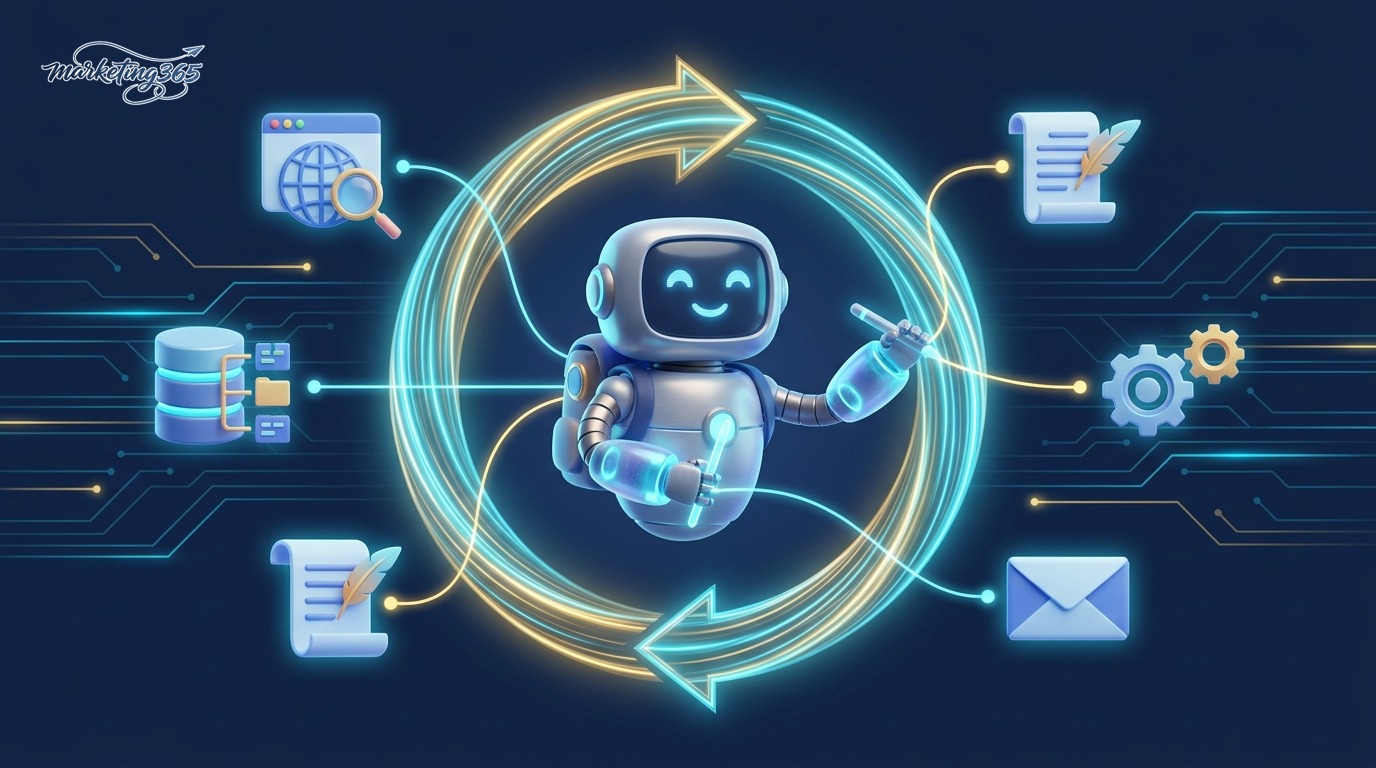
In other words: a chatbot answers, “Here are 5 email ideas”; an AI Agent can independently research competitors, draft the email, place the content into an email-sending tool, track open rates, and report the results back to you. The difference lies in the word act.
An AI Agent usually has 4 components
- Model: an LLM acts as the reasoning brain, for example Claude from Anthropic or ChatGPT from OpenAI.
- Tools: APIs, browsers, databases, files… so the agent can actually “do the work.”
- Memory: stores context and results between steps so it does not start over from scratch.
- Orchestration loop: plan → act → observe → adjust, repeated until the goal is reached.
An important open standard in 2026 is MCP (Model Context Protocol) – a protocol that helps agents connect securely to external tools and data in a unified way, instead of each tool having to build its own integration.
Distinguishing AI Agents from chatbots and traditional automation
These three are often confused. A chatbot responds to each question and then stops, without setting its own goals. Automation tools like Zapier or n8n run a fixed script you have already designed: trigger A does B, and if something unusual happens, it gets stuck. An AI Agent sits in between and above them: it decides the steps, chooses the tools, and changes direction when the result is not as expected.
The practical way to choose: if the task has a clear process and few exceptions, use automation because it is cheaper and more stable; if the task requires reasoning, combining multiple sources, or handling unpredictable inputs, you need an agent. Many good systems actually combine both: the agent handles decision-making, while automation handles consistent execution.
How does an AI Agent work?
The heart of an AI agent is a self-correcting loop: plan → act → observe → adjust. This is what makes an AI Agent very different from a single prompt. Instead of answering once, the agent breaks a large goal into smaller steps, completes each step, checks the result, and then decides the next step based on what it has just observed.
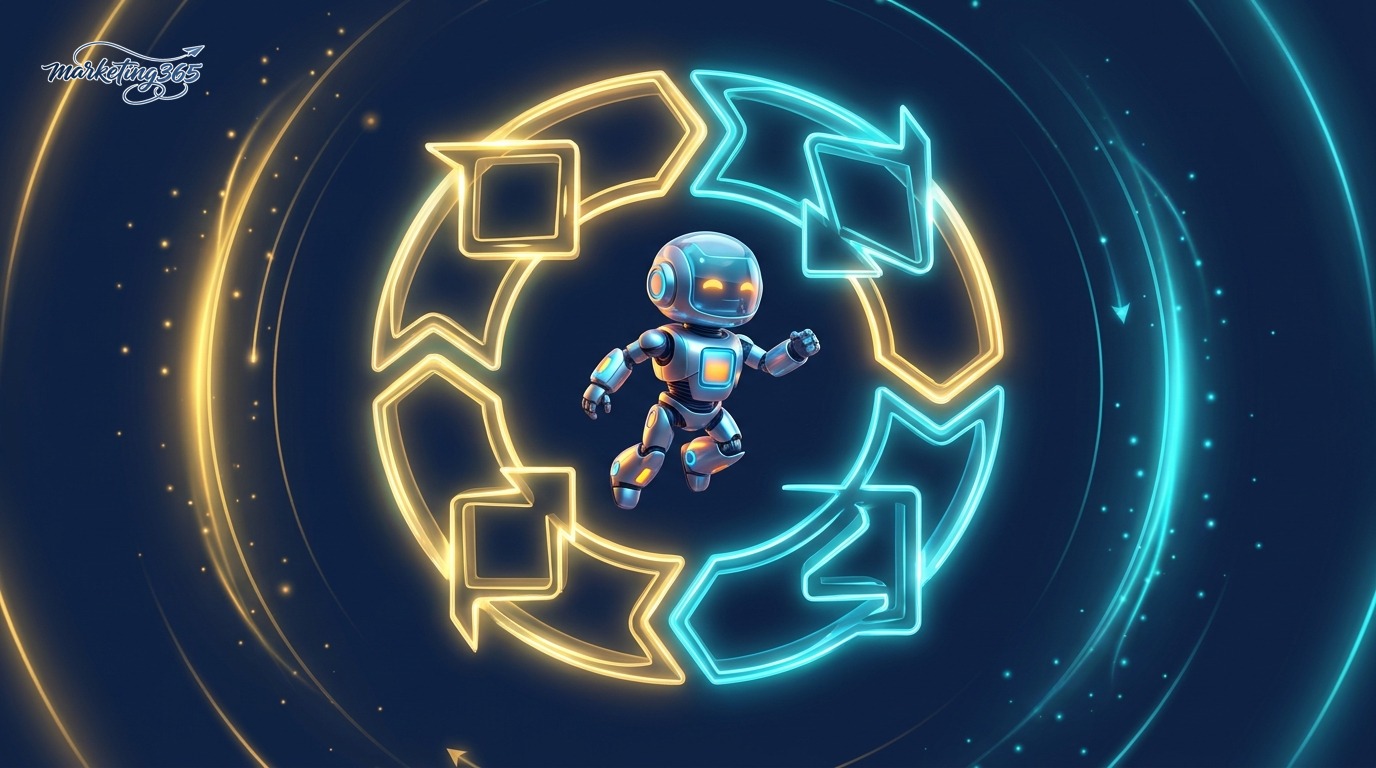
- Plan: the agent breaks the goal into a sequence of sub-tasks and chooses the right tool for each one.
- Act: the agent calls tools – web search, database queries, API calls, file writing.
- Observe: the agent reads the returned results and evaluates whether it is closer to the goal.
- Adjust: if not yet there, the agent revises the plan and repeats; if achieved, the agent stops and summarizes.
Step-by-step example: an agent writing an SEO blog post
Suppose you give the goal: “Write an SEO blog post on email marketing for small businesses.” An AI Agent would run like this:
- Plan: determine that it needs to (a) research keywords, (b) analyze the top 5 ranking articles, (c) create an outline, (d) write the article, and (e) self-check the SEO checklist.
- Act – research step: call a search tool and collect secondary keywords and frequently asked questions.
- Observe: notice that competitors all lack a section on “sample email examples” → identify this as a content gap.
- Adjust: add a dedicated section on email templates to the outline so the article has a competitive advantage.
- Act – writing & checking step: draft the article, then automatically review keyword density, length, and heading tags; if anything is missing, add more content before handing the draft to you for review.
The key point: in each loop, the agent self-corrects based on real data instead of following a fixed script. That is why an AI agent can handle multi-step work that a single prompt cannot.
Where agents can go off track and how to control them
The more self-correction loops there are, the more errors can accumulate. Common mistakes include: the agent misinterpreting the original goal, looping endlessly on a step that makes no progress, calling the wrong tool and creating extra cost, or becoming overconfident in a wrong result because there is no source to compare against. The deeper the automation, the harder it is to detect when one step fails.
A control checklist for marketers: write the goal and the definition of “done” very clearly before running; limit the number of steps and tool-call budget; place human approval gates at risky stages such as sending emails, running ad spend, or publishing; and always require the agent to return sources so you can verify them instead of trusting immediately.
Distinguishing AI and AI Agents
To summarize the core difference, look at the comparison table below. Understanding this table correctly helps you choose the right tool for the right job.

| Criteria | Generative AI (pure LLM) | AI Agent |
|---|---|---|
| Output | A single answer / piece of content | A sequence of actions that achieves a goal |
| Number of steps | One question-and-answer round | Multiple steps, with a loop |
| Uses tools | No (only generates text) | Yes (API, web, database, file) |
| Memory | Limited within one session | Stores context across steps/tasks |
| Self-adjustment | No | Yes – observes and then revises the plan |
| Example | “Write a Facebook caption” | “Research, write, schedule, and report the post” |
In short: generative AI is a pen, while an AI Agent is an employee who knows how to hold the pen, research, make calls, and report back. Both are useful, but for different problems.
The 2026 AI & AI Agent tool ecosystem
In 2026, Vietnamese marketers have a fairly complete ecosystem to start building with. Below are the most common pieces:
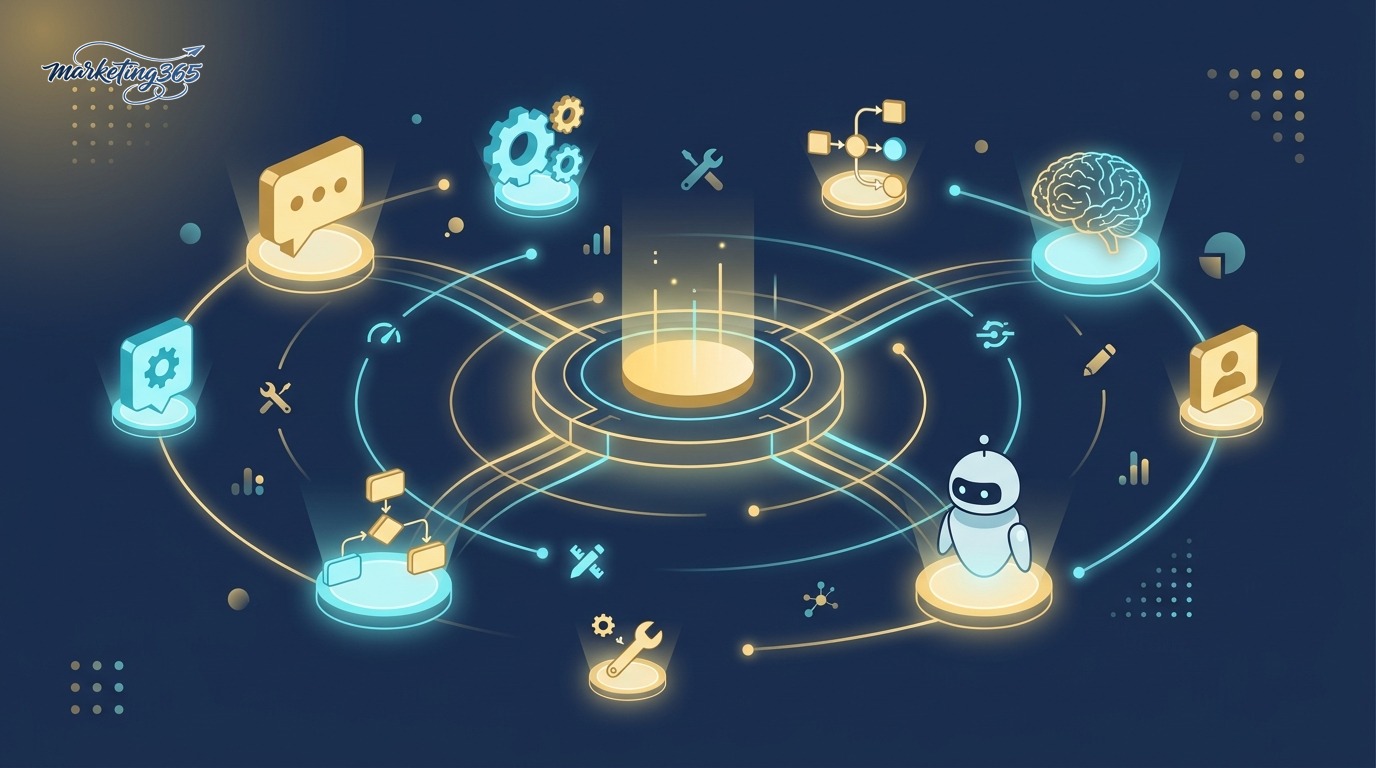
- Foundation models: Claude from Anthropic and the models from OpenAI are the two most widely used “brains” for building agents, thanks to their strong reasoning and tool-calling capabilities.
- Automation & orchestration platforms: n8n is a very suitable no-code/low-code tool for connecting AI with hundreds of services (Google Sheets, Facebook, email, CRM) and building real agent workflows without heavy programming.
- Connection standard: MCP (Model Context Protocol) is an open protocol that helps agents access tools and data securely and consistently – the foundation for a new generation of agents that can “plug into” any enterprise data source.
To go deeper into each platform, you can read the dedicated articles on Claude, what OpenAI includes, and how to use n8n to build automated marketing workflows. These are the three practical building blocks the Marketing365 team uses every day.
Real-world AI Agent examples in marketing
That is the theory, but where does an AI agent create value? Below are four use cases that many marketing teams are implementing in 2026.
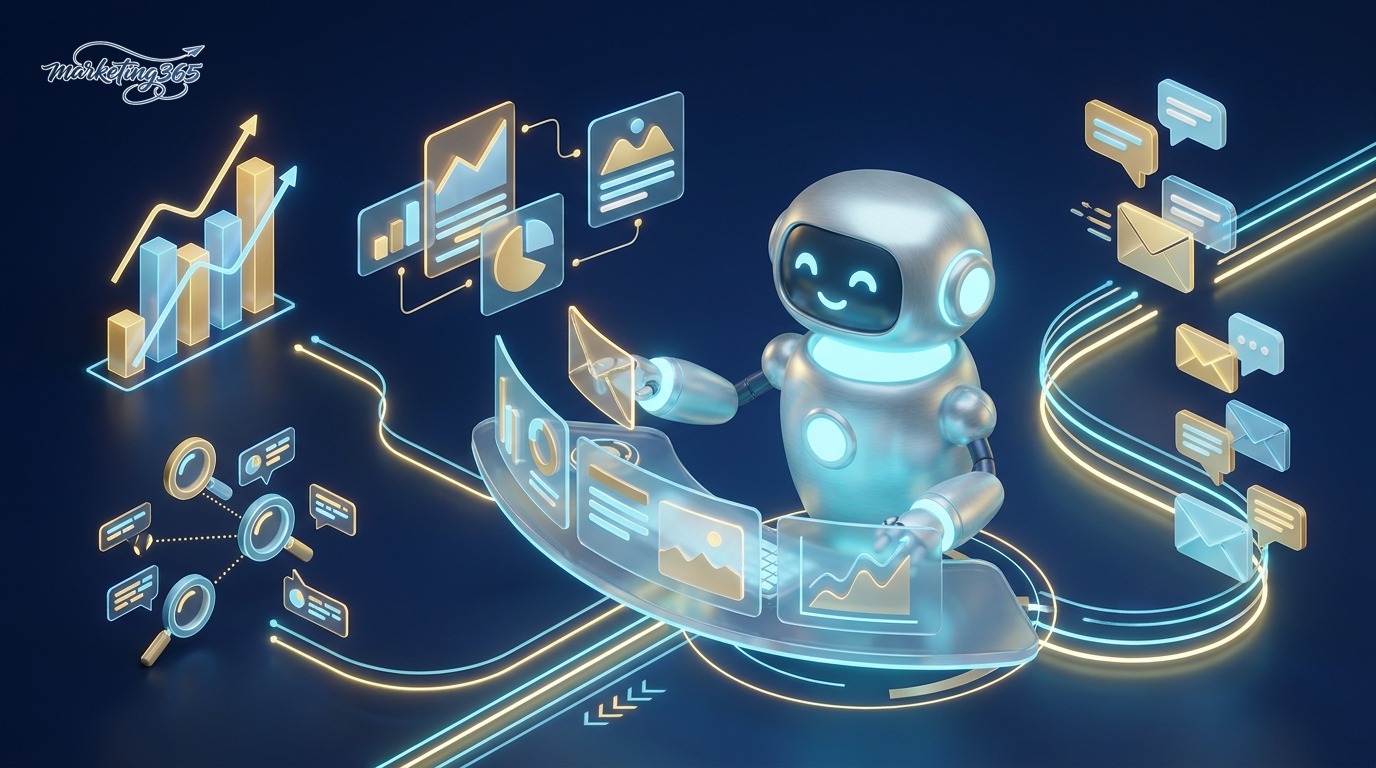
1. Keyword and competitor research. The agent automatically finds related keywords, scans Google’s top results, summarizes content gaps, and outputs a topic recommendation table with priority levels. Work that used to take half a day now takes only a few minutes, and you only need to review it.
2. Mass content production. From a list of topics in Google Sheets, the agent writes SEO articles one by one, generates illustrative images, checks the on-page checklist, and pushes drafts to the CMS for editorial review. This is the model behind many automated content feeders running in the background of news sites.
3. Lead nurturing and qualification. When a new lead comes in, the agent reads the information, scores the potential, tags it in the CRM, drafts a personalized reply email, and alerts the sales team about hot leads that need an immediate call – all within seconds after the form is submitted.
4. Automated reporting. At the end of the week, the agent gathers data from Google Analytics, ads, and social media, writes a readable Vietnamese summary with trend commentary, and sends it to the team chat channel. You receive a report with insights instead of a pile of dry tables.
Why are AI Agents important for marketers?
AI agents are not just a trendy tool – they change how a small marketing team can compete with a larger one.
- Amplify capability, not replace people: agents handle repetitive work so you can focus your time on strategy and creativity.
- Faster time to market: the time from idea to content draft is reduced from days to minutes.
- Consistent & measurable: agents follow fixed processes, so output quality is stable and easier to control.
- Low marginal cost: doubling content volume does not mean doubling headcount.
Important note – human-in-the-loop: the more authority an agent is given (sending emails, publishing posts, spending ad budget), the more human approval is needed at risky points. The best model in 2026 is still “agent does the work – human makes the final call”: let the agent handle 80% of the heavy lifting and keep humans in the final approval stage.
How to get started with AI Agents (5-step roadmap)
You do not need to know how to code to begin. Here is a practical 5-step roadmap:
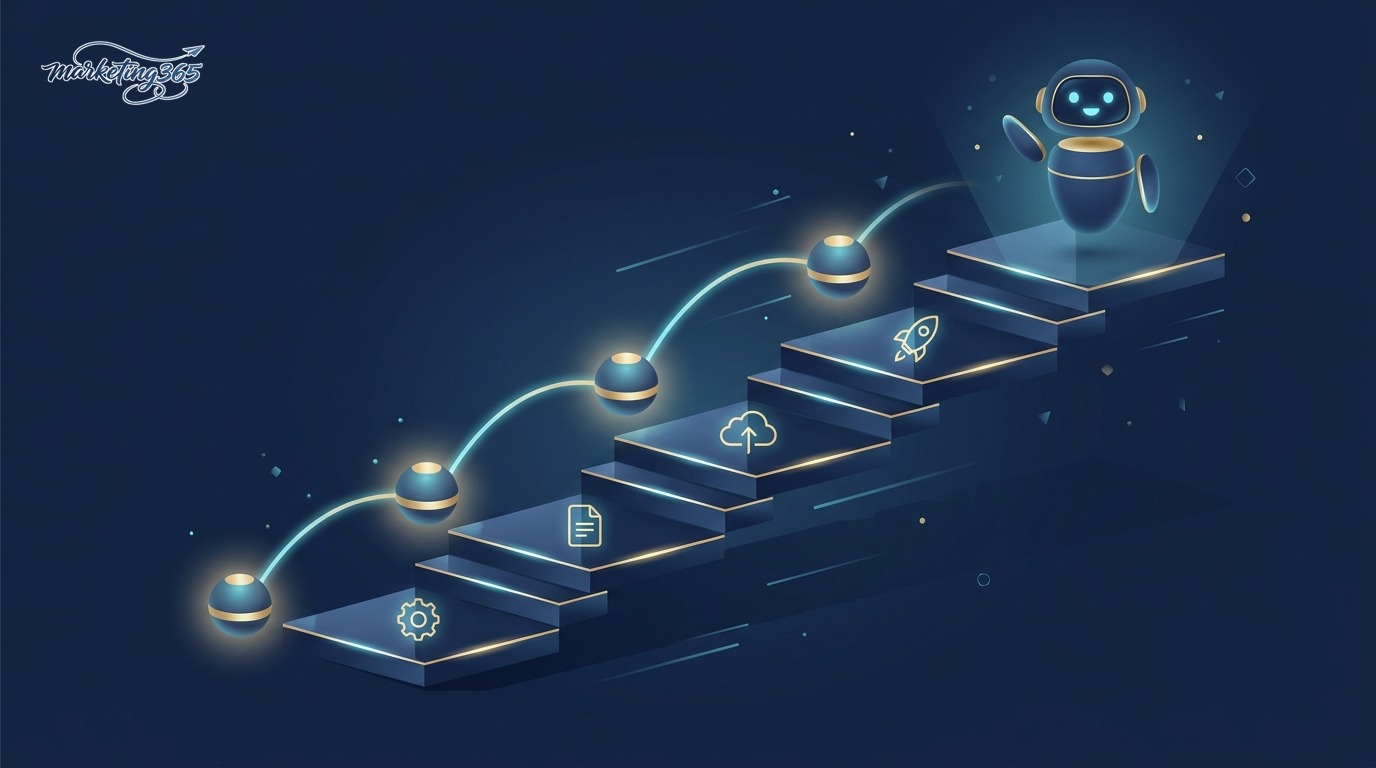
- Choose one repetitive process: start with something small and clear – for example, “summarize customer feedback every morning” or “draft 3 captions a day.”
- Write the goal and boundaries clearly: specify exactly what the agent can do, cannot do, and where it needs your approval.
- Choose the right platform: use a strong LLM as the brain and an orchestration tool like n8n to connect it to your data.
- Run a supervised trial: let the agent work on real data, but review every output for the first 1–2 weeks to fine-tune it.
- Expand gradually & measure: once you trust it, grant more permissions and extend it to the next workflow; always monitor quality and cost.
The golden rule: start narrow, win one small task first, then expand. One agent that does one thing well is more valuable than ten agents that do ten things poorly.
Frequently asked questions
How is an AI Agent different from a chatbot?
A chatbot answers questions in a single question-and-answer exchange. An AI Agent plans multiple steps, uses tools, and self-adjusts until the goal is completed. Simply put, a chatbot talks, while an AI agent does.
Can marketers who do not know how to code use AI Agents?
Absolutely. No-code/low-code platforms like n8n let you build agent workflows by dragging and dropping and describing goals in natural language. The most important skill is process thinking, not programming.
Should I choose Claude or ChatGPT to build an agent?
Both are strong. Claude from Anthropic is often rated highly for long-form reasoning and stable tool use; ChatGPT from OpenAI has a broader ecosystem and many built-in integrations. Practical advice: try the same task on both, then choose based on output quality and your actual cost.
Will AI Agents replace marketers?
No. AI agents replace repetitive tasks, not strategic thinking, aesthetic judgment, or customer understanding. Marketers who use AI Agents well will outperform those who do not – this is a shift in role, not the disappearance of the profession.
What is MCP and why does it matter?
MCP (Model Context Protocol) is an open standard that helps agents connect securely and consistently to external tools and data. Thanks to MCP, you do not need to build separate integrations for each data source, making it much faster to build and scale agents.
Is the cost of using AI Agents high?
The main cost comes from model token usage and tool fees. For most small and medium marketing workflows, the monthly cost is often much lower than hiring additional staff for the same amount of work. Start small and measure the cost on one workflow before scaling.
Are there any security risks to watch for?
Yes. Limit the agent’s permissions according to the principle of least privilege, do not expose sensitive API keys unnecessarily, log every action, and place human approval points on risky operations such as mass email sending or ad spending. The best security combines narrow permissions with human-in-the-loop oversight.
In short, understanding what an AI Agent is is the foundation you need to tap into the 2026 marketing automation wave: from a model that can answer, you move to an AI agent that can plan and act toward your goals on its own. Start with one small process, keep humans at the final approval stage, then expand gradually. To continue, explore the in-depth articles in Marketing365’s AI Guide series.
Updated: June 2026. AI tools change quickly — please refer to the provider’s official documentation for the latest information.