
Contents
The latest wave of AI is no longer centered on “who has the biggest model,” but on “who can turn a model into a usable product that is cheaper and lasts longer.” For Vietnamese marketers, that is a crucial signal because it directly affects the cost of content production, chatbots, automation, and customer experience.
What stands out is that developments are coming from multiple directions at once: Google is rumored to be preparing to bring Gemini 3.5 Pro back into the race, Alibaba is pushing Qwen 3.8 Max to market with a promise of better performance at a lower cost, while Anthropic and DeepSeek are both showing that competition is gradually shifting from “launching models” to “who operates best in practice.”
- Key point: AI advantage is shifting from launch speed to cost, usefulness, and workflow integration.
- A strong model is not enough; the model with good pricing, long context, and support for agentic tasks will be more attractive to product and marketing teams.
- Open-weight, free access, and integration ecosystems are becoming levers for winning users faster than traditional advertising.
- Vietnamese businesses should evaluate AI based on real operational efficiency rather than benchmark scores or social media hype.
Rumors around Gemini 3.5 Pro signal a market reordering
What is happening can be understood as a kind of “market reordering” in AI. On one side, signals around Gemini 3.5 Pro suggest Google has not left the race at all; rumors that the model could launch in August and be optimized for frontend, UI/design, and agentic tasks show that it is aiming at real-world value creation rather than just better technical metrics. On the other side, the discussions around Qwen 3.8 Max emphasize a very different formula: massive scale, long context, multimodal capabilities, but driven by the message “better and cheaper” and, at times, even free access.
Not only that, Anthropic is being pulled into the closed-versus-open debate, with the view that model weights will ultimately be difficult to keep secret forever, and that if long-term safety is the goal, the focus should be on safe open-weight models rather than just access control. Meanwhile, DeepSeek is said to be moving closer to a dedicated coding agent, showing that competition is no longer only about foundation models but about tools that execute work.
In other words, the market is moving from “announcement hype” to an “ecosystem of capabilities”: whoever has a better, cheaper, more open, or better-integrated model will have a clearer commercial advantage.
Cost and utility are winning user acquisition
Qwen 3.8 Max is the clearest example of this trend. The cited sources all emphasize 2.4 trillion parameters, around 95B active, a 1 million token context, multimodal support, and especially the message of low cost and broad availability. Some posts even compare Qwen’s output cost with GPT-5.6 Sol and Opus 5, showing that even when quality is comparable in certain tests, lower operating costs can create a much stronger “worth trying” effect.

That matches how product and marketing teams buy tools: they do not need the “number one model” on paper, they need a model that helps run campaigns, analyze data, write content, or build prototypes at a low total cost. By the same logic, the signals around Gemini 3.5 Pro are not focused on noise but on real improvements in UI, design, and agentic tasks. When a model handles end-to-end tasks better, it moves from “demo” to “infrastructure.”
For marketers, this is a reminder that the AI race is no longer just a race for vendor prestige. End users will be more loyal to the tool that saves time, delivers stable results, and integrates smoothly into daily workflows.
The ecosystem is becoming the real battleground
Looking deeper, signals from OpenRouter, AI Gateway, and the API integrations around Qwen show that model providers need a shorter path to real users. It is not enough to “launch a model”; they also have to appear where developers and businesses already have workflows in place. That is why announcements about OpenRouter, AI Gateway, free credits, or open weights have major commercial significance: they reduce trial friction.
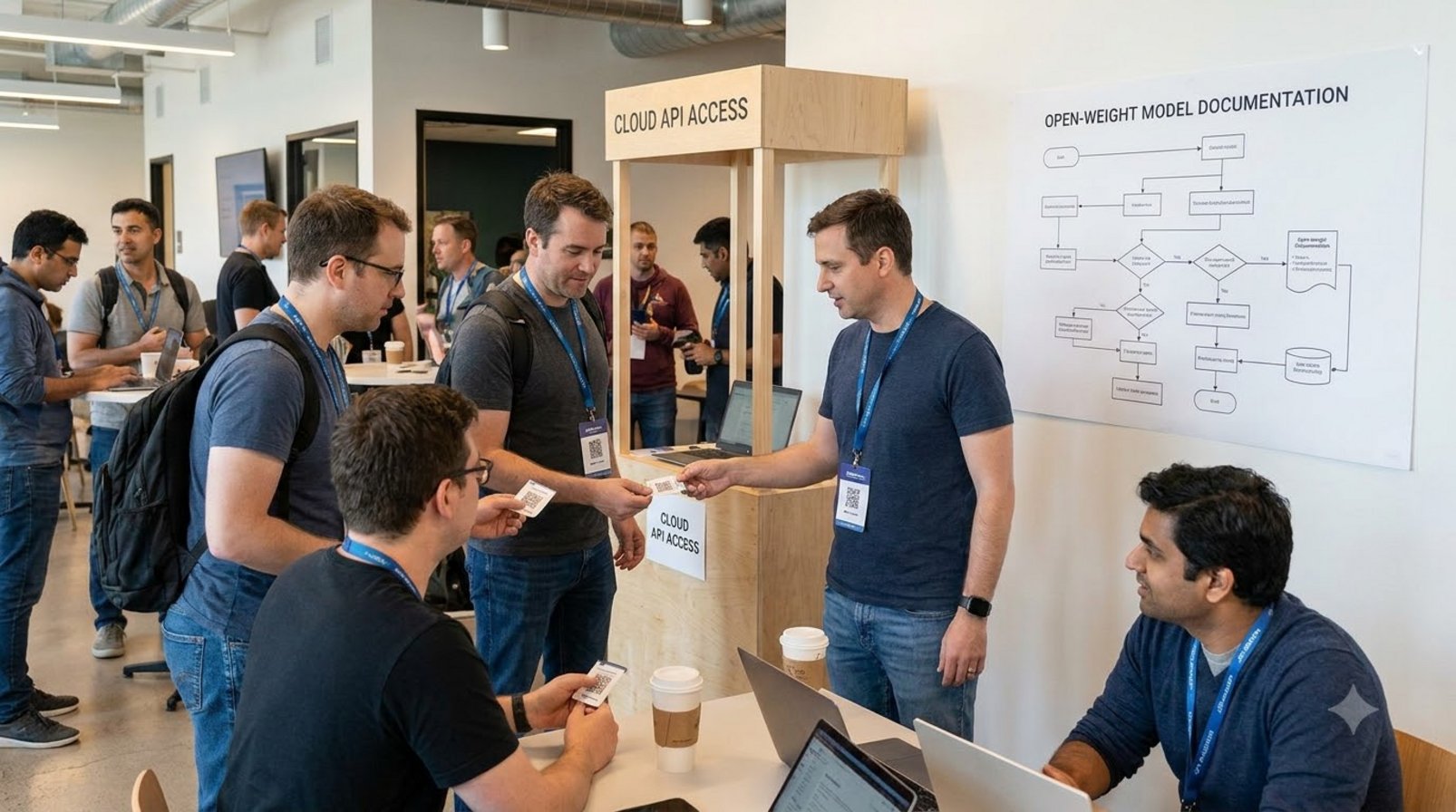
On the other side, DeepSeek Harness is rumored to be moving closer to a dedicated coding agent, while the debates around Claude Code and open-weights show that the market is prioritizing tools that can handle long-running, automated, and repetitive work. When tasks become agentic, the value is not in a single answer but in the ability to complete an entire chain of work.
This also explains why updates related to memory infrastructure such as HBF matter more than their technical appearance suggests. As inference grows rapidly, the issue is not only how smart the model is, but also where the data is stored and how it moves. Even if HBF is not yet a replacement for HBM, the standardization steps and Google/DeepMind’s involvement show that the AI race is moving down to the infrastructure layer, where cost and performance advantages are determined over the long term.
Vietnamese businesses should choose AI by the work it needs to do
For Vietnamese businesses and marketers, this trend has three practical implications. First, the criteria for choosing AI need to shift from “which model is trending” to “which model best reduces the cost of content production, customer support, research, and coding.” Second, teams should track open-weight options, low-cost models, or those with free tiers, because these are where quick experimentation is possible before committing a large budget. Third, if one model is stronger but only performs well in benchmarks, while another is cheaper and integrates better with real workflows, the optimal choice for Vietnamese businesses is often the latter.

Another notable point is that the international competitive landscape could push AI prices down faster. That opens the door for Vietnamese SMEs to access capabilities that were previously only affordable for large enterprises: market research, multi-version content generation, landing page creation, sales support, or internal assistants. But the opportunity only becomes effective if businesses define the problem first and choose the tool second.
Run the same business task through two or three models

- Review marketing workflows where AI can reduce working time: research, drafting, ad optimization, customer segmentation, and FAQ responses.
- Test 2–3 different models on the same real business task, then compare them based on cost per acceptable result rather than benchmark scores alone.
- Prioritize platforms with clear APIs, free tiers, or open weights so the team can experiment quickly without burning budget from the start.
- Build an internal AI criteria set covering accuracy, speed, cost, integration capability, and data risk; do not choose based on social media noise.
In short, the current AI race is not just about who has the “bigger” model. The real race is who can turn a model into a cheaper, more useful, and more work-relevant operating capability. For Vietnamese marketers, this is the moment to shift focus from tracking announcements to optimizing application.
See more marketing analysis and how-to content at https://marketing365.vn.
Follow more analysis from Marketing365 to stay updated on the latest marketing trends.
Read more articles in the same category AI Developments.
References
- Gemini 3.5 Pro leaks and launch timing discussion
- BridgeMind on Gemini 3.5 Pro and Google’s comeback
- Qwen 3.8 Max launch, free access and model details
- Alibaba Qwen on Qwen3.8-Max better and cheaper
- Qwen 3.8 Max availability on OpenRouter and open weights
- Anthropic open-weights discussion and safety debate
- DeepSeek Harness moving closer to launch
- HBF consortium and tiered memory discussion