
Contents
- What are Facebook Ads and Google Ads in a comparison context
- Comparing Facebook Ads and Google Ads by business goals
- Comparing cost, CPC, and budget allocation
- Comparing targeting, the customer journey, and brand reach
- Comparing conversion performance for online sales and services
- Where should you advertise when resources are limited?
- Common mistakes when comparing Facebook Ads and Google Ads
- When to seek professional support
- Frequently asked questions about comparing Facebook Ads and Google Ads
When budgets are limited, choosing the wrong ad channel often wastes money before it wastes time. That is why comparing Facebook Ads and Google Ads should start with the goal: do you need quick orders, brand awareness, or clear conversion tracking? This section puts the two channels on the same criteria so store owners, small businesses, and marketers can see which one fits real needs, from user behavior and targeting to cost and performance measurement. After reading, you can compare them yourself and know which channel to prioritize in each situation instead of choosing by instinct.
What are Facebook Ads and Google Ads in a comparison context
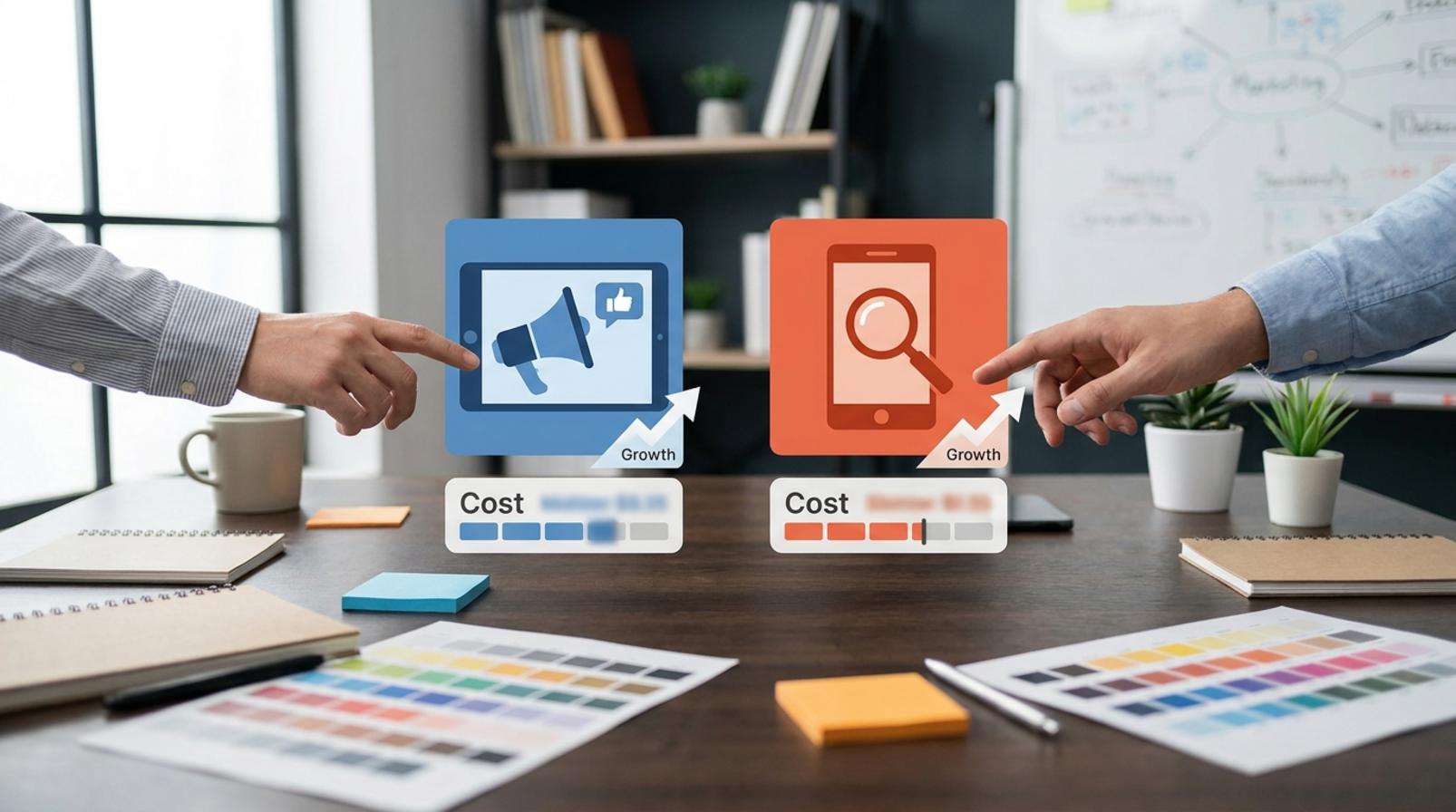
Facebook Ads is an advertising channel on social media that reaches users based on interests, behavior, and past interactions; Google Ads is a search advertising channel that reaches people who have already typed in a specific need. When comparing Facebook Ads and Google Ads, the core difference is that Facebook creates demand, while Google captures existing demand.
A cosmetics shop often uses Facebook Ads to run 15-second videos, before-and-after images, or Reels for women aged 22–35 in Hanoi. By contrast, an air conditioner repair service will prioritize Google Ads when users search for “air conditioner repair District 7” or “home air conditioner maintenance.” If you need a quick rule of thumb, look at intent: Facebook is strong for reach and remarketing, while Google is strong for conversions from existing queries.
Facebook Ads is suitable when you need to create demand first
Facebook Ads is a good fit when a product needs to spark interest first and close later. Ads appear in the News Feed, Reels, and Stories, so they can easily capture attention from people who are not actively searching.
For example, an English conversation course can run a 20-second short video with a Sign Up button so viewers understand the benefits before visiting the consultation page. A fanpage selling household goods can also use remarketing to stay in front of people who watched 50% of a video or clicked on a post. This approach works well for products with a long consideration cycle and multiple touchpoints.
Google Ads is suitable when customers already have clear intent
Google Ads is suitable when users already know what they need and are comparing where to buy. Search ads appear right when they type keywords such as price, location, service, or brand, so they often generate clearer leads.
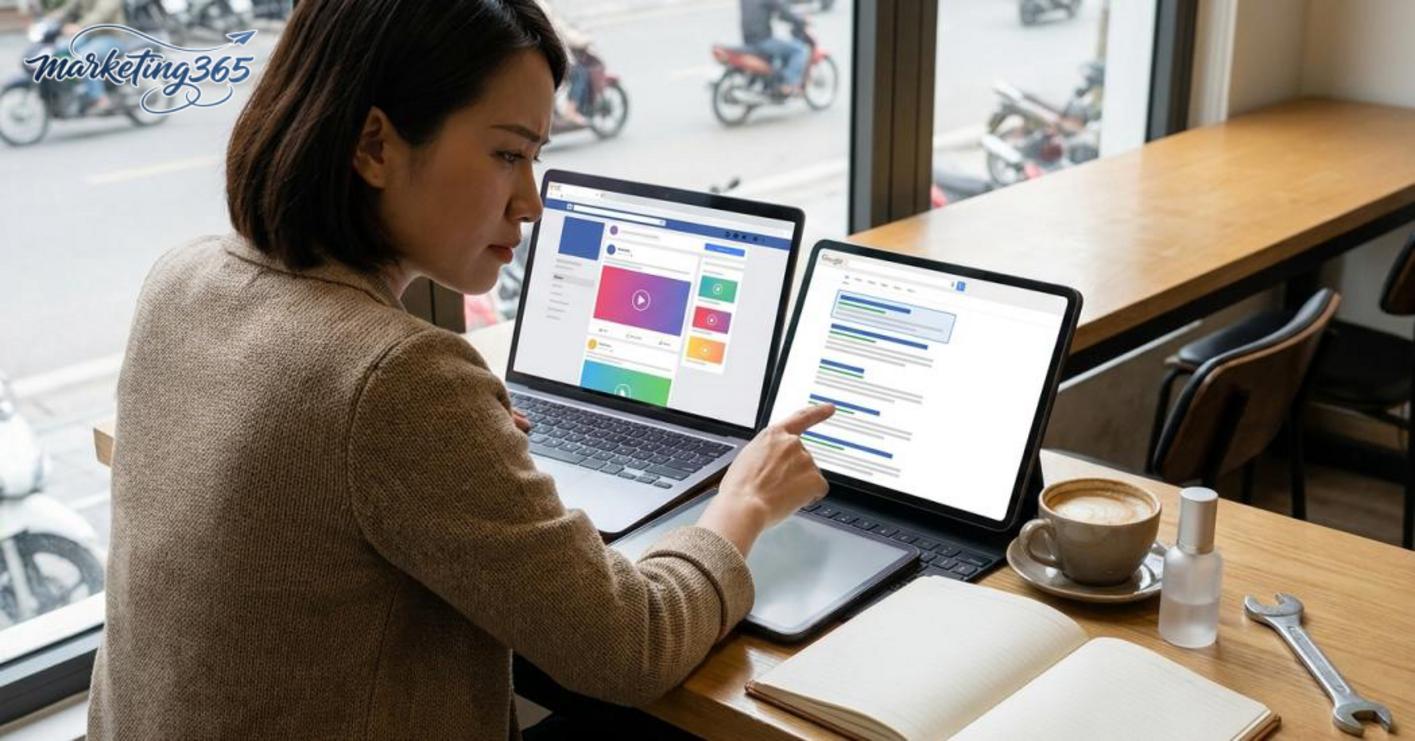
For instance, someone searching for “buy oak wood desk” is usually closer to a decision than someone casually browsing furniture on social media. For small businesses, Google Ads is often used to capture hot demand, measure conversions by keyword, and optimize based on real queries. Facebook Ads is a better fit if the goal is to expand reach, nurture engagement, and bring back people who have already viewed products.
Comparing Facebook Ads and Google Ads by business goals
Comparing Facebook Ads and Google Ads by business goals should start with the marketing funnel, not with the question of which channel is “better.” Facebook Ads is strong for brand reach, demand generation, and re-engaging people who have interacted; Google Ads is strong for capturing hot demand, keeping lead quality high, and closing sales when purchase intent is clear.
If the goal is awareness, Facebook Ads usually comes first because social ads deliver content to the right audience faster. If the goal is traffic, both can do it, but Facebook pulls users from content to the landing page, while Google pulls people who are actively looking for a solution. For leads, Google Ads often delivers better conversion performance when keywords closely match demand; Facebook Ads is better when you need to expand the audience and nurture it before the registration form appears.

For orders, choose based on the customer journey. Products that are easy to buy, low in value, and highly visual often suit Facebook Ads. Services with clear purchase intent, multiple providers to compare, or a need to filter serious prospects usually perform better on Google Ads. Remarketing is where the two channels complement each other: Facebook reminds with images and video; Google follows people who later return to search.
When to prioritize Facebook Ads
Facebook Ads should be prioritized when you need to test the market, launch a new product, or sell online with visual content. This channel works well when the audience is not yet familiar with the brand, because targeting by interests, behavior, and interactions helps expand reach quickly. If you already have video, carousel, livestream, or attention-grabbing offers, Facebook Ads often produces earlier signals.
Choose Facebook Ads first when you need to:
- Create awareness for a new product.
- Drive cold traffic to content or a landing page.
- Run remarketing for people who watched videos, messaged, or visited the website.
- Test multiple creative angles before finalizing the message.
When to prioritize Google Ads
Google Ads should be prioritized when demand is already clear and you need to capture purchase intent accurately. This channel is well suited to services that people actively search for, especially when lead quality matters more than quantity. If customers are comparing solutions, reading quotes, or searching for specific keywords, search ads often produce signals closer to conversion than social ads.
Choose Google Ads first when you need to:
- Capture hot demand from people looking for a solution.
- Get higher-quality leads.
- Drive sales for keywords closely tied to purchase intent.
- Optimize conversion performance at the bottom of the funnel.
The fastest way to decide is to look at the business goal first, then choose the channel. If you want brand reach and demand generation, prioritize Facebook Ads. If you want to close leads and orders from existing demand, prioritize Google Ads. When the budget allows, multichannel marketing is often more effective because the two channels reach different layers of the customer journey.
Comparing cost, CPC, and budget allocation
Cost in comparing Facebook Ads and Google Ads should be read as an input-output chain: CPC, CPA, conversion rate, and final revenue. A channel with cheap clicks is not necessarily the one that drives the best orders, while expensive clicks can still be effective if they match strong search intent and close well.

What cost should you look at: CPC, CPA, or revenue?
CPC tells you the cost per click, but CPA shows how much you pay for one lead or order. When Facebook ad costs and Google ad costs differ, compare ROAS as well to see how much revenue one advertising dollar generates.
For example, a fashion shop may have lower Facebook CPC, but orders come in more slowly because viewers are still browsing. By contrast, Google may have higher CPC on purchase-intent keywords, but a better conversion rate, resulting in a lower CPA. The correct way to read it is:
- Cheap clicks but no leads: stop or change the message.
- Expensive clicks but good ROAS: keep it.
- Traffic without conversions: check the landing page, form, pricing, and offer.
How should a small budget be split between the two channels?
With a small budget, do not spread it too thin from the start. Keep most of the ad budget on the channel closest to your goal, and set aside enough to test ads on the other channel for 7–14 days.
A simple budget allocation approach is:
- Prioritize Google if demand is already clear and users are actively looking to buy.
- Prioritize Facebook if you need to create demand, run remarketing, or reach cold audiences.
- Increase budget only when CPA is stable and conversion signals are consistent.
If the goal is online sales, Facebook and Google CPC costs should be read alongside how well each channel can scale on a small budget. Keep the channel that gives cleaner data and is easier to optimize first, then expand.
Comparing targeting, the customer journey, and brand reach
Comparing Facebook Ads and Google Ads comes down to how they reach users: Facebook targets people, while Google targets the demand they are searching for. As a result, the two channels deliver different levels of brand reach and conversion at each stage of the customer journey.
How Facebook Ads targeting differs from Google Ads
Facebook Ads is strong when you need to find the right audience based on interests, behavior, remarketing, or lookalike audiences. Google Ads is strong when users already have clear keyword intent, for example when they type a specific need and are closer to a purchase decision.
If you need to compare customer targeting on Facebook Ads and Google Ads, look at these three questions:
- Has the person actively searched yet?
- Are you trying to create demand or capture existing demand?
- Do you need to expand the audience or focus on high-intent queries?
For example, a furniture shop can use Facebook to reach people interested in home decor, then use Google to capture those searching for “buy corner sofa” or “small work desk.” This helps separate brand reach from conversion more clearly.
How the two channels move through the customer journey
Facebook is often more effective at the awareness and consideration stages because content can be repeated to improve recall. Google is often stronger at the deeper consideration and decision stages because users already have a specific query and conversions are easier to measure.

In multichannel marketing, the two channels should follow the sales funnel rather than operate separately. A simple structure is:
- Facebook to expand brand reach and nurture people who have already interacted.
- Google to close people with clear demand, especially when queries show purchase or comparison intent.
- Remarketing to bring back people who viewed but did not act.
When comparing Facebook Ads and Google Ads conversion performance, do not look only at order volume. Also look at which channel creates awareness, which one moves users toward the decision stage, and which one keeps conversions more stable at each stage.
Comparing conversion performance for online sales and services
Comparing the conversion performance of Facebook Ads and Google Ads should be based on the type of demand, not on a one-size-fits-all formula. Online sales, appointment-based services, and lead forms will produce different results because search behavior and purchase readiness differ.
Which channel should you choose for online sales?
For online sales, Facebook Ads is often a better fit when the product is visual, easy to spark interest in, and can be closed quickly through inbox or a landing page. Categories such as fashion, cosmetics, accessories, and light household goods often benefit from social commerce because buyers can see it, like it, and click to buy in the same session.
If the product already has clear demand, Google Ads has the advantage in search queries. For example, when users type “long-lasting lipstick for dark skin” or “air purifier for bedroom,” they are already far along in the buying journey. In that case, comparing Facebook Ads and Google Ads conversion performance must focus on purchase intent, not just click cost.
Quick selection guide:
- If the product is emotional and visual, prioritize Facebook.
- If the product has clear search keywords, try Google first.
- If you need both reach and closing power, separate campaigns by conversion goal instead of combining them into one ad group.
Which channel should you choose for services or leads?
For services, Google Ads is often stronger when customers already have a need and are searching for a solution. Categories such as repairs, legal services, dentistry, short courses, and local services often generate leads more easily from specific queries than from a social media feed.

Facebook Ads is a good fit when the goal is to nurture demand, build remarketing audiences, and generate cheaper leads in the early stage. A small agency can use Facebook to collect engagement, then retarget people who watched videos, opened forms, or visited the service page. For lead generation, what matters is not just the number of leads, but whether the leads have enough information, the right need, and a real chance to close.
Channel selection checklist:
- Has the customer already searched for the service? Prioritize Google.
- Does the customer not yet know what they need? Prioritize Facebook.
- Is the buying decision long or short? Long decisions need remarketing; short ones need clear queries.
- Is the goal orders or leads? Separate the KPI before launching.
Where should you advertise when resources are limited?
When resources are limited, advertise where you are closest to your goal and where you can actually handle the results, not based on instinct. If you need to sell quickly to people who already have demand, Google Ads is usually a better fit; if you need to create demand, test audiences, and expand reach, Facebook Ads is easier to start with.
Questions to ask before deciding on a primary channel
Use these five short questions to choose your main channel and avoid wasting budget where you cannot handle it:
- Is the goal immediate sales, leads, or awareness?
- Is the budget enough to run for at least 2–4 weeks and monitor consistently?
- Does the product/service already have search demand, or does it need demand generation?
- Do you have enough content, images, video, and offers to test multiple variations?
- Are the landing page, inbox, and conversion tracking ready?
If the answers lean toward existing demand, a clear landing page, and a lean lead-handling team, prioritize comparing Facebook Ads and Google Ads from the perspective of capturing search demand. If the audience is still cold, the product needs a lot of explanation, or visual content is stronger, start with social media and expand from there.

When it makes sense to combine both instead of choosing one
Combining the two channels makes sense when one creates demand and the other closes it. This is a common approach in multichannel marketing: Facebook Ads brings in new audiences, Google Ads captures people who are searching, and remarketing reminds those who viewed but did not buy.
For example, a furniture shop can use Facebook Ads to showcase designs, features, and styling ideas; then use Google Ads for people searching for “office chair” or “small work desk.” This combination works better when you already have enough people handling inbox messages, enough landing pages, and the ability to read data so you do not cut a channel too early just because orders have not appeared yet.
Common mistakes when comparing Facebook Ads and Google Ads
When comparing Facebook Ads and Google Ads, the biggest mistake is using a single metric to judge the entire channel. Low CPC is not necessarily good if the leads are weak; lots of clicks and likes do not automatically mean sales. The right approach is to compare the goal, the customer journey, and conversion quality before optimizing the campaign.
Choosing by instinct instead of by goal
This mistake happens when advertisers choose a channel because “everyone is running it” or because they are more comfortable with one platform. A common sign is evenly spread budget with no clear objective: awareness, lead generation, or closing sales.
- If you need active demand, Google Ads is usually a better fit.
- If you need to create new demand, Facebook Ads is usually easier to scale.
- If the goal is unclear, do not compare the pros and cons of Facebook Ads and Google Ads based on feeling.
The fix is to lock in one primary goal first, then evaluate channels by the sales funnel, customer audience, and time to results. For a small shop, simply changing from “test both” to “which channel serves this week’s goal” can already reduce many bad decisions.
Misreading data and optimizing the wrong channel
Many people look at clicks, likes, or CTR and then conclude which channel is more effective. This is a very common advertising mistake because it ignores conversion tracking, lead quality, and close rate.
For example, a campaign with many clicks but forms filled with junk information is still poor. By contrast, a channel with fewer clicks but real, qualified leads is worth keeping.

When analyzing performance, compare three layers of data:
- Behavior: clicks, page views, time on site.
- Conversions: form fills, messages, purchases.
- Final results: revenue, close rate, cost per order.
Only by reading all three layers can you see where comparing Facebook Ads and Google Ads is accurate and where you are optimizing the wrong channel.
When to seek professional support
When data, budget, or tracking is no longer under control, it is best to seek professional support to check the system before optimizing further. The goal is to fix the real cause and avoid spending more on a campaign or channel whose performance cannot yet be measured.
Signs you should get help instead of continuing to optimize on your own
If you cannot read the conversion report, costs are rising but leads are not changing, or the landing page is not recording events, it is time to stop experimenting on your own. With comparing Facebook Ads and Google Ads, if tracking is wrong, every optimization decision can easily go off course.
Prioritize checking the campaign by impact level: pixel installation errors, wrong events, destination URL, and only then ad content. Do not add more budget before you know whether the problem is in the channel, the landing page, or the account structure.

What to prepare before handing it over to a support team
Before handing it over, gather the goals, campaign history, account structure, ad data, and landing page status. A clear handoff checklist helps the professional support team get started faster and avoids wasting time retracing everything from scratch.
You should note: the main goal, the metrics being tracked, recent changes, the ad groups that have run, and any access restrictions. If you have reports from Google Analytics or Google Search Console, include them so conversion data can be compared and the campaign can be checked more accurately.
Frequently asked questions about comparing Facebook Ads and Google Ads
Facebook Ads is often more suitable for beginners if the goal is to test demand quickly and read audience reactions. Google Ads is a better fit when users already have clear search intent, such as actively typing product or service keywords.
- If you need quick reach, prioritize Facebook Ads.
- If you need to close on the right demand, prioritize Google Ads.
- If your budget is small, do not run both from the start; choose one channel to measure performance first.
Should you run Facebook Ads and Google Ads at the same time? Yes, but only if the landing page is already strong enough and you know which channel converts better. For a small shop, running both in parallel without separating goals often makes the data too noisy to tell which channel is driving orders.
Why is low CPC not necessarily effective advertising? Because CPC only reflects the cost of one click and does not tell you whether the person who clicked will buy. A campaign with low CPC but poor conversion can still cost more than a campaign with higher CPC that produces steady orders.

When should you prioritize Google Ads over Facebook Ads? When the product already has search demand, the order value is high enough to cover click costs, and you need to appear exactly when customers are comparing options. In comparing Facebook Ads and Google Ads, the difference lies in the customer journey: Facebook creates demand, while Google captures existing demand.
Choosing the right channel is not about which one is cheaper, but which one matches your goal, audience, and ability to measure conversions.
For official and up-to-date guidance, you can also refer to resources from Meta for Business.
You can also find more practical marketing guides at https://marketing365.vn.
Content from marketing365 is created for SMEs, online shop owners, and new marketers.
You can also read more articles on the same topic in the Performance Ads category.