

Contents
Multi-agent orchestration means breaking a large task into multiple specialized agents that coordinate through a controlled workflow, instead of letting a single agent “handle” everything. The approach involves choosing the right orchestration model and using tools such as agent frameworks or the low-code n8n platform to connect agents and decide which agent runs, and in what order.
Key points
- Using multiple agents enables specialization, keeps context cleaner, supports parallel execution, and makes testing/replacement easier, at the cost of higher token usage and more operational complexity.
- The five classic orchestration models are orchestrator–workers, prompt chaining (sequential chaining), routing, parallelization, and evaluator–optimizer.
- Orchestration tools include frameworks such as LangGraph, CrewAI, Microsoft AutoGen, or low-code platforms like n8n, which is well suited for SMEs without large engineering teams.
- Marketing example: an agent chain for research → outline → writing → editing (evaluator) → publishing, with an orchestrator deciding when to move to the next step, repeat, or stop.
- Avoid common mistakes: overusing multi-agent setups, context leakage, missing stop conditions, and not handling errors; start simple, measure, then scale.
Understanding how to orchestrate multiple AI agents is becoming a core skill for every marketer and SME team looking to automate work at scale. When a task goes beyond the capabilities of a single AI assistant — for example, researching the market, writing content, and scheduling posts — you need multiple specialized agents working in sync rather than one model “handling” everything. This article explains the true nature of multi-agent orchestration, common orchestration models, execution tools, and a marketing use case.
Why orchestrate multiple AI agents instead of using a single agent?
A single AI agent works well for compact tasks, but starts to struggle as requirements expand. The reason is that the context window is limited, and when too many instructions, tools, and data are packed into one prompt, output quality drops noticeably. Splitting the work across multiple agents helps each one maintain a narrow, clear, and more controllable role.

If you are not yet familiar with the basics, read What is an AI agent first to understand what makes up an agent before combining them.
The main benefits of using multiple agents:
- Specialization: each agent has its own instructions, tools, and knowledge for a specific task (research, writing, moderation).
- Cleaner context: child agents handle their own work and return only summarized results, avoiding overload in the main agent’s context.
- Parallel execution: independent tasks can run at the same time, reducing completion time.
- Easier testing and replacement: modifying or upgrading one agent does not break the whole system.
Anthropic also notes that multi-agent architectures trade off higher token costs and greater operational complexity, so they should only be used when the task is valuable enough to justify it (see the guide to building effective agents in Anthropic’s technical documentation).
Common orchestration models
“Orchestration” is how you decide which agent runs, in what order, and how data is passed between them. There are several classic models, each suited to a different type of problem:
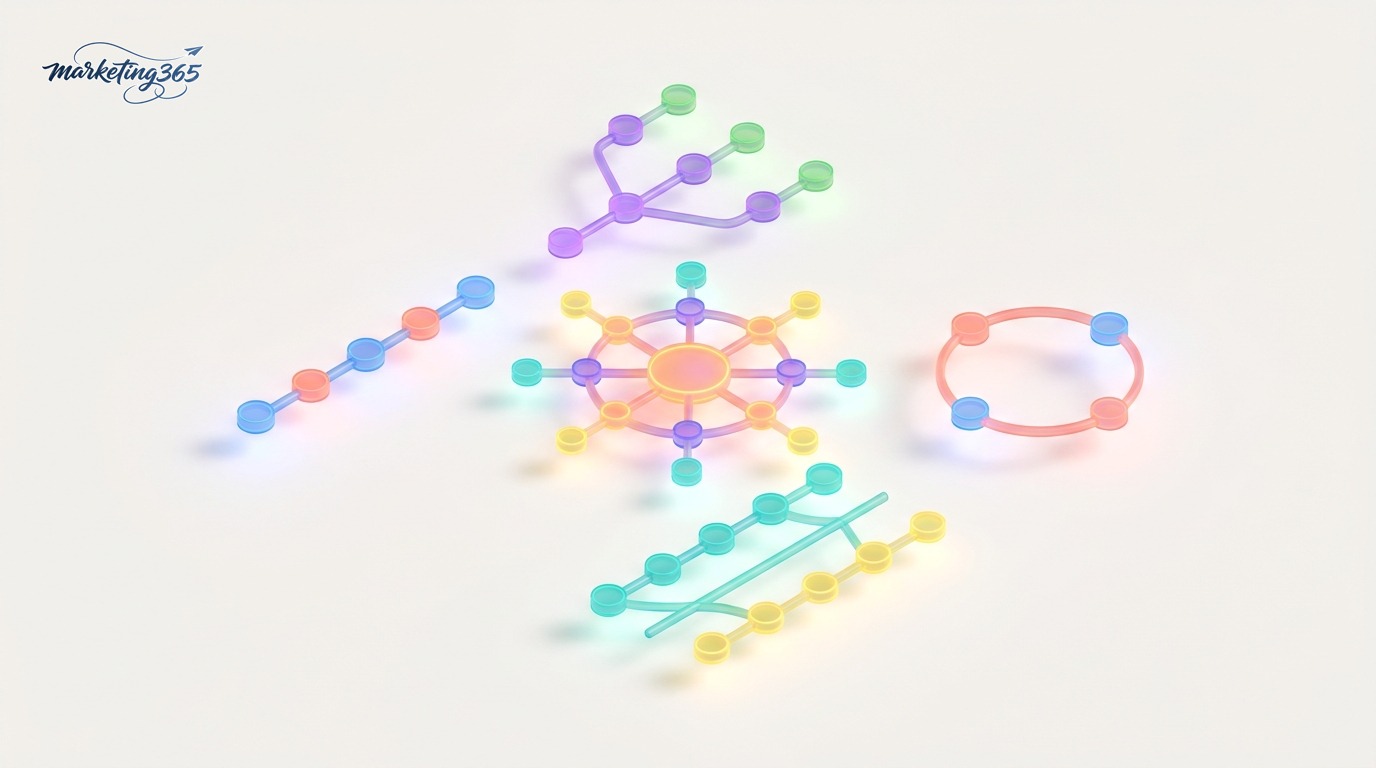
- Orchestrator – Workers: a central agent receives a large request, breaks it into subtasks, assigns them to worker agents, and then aggregates the results. This is the most flexible model when you do not know in advance how many steps are needed.
- Prompt chaining: the output of one agent becomes the input of the next in a fixed workflow, for example research → writing → editing.
- Routing: one agent classifies the input and sends it to the appropriate specialist agent, for example routing customer questions to the correct handling flow.
- Parallelization: multiple agents process independent parts at the same time, after which one agent combines the results; useful for generating multiple content variations at once.
- Evaluator – Optimizer: one agent creates a draft, another scores it and provides feedback, repeating until the criteria are met.
The key point: start with the simplest workflow possible (usually a sequential chain) and only move to a more complex orchestrator model when truly necessary. OpenAI describes these single-agent and multi-agent patterns in detail in its developer guide at platform.openai.com/docs.
Tools for orchestration: harness and n8n
You do not need to build the entire orchestration layer from scratch. There are two common tool groups:

1. Harness / agent framework. A “harness” is the execution layer wrapped around an AI model: it manages the model call loop, tool calls, state storage, and child-agent orchestration. If you want to understand this concept in depth, see what harness AI is. Frameworks such as LangGraph, CrewAI, and Microsoft AutoGen provide built-in mechanisms for defining multiple agents, roles, and the information flow between them — Microsoft summarizes AI agent design patterns at Azure Architecture Center.
2. Low-code automation platforms like n8n. For SMEs without large engineering teams, n8n is a practical way to “wire together” multiple agents: each node can call a different AI model, results flow through logic nodes (conditions, merges, loops), and then are pushed to Google Sheets, WordPress, or social media. n8n includes AI Agent nodes and step-by-step workflow guidance at docs.n8n.io.
To visualize how to build each agent before orchestrating them, you can refer to how to build an AI agent — mastering one agent before combining many will save a great deal of debugging time.
Example of multi-agent orchestration for a marketing campaign
Suppose an SME wants to automatically produce one SEO blog post per day. Instead of one giant prompt, we split the work into an orchestrated agent chain:
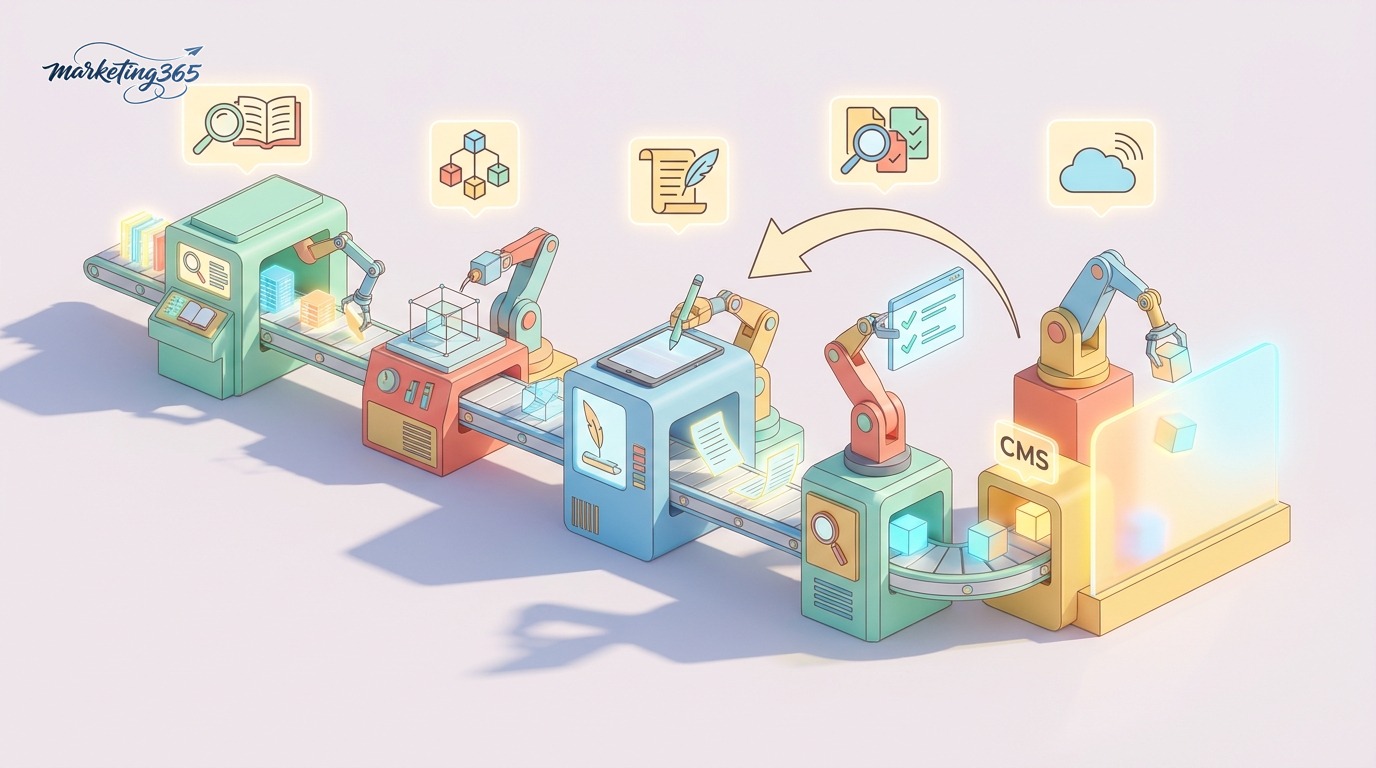
- Research agent: gathers keywords, news, and competitor data, then returns an insight summary.
- Outline agent: takes the insights and creates a structured H2/H3 outline with clear intent.
- Writing agent: writes the draft based on the outline, in the brand’s voice.
- Editing agent (evaluator): checks accuracy, optimizes keywords, and scores the draft; if it is not good enough, it sends it back to the writing agent for revision.
- Publishing agent: pushes the approved content to the CMS and schedules distribution.
An orchestrator agent coordinates the entire chain: it decides when to move to the next step, when to repeat the editing step, and when to stop. This is the combination of the prompt chaining and evaluator–optimizer models described above. Once you have the foundation, you can expand into more complex scenarios covered in AI agents for marketing automation.
A few principles help keep this workflow stable: define clear input-output “contracts” between agents (fixed formats such as JSON), always include a human-in-the-loop review step for sensitive stages, log each step for traceability, and set loop limits and token budgets. If you want to go deeper into implementation, our AI guide series walks through each practical step.
Common mistakes when orchestrating multiple agents
Many teams fail at multi-agent implementation not because the model is weak, but because the orchestration design is not sound. Common mistakes include:
- Overusing multi-agent setups: using five agents for something one agent could do, needlessly increasing cost and latency.
- Context leakage: passing the entire history verbatim between agents instead of only the necessary parts, causing context window overflow.
- Missing stop conditions: an evaluator–optimizer loop without a clear exit condition runs forever.
- Not handling errors: when one agent returns an empty result or an error, the whole chain collapses because there is no fallback path.
The best way to avoid this is to start small, measure, and then scale — in line with the “simple first, complex later” mindset recommended by both Anthropic and OpenAI.
Frequently asked questions
Is multi-agent orchestration difficult for non-coders?
Not necessarily. With low-code platforms like n8n, you can drag and drop AI and logic nodes to create a multi-agent workflow. However, you still need to understand the orchestration logic well (order, conditions, stopping points) for the system to run reliably.

How is multi-agent orchestration different from calling an API multiple times?
Calling an API multiple times is only sequential execution. Agent orchestration adds a decision-making layer: agents can choose tools, repeat steps, route tasks, and respond to one another based on actual results.
Should small businesses use one agent or multiple agents?
Start with one agent until you hit its limits (context overload, too many tools, declining quality). Only then split the work into specialized agents — this is the most cost-effective and maintainable approach.
Is the cost of orchestrating multiple agents high?
Yes, because each agent consumes its own tokens and model calls. You should set token budgets, use smaller models for simple tasks, and reserve stronger models for steps that require deeper reasoning.