
Contents
- What is a million-view TikTok video script, and why shouldn’t you write by instinct?
- Short video script structure: first 3 seconds, retention section, and closing point
- How to write a million-view TikTok script for different popular video types
- Common script mistakes that make videos hard to retain viewers
- A template for writing your own TikTok script for a personal or sales channel
- When should you review, reshoot, or edit before posting?
- Frequently asked questions about million-view TikTok video scripts
Million-view TikTok video scripts are not a formula that guarantees top rankings, but a writing framework that gives your video a better chance of keeping viewers engaged. For shop owners, marketers, personal channel admins, or TikTok beginners, the three things that matter most are: a 3-second hook, a short script rhythm, and details that keep viewers watching until the end. If one of these is missing, the video can be swiped past very quickly. This content focuses on how to write short, easy-to-shoot, easy-to-edit scripts so you can apply them right away to sales videos, reviews, storytelling, or personal content without saying too much.
What is a million-view TikTok video script, and why shouldn’t you write by instinct?
A million-view TikTok video script is a roadmap that helps a video retain viewers, increase engagement, and pave the way for the next action. Its goal is to make viewers stop scrolling in the first 3 seconds, keep watching until the closing point, and respond clearly by liking, commenting, or following.
With a million-view TikTok video script, the most important part is not beautiful wording, but whether the video rhythm can hold viewers. A video that performs well usually has 4 clear elements: an opening hook, content that gets straight to the point, a middle section with anchor points so viewers don’t drift away, and an ending that gives them a reason to interact. For example, a TikTok hook for the first 3 seconds can start with a specific situation, a common mistake, or an unexpected result instead of a long introduction.

Many people write spontaneously because they think filming first and thinking later will feel more natural, but this approach often makes videos feel diluted. Without a short TikTok script structure, the speaker can easily ramble, repeat ideas, or forget the part that keeps viewers watching. The result is a sharp drop in views in the middle of the video, even if the opening is still decent. If you’re making TikTok videos for beginners or a TikTok script for a personal channel, you should clearly define what the video is meant to do: stop the scroll, hold attention, spark comments, or lead to the next step. Only when the goal is clear will the script have rhythm and avoid being driven by instinct.
Short video script structure: first 3 seconds, retention section, and closing point
A million-view TikTok video script usually needs to be divided into 3 clear parts: a hook, a middle section that maintains momentum, and a closing point with a memorable takeaway or a specific action. If a 20–45 second video doesn’t have these 3 beats, viewers can easily swipe away before understanding the message.
How should you open so viewers don’t scroll past?
The first 3 seconds decide whether viewers stay or leave. With a 3-second video structure, the goal is not to explain everything, but to create a reason for them to stay.
A practical way is to use one of these 3 opening styles:
- State a very specific problem: “Why do videos get views but no orders?”
- Promise a clear result: “Just change one opening sentence, and retention usually drops less right at the start.”
- Set up a familiar situation: “If customers swipe away after 2 seconds, the problem is usually the opening line.”
For example, with a TikTok hook for the first 3 seconds, don’t open with a long introduction like your shop name, channel name, or a generic greeting. Go straight to what the viewer cares about. A strong opening line is usually short, includes numbers, a problem, or a conflict.
Quick checklist for the first 3 seconds:
- Does it state the topic directly in one sentence?
- Does it avoid long greetings and rambling explanations?
- Does it create the feeling that “watching on will be useful”?
How should the middle of the video keep viewers watching?
The middle of the video should hold one main idea and push it forward with a clear rhythm, rather than adding unrelated details. This is the part where a TikTok retention script works through logic, examples, and transitions.
An effective way to keep viewers watching is to break the content into small pieces:
- One idea every 1–2 sentences.
- After each idea, add an example or a verification detail.
- Use a light transition so viewers know the video still has value.
In a short TikTok script structure, the middle should have a clear “track.” If you’re talking about how to write a script, follow this order: common mistake → how to fix it → example of application. If you’re making a million-view storytelling TikTok script, keep the flow of conflict, twist, then resolution.
Signs that a video loses momentum in the middle:
- The same idea is repeated in different words.
- Scenes change quickly but no new information is added.
- Viewers understand what you’re saying, but don’t see a reason to stay.
How should you end without losing momentum?
The closing section should end with a memorable takeaway or a clear action, not stop abruptly. With a million-view TikTok video script, the ending is usually shorter than the middle, but it must do one thing well: leave the message lingering or lead viewers to the next step.

There are 3 easy closing styles:
- Summarize in one sentence: “If you want better retention, fix the opening first, then adjust the middle.”
- Close with an action: “Before posting, reread the first 3 sentences and cut every unnecessary line.”
- Close with a takeaway: “A short video only needs one main idea; it doesn’t need to cram everything in.”
Read more: How to Build a Facebook Group from Scratch Effectively
If you’re making a short TikTok structure for beginners, check these 3 questions before posting:
- Do the first 3 seconds make viewers stop?
- Does the middle have enough rhythm to keep them from swiping away?
- Is the ending clear and memorable?
If these 3 parts are clear, the video will be easier to watch, easier to retain, and easier to trigger a response.
How to write a million-view TikTok script for different popular video types
A million-view TikTok video script must change according to the goal of each video type, because sales, reviews, storytelling, trend participation, and knowledge sharing all need different opening rhythms, retention methods, and closing styles. Using one single template for every video often makes it feel unnatural, weakens retention, or leaves viewers unsure whether they’re watching to buy, to trust, or to be entertained.

What should a TikTok sales script prioritize?
A sales script should prioritize the viewer’s problem first, then talk about the product. With a TikTok sales script, the opening should present a very specific situation: bad odor, dry skin, being too busy, or fear of choosing the wrong size. The middle should show how the product solves one pain point, rather than listing every feature. The ending should close with a clear action such as checking the price, seeing how to use it, or comparing two options.
A simple framework is:
- First 3 seconds: state the problem or the desired result.
- Next 5–10 seconds: show why the product fits.
- Last 10 seconds: close with the main benefit, avoiding a long list.
For example, with the same skincare product, a sales video could open with “Dry, flaky skin all day, and your base keeps looking cakey?” before introducing the solution. If you start by introducing the brand first, viewers usually skip very quickly.
How should a product review script differ from an introduction video?
A product review TikTok script should feel like a real experience, while an introduction video usually only shares information. A review needs criteria, impressions, and, if applicable, one thing that isn’t perfect. Viewers look for reviews to decide whether to buy, so the content needs to answer clearly: does it work as expected, who is it suitable for, and what should be considered?
An effective review video usually follows 4 points:
- What situation I’m using it in.
- How it feels after use.
- Where the value lies.
- Who should not choose this product.
If the video only says “this product is great,” it feels more like an introduction video than a review. For the same item, a review may move a little slower, but it builds more trust in return.
Storytelling, trends, or experience sharing: which rhythm is right?
A million-view storytelling TikTok script usually needs a rising rhythm, while a current TikTok trend script needs to get in fast, stay short, and follow the format that’s already working. Story videos should open with a hook, add details that make viewers want to know more, and end with a resolution or lesson. Trend videos don’t need long explanations; what matters is hitting the right rhythm, wording, and action of the trend.
If you’re sharing experience, write in the format “what went wrong, how it was fixed, and what the result was.” This is an easy structure for a TikTok script for beginners because it’s clear and less likely to ramble. When making a viral TikTok script, don’t try to cram too many ideas into one video; choose one main idea and keep the pacing and cuts steady so viewers don’t leave halfway through.
Common script mistakes that make videos hard to retain viewers
Common script mistakes that make videos hard to retain viewers usually come down to three things: a weak hook, a flat speaking rhythm, and an ending that doesn’t give enough reason to keep watching. Fixing these three areas before filming a TikTok video often reduces drop-off the most.
A weak first 3-second hook is the most serious mistake because viewers decide very quickly whether to stay. If you open with a long greeting, spend too long introducing yourself, or circle around the topic, the retention script will lose momentum right from the start. The fix is to put the benefit or problem directly in the first line: state the mistake, state the result, or state a specific situation. For example, with a TikTok script designed to increase engagement, the opening should make viewers feel that you’re talking about exactly what they’re experiencing.
Pre-publishing checklist:
- Does the first line get straight to the point in one short beat?
- Have you removed any introduction longer than 2 sentences?
- Is there one clear curiosity trigger that makes viewers wait for the next line?
Mistakes in the middle and ending usually come from a rhythm that is too even or too long. When every idea takes the same amount of time, the video can feel like it’s just being finished for the sake of it. Break each section into one main idea, one short example, then move on to the next idea. With a million-view TikTok video script, the middle should speed up the flow of information, while the ending should have a clear closing line: restate the benefit, suggest the next action, or end with a short conclusion instead of dragging on.

Read more: What Is TikTok’s Video Distribution Algorithm?
A common mistake when filming TikTok videos is cramming too many ideas into one section. If you read it back and one sentence requires several pauses for breath, it should be split up. A viral TikTok script is usually short, tight, has a clear rise and fall in rhythm, and every section gives viewers a reason not to swipe away.
A template for writing your own TikTok script for a personal or sales channel
The most effective quick-writing framework is a short fill-in template that can be adapted to the topic while keeping the same opening–body–closing rhythm. With a million-view TikTok video script, the goal is for a beginner to be able to fill in the product, insight, or story right away without rewriting from scratch.
Every framework should have 4 parts: a 3-second hook, 1–3 main points, proof or examples, and a closing line. What stays the same is the delivery rhythm; what changes is the topic, angle, data, and call to action.
A fast enough template for a personal channel TikTok script is: “If you’re dealing with [problem], here’s [1 benefit/principle] that helps you [result]. For example, I once [short situation]. If you want, [small action].” This framework works for knowledge-sharing videos, short storytelling, or a concise, clear viral TikTok script. The writer only needs to replace the bracketed parts with the real topic.
If you’re using a TikTok sales script, you can use this template: “Are you looking for [need]? This product is suitable when [condition]. What makes it different is [1–2 specific benefits].” The part that should stay the same is the structure of stating the problem and then closing with the benefit; the part that should change is the product features, audience, and closing line. For a product review TikTok script, add one verification line: “I tried [short experience] before drawing my conclusion.”

When writing a TikTok script for beginners, don’t try to cram too many ideas into one video. A short script only needs 1 hook, 2 main points, 1 example, and 1 closing line. This is easier to film, easier to edit, and less likely to feel diluted, especially for videos under 30 seconds.
When should you review, reshoot, or edit before posting?
A million-view TikTok video script should be reviewed as soon as the logic isn’t tight enough; you don’t need to wait for views before making changes. For short videos, small mistakes in the hook, rhythm, or ending often hurt retention faster than visual mistakes.
Signs you should edit before posting are that the first 3-second hook doesn’t clearly show the benefit, the main idea feels diluted, or the ending doesn’t lead to the next action. If you’re filming TikTok videos for a personal channel or a TikTok script designed to increase engagement, if viewers have to guess what you’re talking about, you should reshoot.

Pre-posting checklist:
- Reread the opening line and check whether it states the problem clearly in one short beat.
- Cut redundant ideas and keep each section focused on one task.
- Check the cut rhythm: if one sentence is too long, split it or reshoot it.
- See whether the ending clearly tells viewers to comment, save the video, or keep watching.
- If the goal is to make a million-view TikTok video, check again whether the current TikTok trend script follows the right short, easy-to-understand, easy-to-finish format.
A simple rule: if you have to explain more after reading the script, then the script is not ready to post.
Frequently asked questions about million-view TikTok video scripts
A million-view TikTok video script should be clear enough that the person filming doesn’t have to guess, but it doesn’t need to be written out in long prose. For short videos, 3–5 main points are the easiest to manage: hook, problem, proof, key takeaway, and CTA.
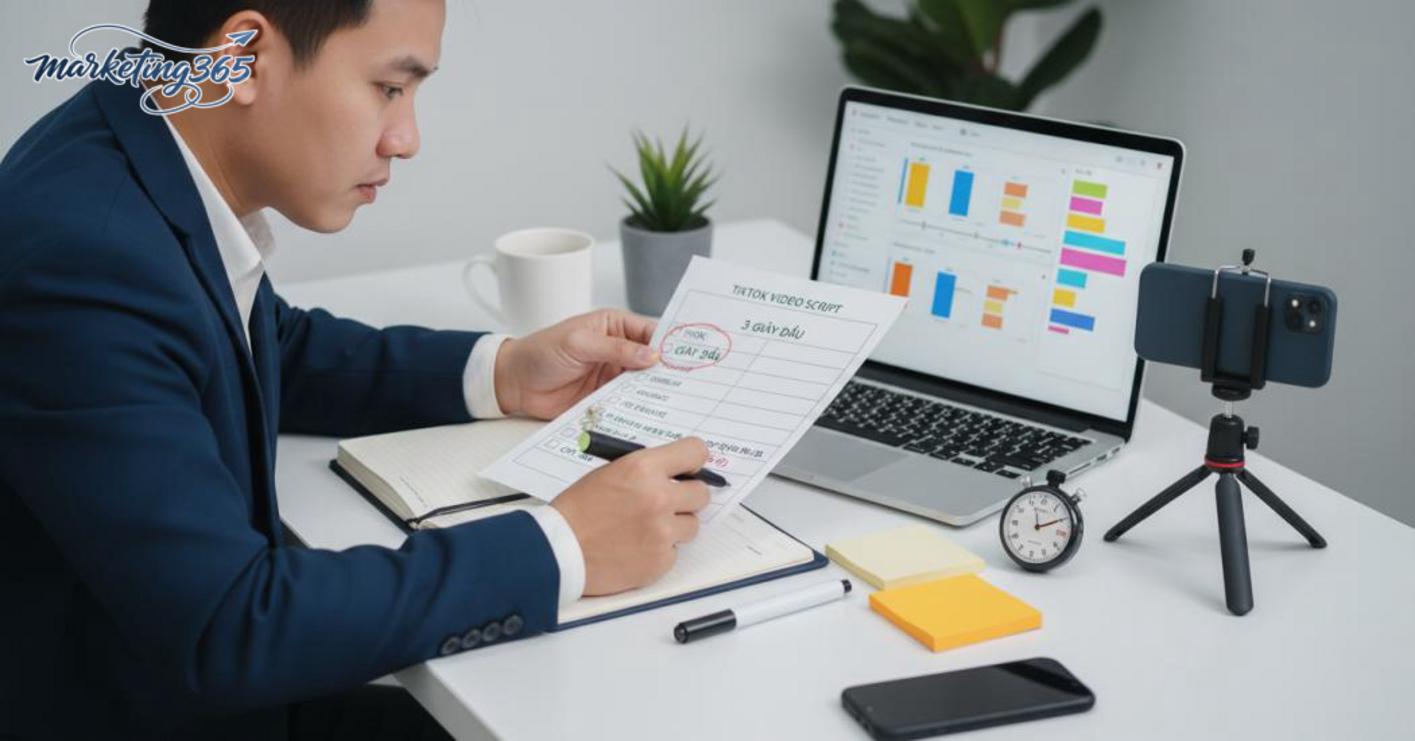
- Do I need a very detailed script? You don’t need to memorize every sentence, but you do need to clearly define the rhythm of the visuals, the words, and the action. For example: the opening scene in the first 3 seconds, the first line spoken, the key moment in the middle, and the closing line. If a viral TikTok script is too long, the person filming can easily become stiff; if it’s too sparse, the hook and CTA are often lost.
- How many ideas should a short video have? Usually 3 ideas is the safest, and 5 is the maximum for maintaining rhythm. If you’re making a short TikTok script for sales, prioritize 1 problem, 1 benefit, and 1 next action. Cramming 7–8 ideas into 30 seconds usually dilutes the message and reduces your ability to hold viewers.
- How do I know whether the first 3-second hook is good enough? A hook is strong when viewers immediately understand what the video is about, why they should keep watching, and what detail makes them curious. A quick test is to read the hook once: if it still feels vague or needs extra explanation, it’s not ready. For a TikTok hook for the first 3 seconds, you should write 2–3 versions and compare reactions to the opening.
- When should I revise the script? When the person filming keeps forgetting lines, the video runs unusually long, or the opening can’t hold the rhythm. Cut unnecessary points, clarify one main idea, then reshoot and test again. For a TikTok script designed to increase engagement, adjusting the hook and ending is often more effective than rewriting everything.
To stay updated with official and latest guidance, you can also refer to materials from TikTok for Business.
You can also find more practical marketing guides at https://marketing365.vn.
Content from marketing365 is created for SMEs, online shop owners, and new marketers.
You can read more articles on the same topic in the Social Media category.