
Contents
- Social media under pressure from stronger AI: content must be trustworthy before it spreads
- What changes in GPT-6 Astra — and why social teams have to work differently
- What social media loses when the user’s right to choose and transparency become the new standard
- How Vietnam’s market will read social media through the lens of trust
- What social teams need to do to keep content valuable
- Reference sources
Social media is no longer valued mainly by reach or speed of spread. As AI models get better at browsing, writing content, and supporting professional work, the harder part of social media shifts to verification, transparency, and the user’s right to choose.
This matters for Vietnamese marketers because the same post, clip, or comment thread can now be reread, extracted, and ranked by AI according to different criteria. If content is not clear enough about its source, not consistent enough, and does not build trust, it will weaken even if engagement still looks good.
- Key point:
- More powerful AI puts social media under greater verification pressure, not just reach optimization.
- Transparency and the user’s right to choose become conditions for content to remain trusted.
- Marketers need to redesign how social content is produced, reviewed, and sourced.
- Vietnam’s market will feel this pressure earlier in trust-sensitive sectors such as finance, healthcare, and education.
Social media under pressure from stronger AI: content must be trustworthy before it spreads
OpenAI says GPT-6 Astra is a stronger model for browsing, computer use, and professional work; Healthcare IT News also describes it as having better capabilities in healthcare, documentation, and research-related tasks. These two signals show that digital content no longer stands alone: it is increasingly being read, summarized, and ranked by machines.
For social media, that changes the value of every piece of content. A post is no longer just expected to be liked by people. It also has to be clear enough for AI systems to understand what it says, where it came from, and whether it is worth citing. As machine reading becomes more important, vague, clickbait-heavy, or exaggerated content will be weaker because it is harder to produce trustworthy signals.
From a marketing perspective, this is a bigger change than “AI writes captions faster.” It pushes social media from an attention game into an evidence game. Content that does not help readers verify information will struggle to keep a long-term role in the new distribution ecosystem.
What changes in GPT-6 Astra — and why social teams have to work differently
This section looks at what has been announced and how it directly affects social content work. The source data comes from OpenAI and Healthcare IT News, with one core argument: the better AI gets at reading, processing, and evaluating content, the more social media has to be built with greater clarity.
Browsing and computer use: content must be clear enough for machines to grasp the main point
OpenAI describes GPT-6 Astra as strong in browsing and computer use, while Healthcare IT News emphasizes that it can support research, documentation, and professional work tasks. When a system like this reads social media, it does not look at a post the way a person scrolls a feed. It breaks down ideas, gathers signals, and looks for structure.

The result is that social teams have to write for both people and machines. Headlines, descriptions, captions, alt text, and source references all need to be clear. Roundabout writing weakens content because machines have a harder time identifying the core message. That is why social formats with strong structure, such as checklists, data-backed insights, short case studies, and step-by-step explanations, will have an advantage over vague generalities.
High benchmark scores: social media now has to compete on verifiability
OpenAI says Astra scored very highly on FrontierMath, ARC-AGI-3, and ExploitBench; Healthcare IT News says the model outperformed previous models and competitors on benchmarks for healthcare, medical documentation, and research. Even though those benchmarks are not social media, they show that AI processing standards are moving up another level.

For marketers, the takeaway is not to chase model scores. The takeaway is that social content will be compared against increasingly high machine accuracy. When AI can read, cross-check, and spot weaknesses faster, content that lacks sources, lacks context, or is deliberately ambiguous will lose credibility more easily than before. Social media can no longer live on the feeling that “viral is enough for now.”
Rollout across product tiers and APIs: social content has to enter the workflow, not just the creative stage
Both OpenAI and Healthcare IT News say Astra will be available across multiple product tiers as well as API, Azure, and Bedrock. That means the model is not staying inside a single tool. It is entering enterprise workflows.
For social media, the consequence is that content workflows must connect to systems for review, source storage, and fact-checking. A post is not just the output of a copywriter or designer. It is the result of a chain with a writer, a reviewer, a fact-checker, and an owner. Without that chain, the stronger AI becomes, the greater the risk of spreading errors.
What social media loses when the user’s right to choose and transparency become the new standard
The most important point from the two sources is that AI does not only increase content creation capability. It also raises expectations from users and organizations about how content is created and what it is used for. For social media, this changes the trust mechanism.
Content with clear sources: the advantage is no longer being good, but being verifiable
When AI can summarize, synthesize, and answer quickly, a post on social media only truly has value if readers can verify its source. That is especially true for health, finance, B2B, and education. A polished post that cannot be traced back to its origin will struggle to hold up when machines compare it against other information.

This forces marketers to change habits: record data sources, keep reference links, and clearly state what is an opinion, what is a fact, and what is practical experience. At this point, social media is not just a place to deliver a message; it is a place to prove that the brand has the right to speak on that topic.
The user’s right to choose: social media must respect how much intervention viewers accept
Healthcare IT News says Astra is built for automated tasks and stronger safety capabilities. That perspective is directly relevant to social media: users increasingly want to know which content was written by a person, which content was AI-assisted, and how deeply AI intervened.
When the right to choose becomes the standard, brands cannot simply “push content out” and assume users will accept it. Social teams need to show viewers the level of AI support, the editing policy, and how content is checked before publication. Transparency does not slow content down too much. It makes content more durable.
How Vietnam’s market will read social media through the lens of trust
In Vietnam, social media has a very clear pattern: high consumption, fast spread, and trust often decided within the first few seconds. Because of that, the changes brought by stronger AI will not arrive evenly across industries.
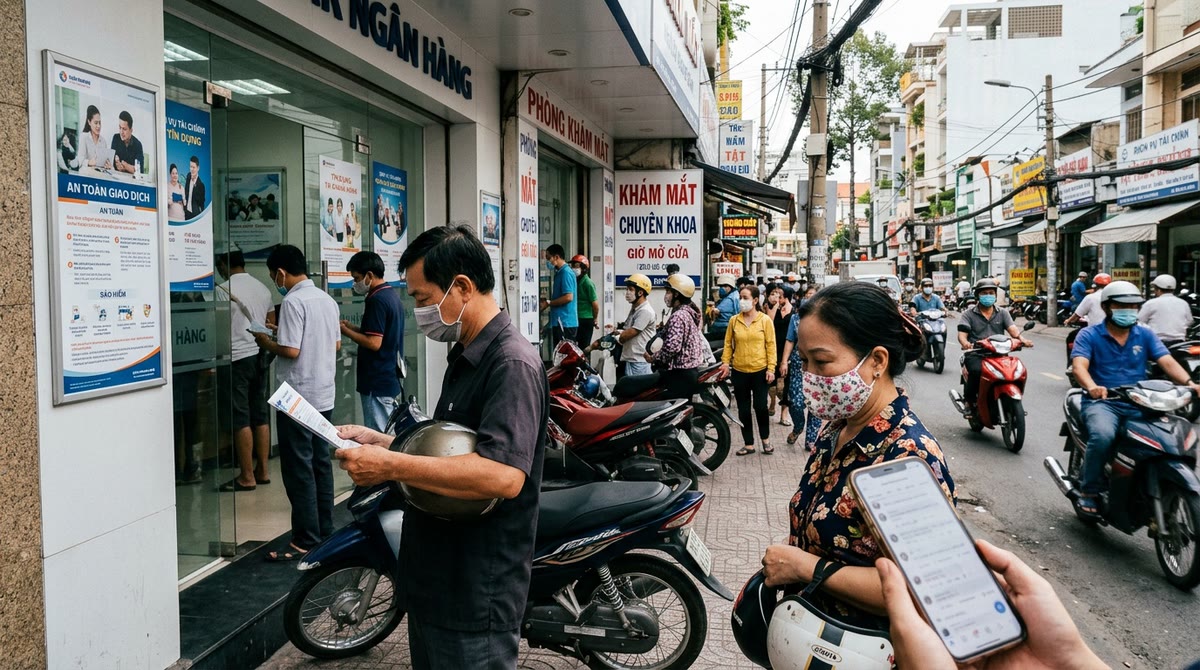
The sectors that will feel the pressure first are finance, healthcare, insurance, education, and B2B services. In these industries, Vietnamese users do not just ask, “Is the post interesting?” They also ask, “Who said this?”, “Is there a source?”, and “Can it be trusted?” Posts without evidence will be harder to turn into leads, even if views remain high.
For the domestic market, the issue also lies in how social teams are organized. Many teams still keep content, design, and account work too separate. In a context where AI can better read and filter content, that fragmented setup can easily produce posts that look good on the surface but are weak on verification. Vietnamese businesses need clearer content approval processes, especially for posts with data, expert advice, or comparative claims.
What social teams need to do to keep content valuable
- Redesign the publishing process so every post has a clear source, reviewer, and owner.
- Prioritize formats that can be verified, such as case studies, data, step-by-step explanations, and clear quotations.
- Build transparency into AI use: disclose the level of AI support and the parts edited by humans.
- For the Vietnamese market, test most carefully in trust-sensitive sectors before expanding into lighter content.
In short, social media is moving from an attention race to a verifiable trust race. The stronger AI gets, the more the reward shifts toward content that is clear about its sources, structured, and transparent. Marketers who still optimize only for views will soon see their content left behind by both machines and people.
See more marketing analysis and guides at https://marketing365.vn.
Follow more analysis from Marketing365 to stay updated on the latest marketing trends.
Read more articles in the Digital Trends category.
Reference sources
- OpenAI — GPT-6 Astra: A new generation of intelligence
- Healthcare IT News — OpenAI launches GPT‑6 Astra model