
Contents
- TikTok Shop growth tips from scratch: what to prepare before posting videos
- Optimizing your TikTok Shop profile so the channel looks trustworthy from the first visit
- TikTok Shop product selection tips: what to prioritize for easier sales and easier content
- How to make TikTok sales videos without making the channel feel scattered
- What the TikTok Shop algorithm usually prioritizes and how to avoid “posting but nobody watches”
- From video to order: how to create orders, manage orders, and handle operations with fewer mistakes
- When to use ads, grow followers, or get professional support to move faster
- Common mistakes beginners make when building a TikTok Shop channel
- FAQ about TikTok Shop growth tips
Building a TikTok Shop channel is not just about posting videos consistently. For shop owners and marketers, the first step is setting a safe foundation: choosing the right products, optimizing the profile, checking access permissions, and only then moving on to content and sales. If you do it the other way around, the channel can easily run into account issues, videos that don’t generate orders, or wasted time on work that doesn’t create revenue. TikTok Shop growth tips are most useful when you know how to prioritize the right tasks from the start, so beginners can launch a channel on their own, avoid basic mistakes, and operate more steadily when they begin selling.
TikTok Shop growth tips from scratch: what to prepare before posting videos
TikTok Shop growth tips from scratch start with locking in the right operating foundation, not posting videos first and fixing things later. If the account, products, content, and order handler are not clearly assigned, the channel can easily lose momentum in the first week.

What to lock in before you start
Before creating a TikTok Shop account, you need to define the channel’s goal: sell a specific product group quickly, build awareness, or do both at once. From that goal, choose 1–3 product groups with enough supply, enough margin, and the ability to be filmed in real videos. Then assign roles clearly: who handles content, who approves videos, who manages inboxes and orders, and who tracks inventory. For a small channel, one person can still handle multiple tasks, but there must be a planned posting schedule and response deadlines for orders and inboxes so the workflow doesn’t break. An effective way to build a TikTok Shop channel always starts with an operating plan, not with the number of videos.
Checklist to avoid starting off wrong
The TikTok Shop checklist should be reviewed in this order:
- You already have products eligible for sale, with photos and descriptions that are not vague.
- You have agreed on the brand identity: channel name, avatar, bio, tone of voice, and video format.
- You have prepared at least a few sample videos to test the rhythm, rather than posting randomly.
- You have an order-handling process: who closes the sale, who confirms it, who packs, and who updates the status.
- You have measured your real capacity: how many videos you can make per day and how many inbox messages you can answer.
If any of the steps above are not done yet, you should delay launching the sales channel and complete them first. Many shops fail because they want to grow TikTok Shop followers too early while their sales process is still unstable.
Optimizing your TikTok Shop profile so the channel looks trustworthy from the first visit
Optimizing your TikTok Shop profile is a quick fix, but it has a strong impact on first impressions and trust. Just by looking at the channel name, avatar, bio, and shop link, viewers decide whether to stay or keep scrolling.

Profile elements that are often done too casually
The display name should tell people what you sell or who you represent; don’t make it so generic that viewers can’t remember the channel. The avatar should be clear, simple, and aligned with the product category to strengthen recognition as people scroll. The short bio should state one specific benefit, one differentiator, or how to order, instead of filling space for the sake of it. The TikTok Shop link must point to the correct shop page or relevant product page, because one wrong click is enough to reduce credibility. When creating a TikTok Shop account, review the entire profile so the content, visuals, and links all tell the same story.
A good profile usually feels clean, consistent, and intentional. If viewers land on the profile and see a vague name, a blurry avatar, an empty bio, and scattered links, they will doubt both the channel and the products. This is the part you should fix before investing heavily in videos or livestreams.
Profile mistakes that make it hard to sell
TikTok Shop profile mistakes often come down to small details that quickly destroy trust. A too-generic channel name, an avatar that doesn’t clearly show the brand, a description without benefits, and a wrong link are the four most common issues. If even one of these appears, the profile is already enough to make viewers hesitate.
The fastest way to fix it is to follow this order: 1) change the display name so it is memorable and hints at the product category; 2) replace the avatar with a clear image and a clean background; 3) rewrite the short bio using the formula “what you sell + what benefit + what the viewer should do”; 4) check the shop link and landing page again. If the profile says one thing but the videos sell another, fix the profile first. Alignment between the profile and the product is the most visible part of profile optimization.
TikTok Shop product selection tips: what to prioritize for easier sales and easier content
When choosing products for TikTok Shop, prioritize items that can be filmed, whose benefits can be demonstrated, and that have enough repeat demand to generate steadier orders. TikTok Shop growth tips usually start with categories that are easy to demo first, then move on to margin and return risk.

What makes a product suitable for short-form content
Products that work well on TikTok usually have a visible problem, a clear demo, and an obvious before-and-after result within just a few seconds. A cleaning tool, personal care item, or small accessory is easier to turn into a “try it out” scene than a product that requires a long explanation.
Quick selection checklist:
- It can be explained in 1–3 shots.
- It has before-and-after, water tests, adhesion tests, or convenience tests.
- The perceived value is clear enough to make viewers want to keep watching.
- It does not depend heavily on complex technical specifications.
If a product requires too much explanation, short-form content will struggle to keep pace. On the other hand, products that are easy to film let you create multiple angles: unboxing, flaw testing, comparisons, and real-life usage scenarios.
Warning signs to avoid when choosing products
A product should be avoided if its benefits are hard to prove, the description is long, or customers are likely to change their minds after receiving it. A low-priced order that generates many questions and returns will make operations far heavier than the revenue it brings in.
Common risk signs include:
- No visible difference that can be seen with the eye.
- It requires deep consultation before the value is understood.
- It is easy to break, dent, or disappoint expectations.
- It looks small, but after-sales handling takes a lot of time.
A key TikTok Shop selling tip is not to choose products just because they “seem easy to sell.” Check return rates, packaging ability, and how often the demand repeats. If a product is good for content but too risky operationally, cut it early.
Quick comparison table for choosing your first category
The fastest way to choose a product on TikTok Shop is to compare three criteria: easy to film, easy to close, and easy to fulfill.
| Criteria | Suitable | Not suitable |
|---|---|---|
| Demo | Results are visible immediately | Requires long explanation |
| Demand | Repeats regularly | Bought once and done |
| Return/exchange | Low risk | Easy to disappoint expectations |
| Margin | Enough room for content | Too thin |
If a category meets 3 out of 4 criteria, it is usually a safe choice to start with.
How to make TikTok sales videos without making the channel feel scattered
Effective TikTok sales videos create content that is clear enough for viewers to understand the product, short enough to keep momentum, and focused enough to avoid drifting off-topic. With TikTok Shop growth tips, small shops should prioritize videos with one single goal: grab attention, answer one concern, or prove one specific benefit.
A simple short-video formula for small shops
The easiest formula to use is opening – problem – proof – light call to action. The first 3 seconds must have a clear video hook, such as asking about the exact concern buyers have, like “Is it hot to wear?”, “Is it easy to use?”, or “Who is it for?”. Then move immediately to a real customer problem, and show the product in use rather than just holding it in your hand.
A clean sales-video structure is: 1 hook line, 1 problem scene, 1 product-use scene, 1 closing benefit. For example, with household items, film a cluttered tabletop, then switch to a tidier setup thanks to the product. The closing line should focus on a concrete benefit, such as saving time, being easy to clean, or being simple to use.
Quick filming checklist:
- Open with a question or a situation.
- Talk about only 1 product and 1 problem.
- Show hands touching, using, and getting the result.
- End with an invitation to see more or pin the product.
Content types to prioritize in the early stage
When you don’t have much data yet, TikTok Shop content should prioritize five groups: product introductions, FAQ answers, comparisons, behind-the-scenes, and real reviews. These are core content pillars because each one serves a different type of viewer: people who don’t know the product yet, people who are still unsure, and people who need proof.
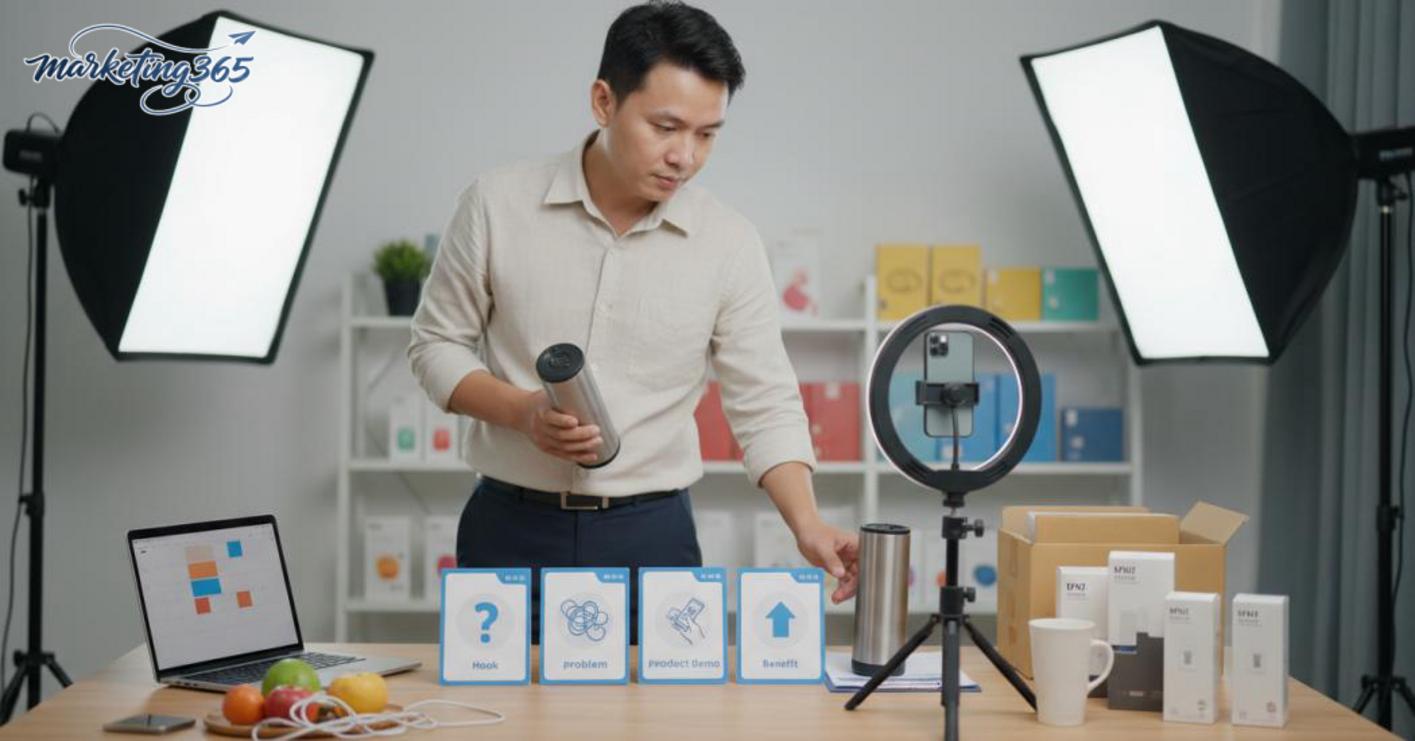
If resources are limited, follow this order: introduction videos to cover the product, FAQ videos to handle recurring questions, then real review videos to build trust. Comparison videos should only be made once you already have two standout options; behind-the-scenes content works better for shops that want to build trust around packaging, quality checks, or order preparation.
A light but consistent posting schedule is 3 to 5 videos per week, with each video focused on just one angle. If you already posted a video about product benefits that day, don’t repeat the same benefit again; instead, move to usage, common mistakes, or who should buy it. This helps you create TikTok Shop sales videos while keeping the channel’s content flow clear.
What the TikTok Shop algorithm usually prioritizes and how to avoid “posting but nobody watches”
The TikTok Shop algorithm prioritizes signals that help predict whether a video will keep viewers watching and lead to a purchase. So if you want to escape the “posting but nobody watches” problem, focus on content-product fit, retention, real engagement, and a stable posting rhythm.
Signals to track instead of just looking at views
The most important metrics are retention, rewatch rate, comments, product clicks, and signs that the content is reaching the wrong audience. A video with 2,000 views but viewers leaving after a few seconds is usually weaker than a video with 500 views but many product clicks and purchase-related comments.

When reading channel signals, look in this order:
- Does it hold viewers in the first 3 seconds?
- Do they watch to the end or rewatch?
- Are the comments actually about the product?
- Are there product clicks or profile visits?
If a video gets views but the comments are all about something else, that is a sign the audience is off-target. At that point, adjust the content angle, hook, and product before increasing posting frequency.
When to adjust content instead of posting more
Read more: How to Link TikTok Shop to a Personal TikTok Account
You should adjust content when the channel gets a lot of views but little engagement, or when posting more often does not improve distribution signals. In this case, the problem is usually the content, not the number of videos.
The cleanest way to handle it is:
- Keep one product group within the same audience.
- Change the opening hook to better match the need.
- Review which video gets better product clicks and replicate that structure.
For example, if one video about how to choose products on TikTok Shop gets good views but no clicks, while another gets fewer views but comments asking for the price, you should prioritize optimizing the second video. This is when adjusting strategy is more effective than trying to grow TikTok Shop followers by posting more consistently in the wrong direction.
From video to order: how to create orders, manage orders, and handle operations with fewer mistakes
Orders on TikTok Shop need to move from confirmation to delivery and tracking through a fixed workflow to reduce operational errors. When each step has a clearly assigned owner, the shop will reduce missed orders, delayed processing, and negative reviews.
The basic order workflow that should be agreed from the start
The order process should be finalized as soon as an order comes in: confirm the order, check inventory, pack it, update the status, and then track it until completion. If the shop uses a shared tracking file between the sales channel, warehouse, and shipping provider, order handling will stay more in sync.
- Confirm orders at fixed times, prioritizing new orders at the start of the shift.
- Check actual inventory before printing labels.
- Inspect the item for the correct model, color, and quantity before packing.
- Update the status immediately after handing it over to the shipping provider.
- Track pending, returned, and delayed orders so they can be handled the same day.
For example, a shop with many shirt styles but an unsynced warehouse is likely to ship the wrong size. Simply adding a manual check before attaching the order code can significantly reduce errors on days when orders spike. This is a core part of the sales process if you want stable operations.
Operational mistakes that quickly damage credibility
The operational mistakes that damage credibility fastest are slow handling, inventory errors, content that sells one thing while the product description says another, and replying to customers too slowly. These issues not only slow down order flow but also drag down the customer experience from the very first order.

If orders come in but inventory is not updated in time, the status will no longer match reality and cancellations can easily happen. If a video promotes one benefit but the description says something else, customers will feel misled even if the product is delivered correctly.
Daily checklist to keep:
- Check inventory at the start and end of each shift.
- Prioritize older orders before newer ones.
- Keep the video content, product description, and chat replies aligned with the same message.
- Reply to messages within clearly defined working hours.
TikTok Shop growth tips are not only about videos that get views, but also about consistent order handling, because returns and bad reviews often come from repeated small operational mistakes.
When to use ads, grow followers, or get professional support to move faster
When the channel already has a foundation but growth is slow, you should consider running TikTok Shop ads, growing TikTok Shop followers, or hiring professional support to speed up the step that is stuck. The right choice depends on the content stage, operational capacity, and short-term goal; spending money or hiring help only makes sense when it solves a clear bottleneck.
Signs the channel is ready for more resources
A channel needs more resources when the videos are showing signs of potential but distribution is weak, orders are coming in but not consistently, or the team is constantly overloaded with video production and order handling. A shop often faces this when 5–10 consecutive videos still fail to create a stable order rhythm, even though the products and profile have already been cleaned up quite well.
- Content is posted regularly, but views and followers are not increasing proportionally.
- There are occasional orders, but no repeat sales wave.
- The person in charge has to film, post, and close orders, which easily breaks the rhythm.
When these signs appear, the problem is usually not a single video, but distribution, process, or execution capacity.
Where to draw the line between doing it yourself and hiring help
Doing it yourself is suitable for repetitive tasks like profile optimization, posting schedules, comment handling, and basic order tracking. Hiring support makes more sense for tasks that require experience, such as channel strategy, sales-content optimization, ad structure, or fixing operational issues that keep slowing the channel down.
A simple budget split is to keep product knowledge in-house and outsource the parts that require technical skill and speed. If a small shop tries to handle everything itself, costs may be low at first, but time is wasted and opportunities are missed. If you hire too early, before you have products or good videos, it only increases costs.

| Do it yourself | Hire support |
|---|---|
| Profile optimization, descriptions, posting schedule | Channel strategy, growth, advertising |
| Closing sales, customer care | Video production, campaign setup, channel audit |
| Tracking basic metrics | Fixing operational bottlenecks, resource allocation |
TikTok Shop growth tips are usually most effective when you use outside resources only to remove the right bottleneck, not to replace the entire process.
Common mistakes beginners make when building a TikTok Shop channel
When building a TikTok Shop channel, beginners often run into five problem areas: product selection, profile, video, operations, and expectations. Identifying these TikTok Shop mistakes early helps you avoid missteps, fix the right issues, and get your TikTok Shop selling experience into a rhythm faster.
Strategic mistakes that keep the channel from finding its rhythm
A bad strategy is what keeps a channel running without producing clear signals. This usually starts with not defining the target audience, changing products constantly, posting inconsistently, and not measuring performance week by week.

- Easy-to-see sign: today’s video speaks to one customer group, but next week it switches to another.
- Quick fix: lock in one main audience, one product group, and one fixed posting rhythm for 2–4 weeks.
- How to check: review the last 10 videos; if the messages differ too much, the channel lacks direction.
- When to change direction: only switch after views, retention, and orders remain low through a clear testing cycle.
Execution mistakes that waste time without results
Execution mistakes are small actions that drag channel performance down very quickly. Weak first 3 seconds, an untrustworthy profile, a messy order process, and slow customer replies all make viewers leave before they have a chance to buy.
- If a video does not open with a benefit or problem, it is very hard to keep viewers watching.
- A profile without an avatar, vague description, or basic information reduces credibility.
- A messy order workflow causes delays, which can lead to cancellations and complaints.
- Slow customer replies lose closing opportunities, especially for products that require quick questions.
To improve execution, fix things in this order: make the profile clearer, rewrite the video opening, standardize the order process, and then set response deadlines during the day. This is the part many people overlook, but it is what determines channel performance.
FAQ about TikTok Shop growth tips
The FAQ on TikTok Shop growth tips should be short, clear, and focused on the situations beginners most often run into. Each answer below prioritizes decisions you can apply immediately, rather than general advice.
Should you build a TikTok Shop channel if you don’t have much budget?
Yes. If your budget is low, handle the foundation yourself first: optimize the profile, plan short videos, set up inbox replies, and manage TikTok Shop orders. The early investments should go into products that are easy to sell, basic lighting, basic audio, and consistent content time; don’t spread money across too many items at once.
How long should you wait before reviewing channel performance?
You should review it on a 2- to 4-week cycle, because TikTok Shop growth tips need enough data to reveal a trend. If videos are being posted consistently but views, orders, and retention are not moving, or if livestreams have viewers but few orders, that is a sign you need to adjust content, products, or posting times.

Should a new channel focus on videos or livestreams first?
A new channel should use short videos as the foundation first, then push TikTok Shop livestream selling once it already has a content rhythm and understands its audience. Videos help test products, measure response, and grow TikTok Shop followers; live selling is more suitable once you already have stable viewers, a clear closing script, and someone who can handle comments quickly.
When should you ask an experienced provider for help?
You should ask for help when the channel lacks staff, the process keeps repeating mistakes, or you need to standardize how to build a TikTok Shop channel so it can run more smoothly. For example: posting consistently but not getting orders, messy order management, or optimizing the TikTok Shop profile several times without getting the focus right. At that point, professional support saves time spent on trial and error.
Suggested topic groups to link to
The article groups that should be linked in a hub-spoke structure are the topics readers usually need right after learning how to build a TikTok Shop channel. An article about profile optimization is a good fit for links in the section about avatars, bios, categories, and pinned products. An article about short videos should be referenced in the section discussing the first 3-second hook, how to film close-up product shots, or how to fix videos that don’t generate orders. Articles about order handling, order management, and social commerce content strategy should be placed in the section about order operations, closing sales, and channel optimization. If the article mentions sales content, only insert links in that exact context, and avoid placing links in every paragraph just to increase the count.
For the latest official guidance, you can also refer to resources from TikTok for Business.
You can also explore more hands-on marketing guides at https://marketing365.vn.
Content from marketing365 is built for SMEs, online shop owners, and marketers who are new to the field.
You can read more articles on the same topic in the Ecommerce Marketing category.