

Contents
As of mid-2026, AI has moved out of the lab and into game development, content production, and creative work itself, which means marketers can no longer treat it as a distant experiment. Two signals from the global gaming industry capture the tension clearly: adoption is accelerating fast, yet the debate over what human creativity is worth is growing louder, and both sides of that tension carry lessons for how brands deploy automation without hollowing out the experience.
CD Projekt Red: fully AI-generated games are “something that is definitely going to happen”
According to IGN India, CD Projekt Red co-CEO Michał Nowakowski said he “knows for a fact” that games created entirely by AI will eventually appear. He recounted a conversation with a studio executive who is strongly AI-driven, in which the person described the ability to generate dozens of prototypes in a very short time, quickly filter them to select the best few options, and then launch a product within weeks.
The key point is not whether AI can completely replace developers, but rather the observation that AI is changing the pace of experimentation and the product lifecycle. If the path from idea to prototype once required significant manpower and time, AI can now shorten the initial creation phase dramatically. Still, Nowakowski left room for uncertainty about whether this model will succeed, showing that the industry itself does not yet see it as a guaranteed answer to game quality.
For creative businesses, this is a reminder that AI is shifting competition from “who has the idea” to “who can test faster, filter better, and commercialize more effectively.” In other words, speed will be an advantage, but it does not automatically mean lasting success.
Source: IGN India, interview on Michał Nowakowski’s remarks.
Voice actor pushes back hard: AI cannot replace human emotion
On the other side, Toy People quoted Jennifer English — an actor who appeared in Baldur’s Gate 3 and Clair Obscur: Expedition 33 — who said using AI to replace actors is “stupid” and unnecessary. In a conversation with Radio Times, she stressed that she does not want her art to become “perfect” in a soulless sense; instead, humanity, imperfection, and emotion are the core elements that give a performance its life.

This message goes straight to one of the industry’s biggest debates: AI can mimic voice, image, or expression, but can it reproduce the emotional resonance, context, and lived experience of a human being? In role-playing games, where performance helps create character depth, Jennifer English’s reaction shows that the concern is not only about job loss, but also about the risk of eroding the artistic value that makes players connect with a work.
From a market perspective, this kind of backlash tends to grow stronger when AI enters the parts of the experience that directly create emotion for users. That means brands, developers, and content platforms need to carefully balance cost optimization with preserving the user experience.
Source: Toy People, quoting Jennifer English in an interview with Radio Times.
Read more: Local SEO and Affiliate Tax: Where Ad Growth Meets Compliance
AI in creative work can speed things up, but it cannot replace people
For Vietnamese businesses, these two stories offer three practical lessons. First, AI is opening up opportunities to speed up idea production, concept testing, and draft content creation, especially useful for games, advertising, social content, and short videos. Second, AI should not be seen as a complete replacement for humans in areas that require emotion, brand identity, and originality.
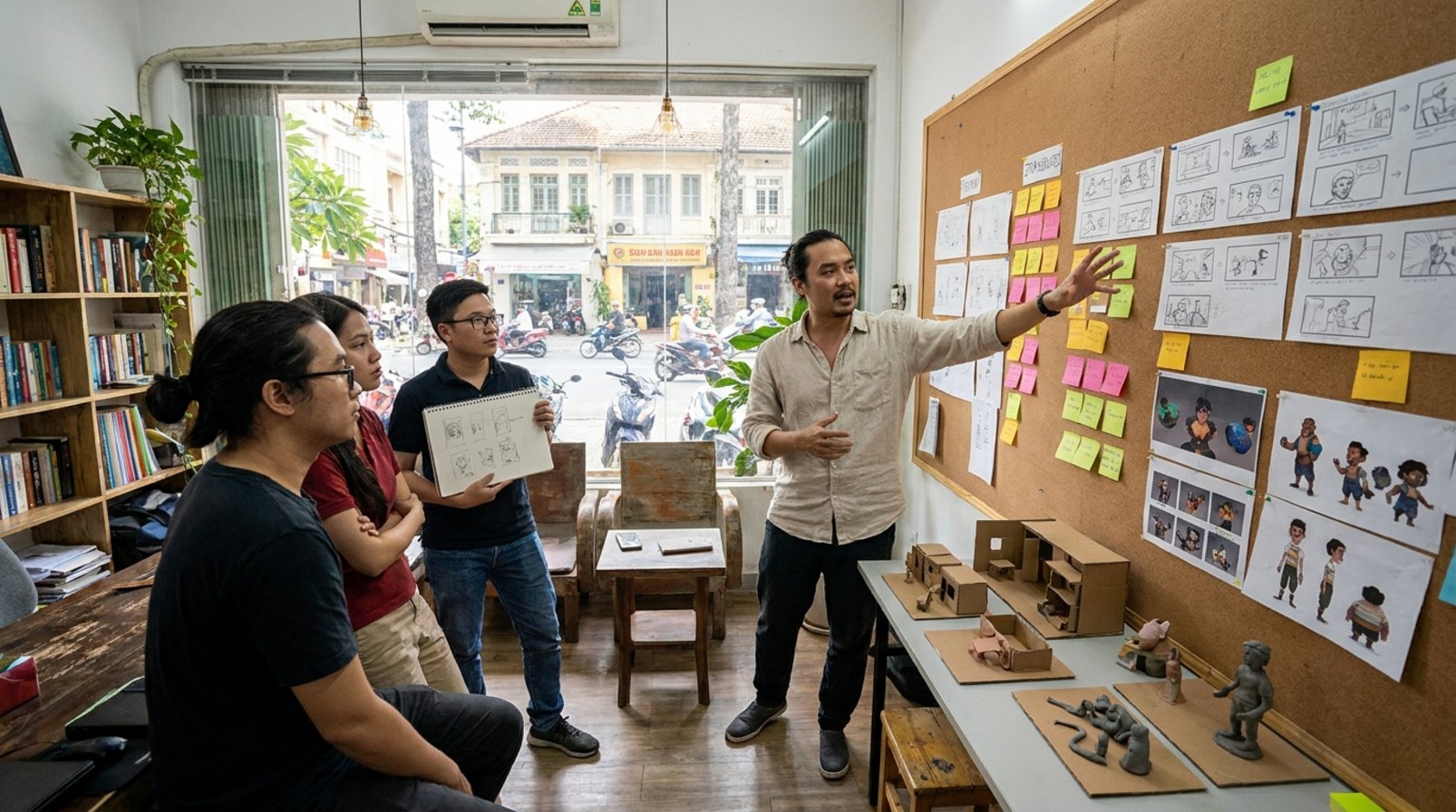
Third, when deploying AI in creative work, businesses need to prepare early for review processes, intellectual property rights, data transparency, and quality standards. Vietnamese users are increasingly sensitive to content that feels repetitive, soulless, or lacking personality; therefore, the most effective use of AI is often a hybrid model: machines support speed, while humans provide direction, editing, and final decisions.
For marketers, this is the right time to experiment with AI in a controlled way: use it for quick research, idea sketching, content personalization, and operational optimization, while still keeping real human experience at the center. That is the path that helps brands keep pace with technology while maintaining customer trust.
See more marketing news and guides at https://marketing365.vn.
Explore more marketing analysis & guides at Marketing365.
Read more articles in the same category Digital Trends.
This article focuses on AI in the gaming industry with a perspective for the Vietnamese market.
References
- CD Projekt Red Co-CEO Says He “Knows for a Fact” That Completely AI-Generated Games Are on the Way
- AI Voice Acting Sparks Controversy: “Baldur’s Gate 3” Star Slams Using AI for RPG Performance as “Stupid”



